The Crystal Is the Speaker: Chopard's Full Strike Sapphire-Gong Minute Repeater
A minute repeater chimes the time on demand, and every one of them has the same physics problem: the sound starts inside a sealed metal box. Chopard's answer was to throw out the metal and machine the gongs out of the glass. This week the thirteenth edition of the Día de los Muertos series gave that idea a skull made of straw and eggshell.
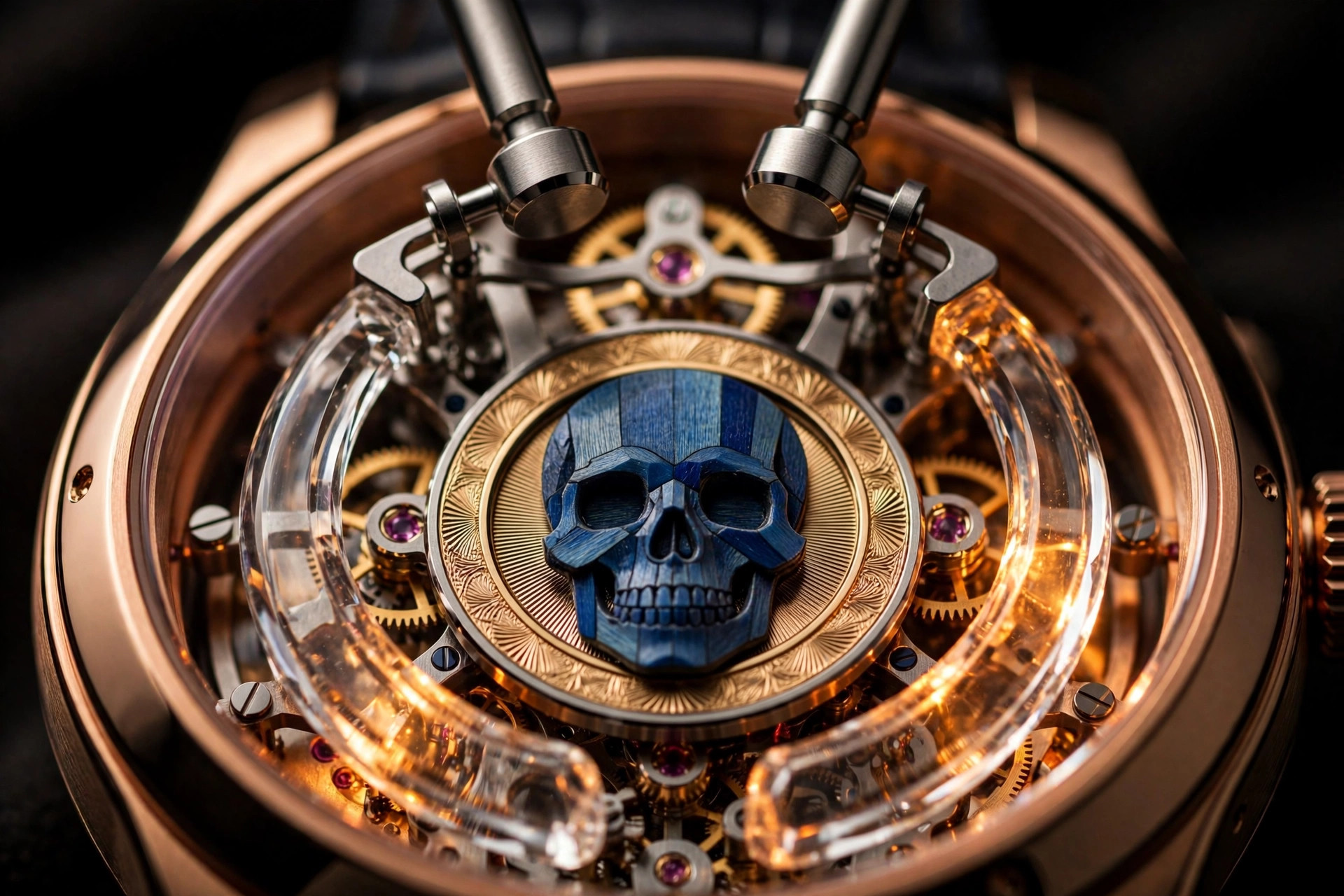
A skull for the thirteenth time
Some context first, because the calendar matters. Chopard has been releasing one Día de los Muertos L.U.C Full Strike per year for most of a decade, each a unique piece built around the same minute repeater caliber, each dressed by the crafts calendar in a different skin. Edition 13 arrived this week in New York, during New York Watch Week, and it wears an 18-karat ethical rose gold case with a dial of blue-dyed straw marquetry, crushed eggshell marquetry, and black lacquer over hand engraving, finished in satin. The reference is 161947-5007; price is on request, which is how brands say this watch is a conversation, not a transaction.
I want to be honest about the order of operations in this piece. The skull is the news hook, and the engineering is the reason to care. A minute repeater is the hardest acoustic problem in watchmaking, and Chopard's solution to it, a patented construction nobody else builds, deserves the long look. Save the straw and the eggshell for the end.
Every repeater is a music box in a safe
Strip a minute repeater to its physics and you get something brutal. A small hammer strikes a wire gong inside the movement. That wire is typically brazed to a steel gong block mounted on the caseband. What you actually hear has traveled from the impact point through the brazed joint, the gong block, the case metal, and whatever air the case traps, before it reaches the room.
Every one of those interfaces steals energy. Brazing material is acoustically dead compared to the wire it joins. Steel has internal damping. And the case, which most people think of as the resonator, is doing two jobs badly at once: it is a pressure vessel that keeps water out and a loudspeaker that is supposed to let sound through.
Traditional repeaters fight this with size and mass. Big case, thin back, longer gongs with more turns for richer harmonics. Cathedral gongs that wrap twice around the movement. Some houses cut sound holes in the caseback, which is the acoustic equivalent of drilling a drain in your amplifier. It works, sort of, and it leaks.
Chopard machined the gongs out of the glass
In 2016 Chopard Manufacture went at the problem from the other end entirely. Instead of steel gongs attached to the movement, the L.U.C 08.01-L strikes gongs machined from the same single piece of synthetic sapphire as the watch crystal. Gong and glass are one monobloc piece, a crystal that is no window over the mechanism but its voice.
Think about what that erases. No brazed joint between gong wire and gong block, so no damping loss at the single worst interface in the chain. No separate radiator stage, because the vibrating arms couple straight into the largest flat acoustic surface the watch owns: the whole dial-side crystal. The sound does not have to negotiate the case to escape; the glass itself is the escape route.
That choice is not romantic; it is acoustic engineering wearing a lab coat. Single-crystal sapphire, aluminum oxide, has a Young's modulus around 400 gigapascals, roughly twice that of steel. Sound travels through it at something like 10,000 meters per second. High stiffness per unit mass is exactly what a loudspeaker diaphragm wants: the surface moves as one plate instead of flexing locally, and it radiates energy into air efficiently. A steel diaphragm the same thickness would bend and waste motion as internal flex. Sapphire pushes.
A bell you wear on your wrist
Here is where the physics gets genuinely elegant, and it is the original contribution I want this piece to carry. A conventional repeater treats the case as the instrument body and fights the seal. Chopard's construction treats the crystal as a bell, and the watch case becomes the bell's yoke.
Consider the radiation problem. A struck gong wire is a terrible sound source in open air: its surface area is tiny, so most of its motion just pushes air around itself instead of compressing it. Acoustic impedance mismatch kills it. What radiates well is area, a big surface moving coherently. At 42.5 millimeters, the dial-side crystal offers roughly 1,400 square millimeters of radiating surface. That is the difference between a tuning fork held in the air and a tuning fork pressed onto a tabletop. Same vibration, completely different room.
By construction, the monobloc coupling is rigid, which is the other half of the trick. In a brazed gong, the hammer's energy enters the wire and part of it reflects at every material boundary. Chopard's hammers strike arms that are continuous with the crystal, so the wave enters the dome and spreads. No joints, no solder, no boundary losses. Five granted technologies make up the patent portfolio around the 08.01-L, starting with this monobloc sapphire construction; the rest of the caliber is built to deserve it.
Keeping the sequence clean
A repeater that chimes wrong is worse than one that chimes quietly, and the 08.01-L's remaining patents are all about keeping the sequence clean.
Most striking mechanisms read the time off a stack of snail cams and can stall between groups of notes, leaving an awkward silence mid-chime while the train catches up. Chopard's ratchet-driving mechanism keeps hours, quarters, and minutes sounding in continuous succession. Then there is the strikework-pusher disengagement: pressing the slide while the mechanism is already chiming does nothing destructive, because the system decouples the pusher instead of jamming the train. And a clutch-lever device blocks the strikework from draining the going barrel while the cams are being read, so the watch does not lose amplitude mid-performance. Variable-inertia balance, Phillips terminal curve on the hairspring, the familiar Geneva Seal choreography underneath. It is a repeater designed by people who had personally heard one jam at midnight and refused to ship that failure mode.
On this edition, the hammers, strike ratchet bridge, and repeater inertia governor drum get a blue CVD coating echoing the straw marquetry up top. Details like that are usually marketing fluff. Here the governor drum is visible through the exhibition back doing real work, metering the chiming speed so the notes stay separated. Coating it blue is theater, but the drum is not.
Straw, shell, and lacquer
Now the skin. Straw marquetry is one of the older decorative arts in watchmaking, and it is brutally unforgiving. Each dyed straw is split, flattened, and cut by hand; the pieces are laid edge to edge, and any gap or height mismatch shows like a scar. Edition 13's dial uses blue-dyed straw, crushed eggshell for texture, and black lacquer, all over hand engraving, with a hand-guilloche contour framing the skull. Mother-of-pearl and diamond teeth have appeared on earlier editions. This one is quieter, all blues and shell, satin-finished instead of glossed.
Hand engraving carries the Día de los Muertos motifs across caseband, bezel, lugs, and crown, and the exhibition back gets the same treatment around the sapphire window. Power reserve for the going train and the strikework sit in concentric displays at 2 o'clock, which is honest design: a repeater needs to know whether the chiming barrel is wound, and most brands hide it.
Specs for the record, from Chopard's technical sheets: 42.5 by 11.55 millimeters, 533 components, 63 jewels, 28,800 vibrations per hour, 60-hour power reserve, mainplate and bridges in untreated nickel silver, Côtes de Genève finishing, Geneva Seal. Splash-proof only. A sapphire bell does not like submersion, and to be fair, nobody is swimming with a unique-piece repeater.
What the series actually is
Here is my opinion, and I will state it plainly. Chopard could not have built a smarter commercial vehicle for this caliber than the Día de los Muertos editions. A minute repeater is an engineering statement that almost nobody hears, because the owners keep them in safes and the press keeps them in vitrines. A skull dial turns the repeater into a once-a-year cultural event, and the engineering rides along.
But the framing cuts both ways. Thirteen unique pieces in a decade is a museum strategy, not a product strategy, and every edition being one-of-one means the sapphire-gong construction has never had to survive as a production technology. Machining gongs into a crystal is one thing on a bench in Fleurier with unlimited time. Doing it at volume, with yield, would be the real proof, and Chopard has not attempted it. This remains a demonstration that happens to be wearable.
There is also the brittleness question, which nobody at a launch event will raise and which I will raise here because it is real. Sapphire is Mohs 9, wonderfully scratch-resistant, and single crystals have no grain boundaries to arrest a crack. A steel gong survives a drop by bending. A sapphire gong arm survives by being flawless. Edition 13's case measures 42.5 millimeters wide and 11.55 thick, dimensions driven in part by the acoustic surface the bell needs. You are wearing a tuned crystal the size of a coaster. Treat it accordingly.
What I could not verify
I have not heard a Full Strike chime in person, and that limitation shapes everything above. Chopard won the Aiguille d'Or at the 2017 Grand Prix d'Horlogerie de Genève for this caliber's technical innovation and acoustic performance, and reviewers who have handled it describe a clean, sustained, unusually loud chime. I can reason about why it should sound loud: stiffness, area, monobloc coupling. I cannot tell you whether it sounds beautiful, because beauty in a repeater lives in the harmonic decay and the governor's pacing, and neither shows up on a spec sheet. Anyone who tells you a repeater sounds good without having heard it is selling you something.
Still. On paper, though, the engineering is the part you can verify, and on paper it is the most interesting acoustic idea in modern repeater design. Patek Philippe went a related route in its Advanced Research repeaters, bridging the gongs to a sapphire disc with acoustic ducts, which we covered in this site's repeater acoustics piece. Chopard skipped the amplifier and made the instrument out of glass. One company amplified the box; the other turned the window into the speaker.
Edition 13 is a unique piece, priced on request through Chopard boutiques. It will sell to someone who wants the skull, and the sapphire bell goes along for the ride. I am fine with that. The best engineering often ships inside the prettiest box, and the box this time happens to be made of straw, shell, and the Day of the Dead.
| Specification | L.U.C Full Strike "Día de los Muertos" Edition 13 |
|---|---|
| Reference | 161947-5007 |
| Case | 42.5 x 11.55 mm, 18k ethical rose gold, hand-engraved caseband, bezel, lugs, crown; exhibition back |
| Dial | Blue-dyed straw marquetry, crushed eggshell marquetry, black lacquer, hand engraving, satin finish; hand-guilloche contour |
| Caliber | L.U.C 08.01-L, manual-winding, minute repeater |
| Components / jewels | 533 / 63 |
| Dimensions | 37.20 x 7.97 mm |
| Frequency | 28,800 vph (4 Hz) |
| Power reserve | 60 hours (going train + strikework, concentric indicators at 2 o'clock) |
| Acoustic system | Patented monobloc sapphire crystal with machined gongs; crystal acts as resonator |
| Regulating organ | Variable-inertia balance, Phillips terminal curve hairspring |
| Hallmark | Poinçon de Genève (Geneva Seal) |
| Water resistance | Splash-proof |
| Strap | Hand-sewn cognac-brown alligator, hand-engraved rose gold deployant |
| Availability | Unique piece; price on request via Chopard boutiques |
Sources: Chopard technical specifications via watchadvice.com.au (Oct 16, 2026) and timekeepers.club; calibre analysis via watchtime.com (Oct 2026); New York Watch Week context via robbreportindia.com (Oct 17, 2026); original Full Strike acoustic review via quillandpad.com (2017); Edition history via monochrome-watches.com (2021).