No Paint on the Bezel: How Structural Color Built Casio's MR-G 30th Anniversary
Announced September 24, 2026, the MRG-B2100HR is a 30th-anniversary MR-G with an iridescent bezel that contains no pigment, no dye, and no colored plating. Color is generated by the metal's own surface, rewritten at microscopic scale by an ultrashort-pulse laser.
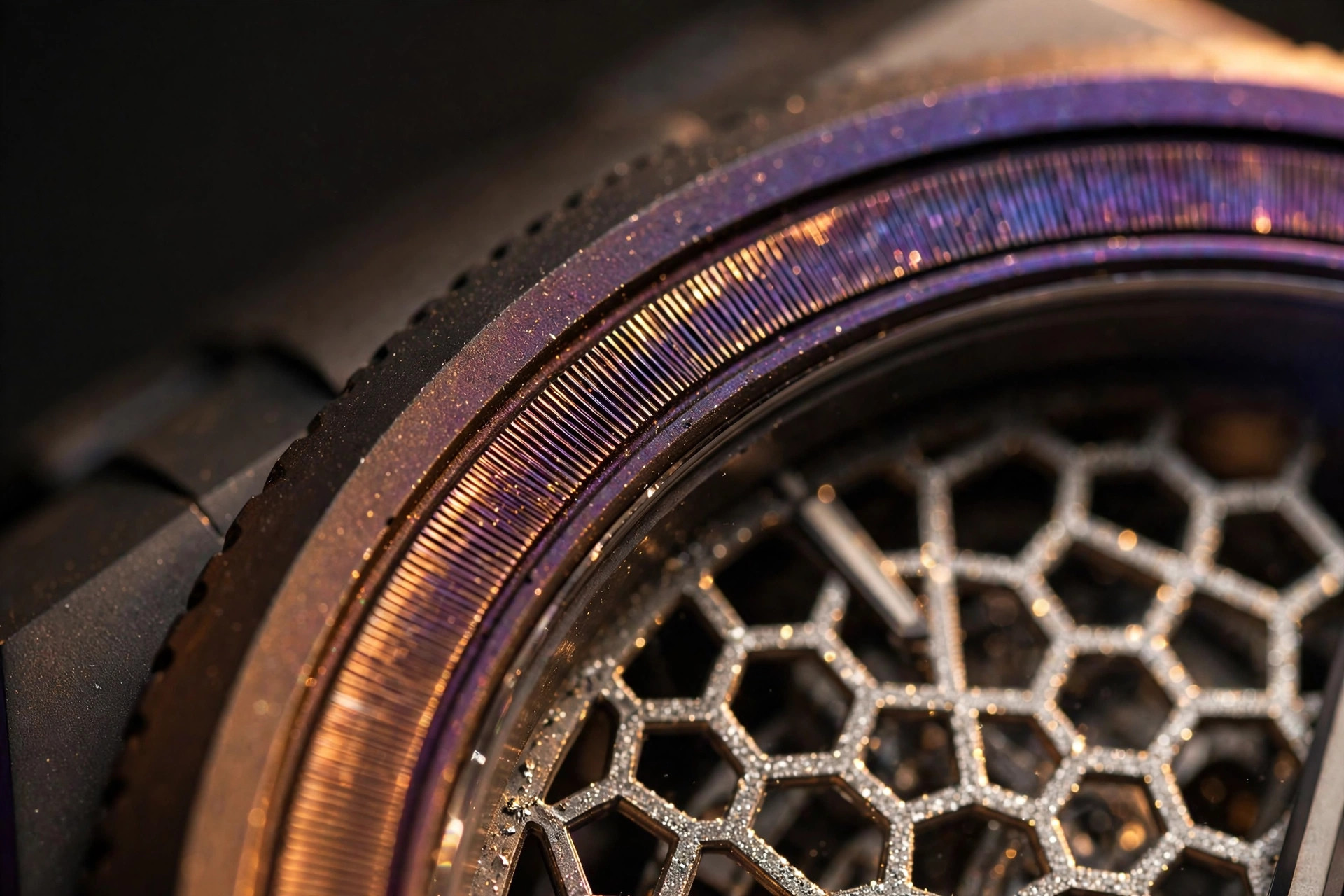
MR-G turns thirty this year, and to mark the occasion Casio produced a CasiOak whose prettiest surface is also its most technical one. Look at the MRG-B2100HR bezel head-on and you see one hue; tilt the wrist and the color slides to another. Nothing was painted to make that happen. An ultrashort-pulse laser carved microscopic textures into the metal, and those textures diffract incoming light so the surface makes its own color depending on your viewing angle.
Structural color is the phenomenon that puts iridescence on butterfly wings and inside certain minerals, a point Casio makes in its own announcement. The physics is old, but the manufacturing is genuinely new. A laser firing pulses short enough to avoid heating the surrounding material can etch periodic grooves on the order of the wavelength of visible light into a metal surface without warping the part. Light reflecting off neighboring grooves interferes with itself, and which wavelengths survive the interference depends on geometry and angle, so rotate the part and you change the answer.
Here is why that matters for a watch bezel. Paint chips, and anodized layers scratch through to bare metal. PVD color coatings are thin films that flake at edges. A structural color has no film to fail, because there is no film; the color is the topography of the metal itself. You cannot chip a color that is geometry. My reading, and this is analysis rather than a Casio claim: the subsequent diamond-like carbon coating has to be applied thin enough to preserve the interference effect, which constrains the DLC process in a way a flat bezel never would. Nobody publishes their laser recipe, and Casio has not released pulse duration or grating pitch, so the exact structure stays proprietary. What is verifiable is the principle, and the principle is sound.
Twenty-seven pieces of shock absorption
Casio split the bezel into 27 separately polished components, each finished before assembly, which reads like jewelry until you remember what a G-Shock is. According to coverage of the release, the multi-piece construction includes built-in buffers, and the segmented architecture is part of the shock-protection system, so the elaborate finishing did not replace the toughness. It is the toughness, articulated.
Casio's material stack is the MR-G formula refined: a Cobarion top bezel, a DAT55G titanium bracelet, and a Ti64 titanium case, case back, buttons and screw-down crown, with the whole exterior DLC-coated. Cobarion is Eiwa's cobalt-chromium-molybdenum alloy, a super-hard grade made exclusively by that company, noted in press coverage for a platinum-like gleam; it sits in the bezel, the part that takes the knocks. DAT55G is Daido Steel's hardened titanium grade for the bracelet. Put together: the hardest metal where impacts land, a hard titanium where the wrist touches, and Ti64 where nothing decorative is required.
Leaf, joinery, and a craftsman from Nishijin
The dial is a three-dimensional latticework taking its cue from kigumi, the Japanese joinery technique that locks wooden parts together without nails. Onto that lattice, Kyoto metal-leaf artist Hiroto Rakusho applied powdered platinum leaf by hand. Rakusho learned the craft from his father, Jisaku Nishiyama, and founded his own brand in 2002; because the foil stamping is manual, no two of the 800 dials come out the same. For the anniversary the theme is haruka, eternity, and a gold-leaf sibling, the MRG-B2100HS, gets 150 pieces plus a box gilded with gold leaf and signed by Rakusho.
It is worth stating plainly what this watch is not. Underneath the leaf and the laser work sits a standard connected G-Shock module: Tough Solar good for about five months on a charge or eighteen in power-saving mode, Multi-Band 6 radio sync, Bluetooth time adjustment through the Casio Watches app, a sapphire crystal, 200 meters of water resistance and an LED light. The electronics are not new; the making is.
That is also the honest answer to the price. Casio Japan lists the MRG-B2100HR at 1,100,000 yen including tax, roughly $6,964, with international availability from November 2026; only 800 will exist, each with an individual serial number. A $180 CasiOak tells the same time. What the extra money buys is the bezel that was polished as 27 pieces before it was assembled, the dial that a human being in Kyoto finished in platinum, and a laser-textured alloy surface that generates color from nothing but light. Whether that is worth the delta is a taste question, not an engineering one. Unimpeachable engineering.
Specifications
| Reference | MRG-B2100HR-1AJR |
|---|---|
| Case | Ti64 titanium, 49.5 × 44.4 × 13.6 mm, 122 g |
| Bezel | 27 individually polished components, Cobarion top bezel |
| Bracelet | DAT55G titanium |
| Color treatment | Ultrashort-pulse laser structural-color texturing, bezel and bracelet; DLC coating throughout |
| Dial | Kigumi-inspired latticework, hand-applied platinum leaf (Hiroto Rakusho) |
| Crystal | Sapphire with anti-reflective coating |
| Movement | Tough Solar, Multi-Band 6, Bluetooth |
| Water resistance | 200 m |
| Power reserve | ~5 months normal use, ~18 months power-saving (per coverage) |
| Edition | 800 pieces worldwide, individually numbered; gold MRG-B2100HS limited to 150 |
| Price | ¥1,100,000 incl. tax (Japan); international from November 2026 |
References
- Casio Computer Co., "Casio to Release Limited-Edition Timepiece Celebrating MR-G 30th Anniversary" (PRNewswire/Cision, September 24, 2026): platinum leaf by Rakusho, ultrashort-pulse laser structural color, 27-piece bezel, 800 pieces, Cobarion and DAT55G.
- Notebookcheck, "Casio unveils new titanium MRG-B2100 limited-editions" (September 2026): ¥1,100,000 incl. tax (~$6,964), 49.5 x 44.4 x 13.6 mm, 122 g, Ti64 case, sapphire, 200 m, Tough Solar/Multi-Band 6/Bluetooth, Rakusho biography, gold HS variant.
- Gizmochina, "Casio launches one of its most extravagant G-Shocks yet with real platinum leaf" (September 24, 2026): 27-component bezel as shock-protection system, COBARION bezel / DAT55G bracelet / Ti64 case, DLC coating, 5 months battery.
- Gear Patrol, "G-Shock's Celebratory CasiOak" (September 2026): Rakusho's Yujin Sho, Cobarion as cobalt-chrome-molybdenum with platinum-like gleam, 200 m, Tough Solar, Bluetooth.
- The Gadgeteer (September 23-25, 2026): MR-G line launched 1996 as premium metal range, November 2026 international window, serial numbering, presentation box.
Limitations: Casio's laser parameters (pulse duration, grating pitch) are undisclosed; the DLC-over-structure reading is the author's inference. No hands-on access; all specifications are as reported by Casio and the coverage above.