Four Portholes, One Thin Stack: Bvlgari Bolts Vianney Halter's Dials Onto a 5.49mm Dual-Time Calibre
Geneva Watch Days 2026 gave us the Octo Finissimo's first movement-level collaboration with an independent watchmaker. Vianney Halter chopped the dial into four portholes. Bvlgari's answer was calibre BVF 200: three new complications stacked onto a 2.23mm micro-rotor base, in a case still under a centimeter thick.
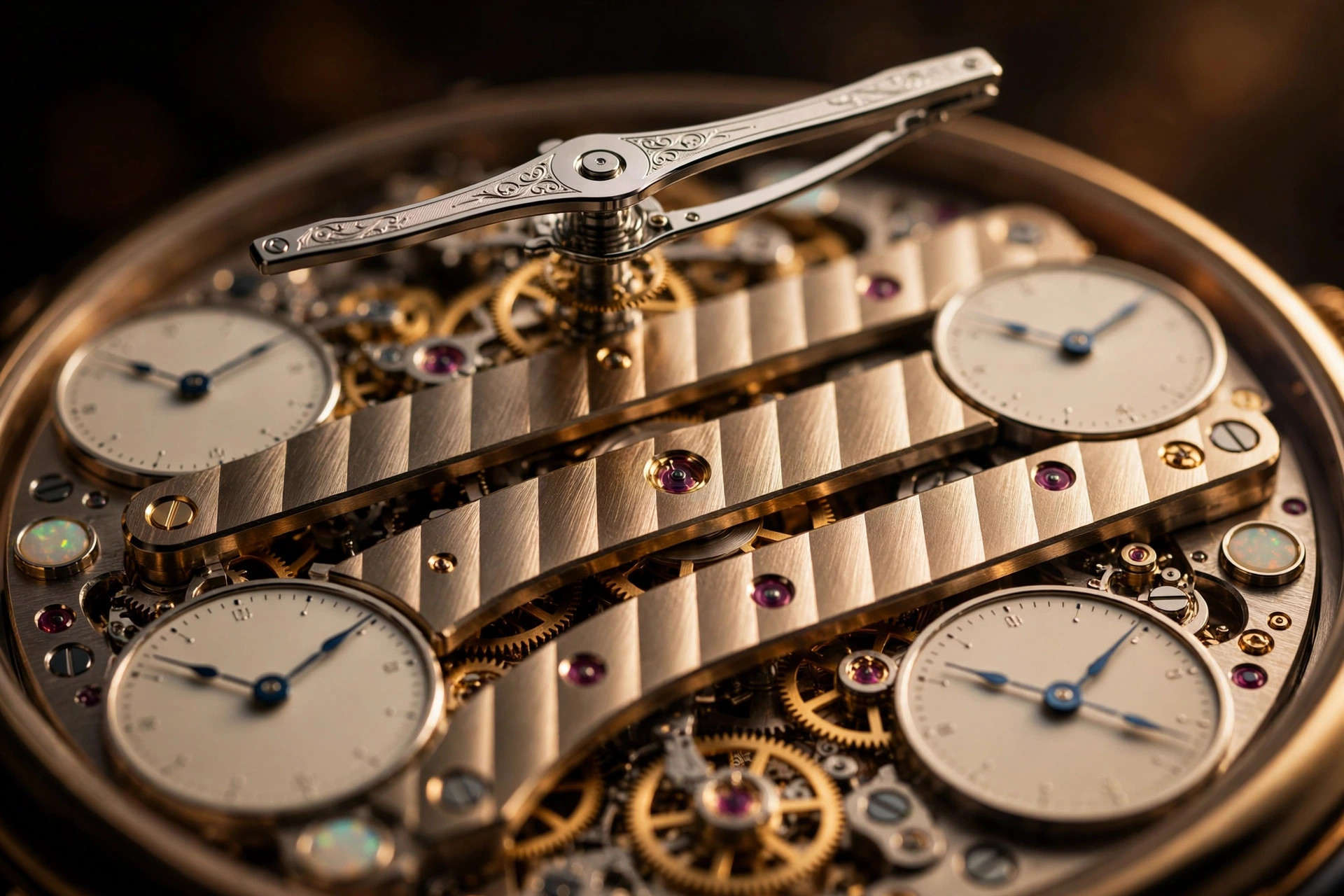
Nobody expected these two to share a workbench. Bvlgari's Octo Finissimo spent a decade collecting thinness records with the severity of a Bauhaus manifesto: eight world records, each one flatter and more disciplined than the last. Vianney Halter, meanwhile, has spent thirty years building the opposite, riveted brass portholes, triple displays, and a retrofuture aesthetic that reads like a Jules Verne submarine crossed with a graphic novel. Announced at Geneva Watch Days in early September 2026, the Octo Finissimo Dual Time x Vianney Halter is the first time the collection has let an independent watchmaker touch the movement itself, not the dial. The movement.
That distinction matters, because everything hard about this watch lives underneath the dials. Bvlgari started from its calibre BVL 138, the 2.23mm micro-rotor automatic that powers the standard Octo Finissimo Automatic, and built the new manufacture calibre BVF 200 on top of it. It adds GMT, date, and day/night indications at 5.49mm thick. Do the subtraction: 3.26 millimeters of added complication, and the finished watch still closes at 9.70mm in a 40.5mm case. Anyone who has ever tried to add a second time zone to an ultra-thin base movement knows this is the horological equivalent of adding a second story to a house without raising the roofline.
Why stacking modules on a thin base is genuinely hard
Ultra-thin movements are not simply scaled-down normal movements. Every fraction of a millimeter removed from the mainplate forces the gear train into a flatter, wider arrangement, which lengthens the power path and multiplies friction surfaces. Torque is the currency everything else spends: the barrel holds a fixed budget, and each added wheel, each jumper spring, each date disc takes its cut before the escapement sees a joule.
Three complications draw on that same fixed budget. A GMT mechanism needs its own wheelwork driven off the going train, plus a setting system that lets the second hour hand jump without disturbing local time. A date needs a driving wheel, a date disc large enough to be legible, and a jumper stout enough to snap the disc over at midnight without draining the amplitude. A day/night indicator is comparatively cheap, a disc geared to rotate once per 24 hours, but it still needs its wheel and its place in the stack. Bvlgari's engineers, working between the Saignelégier and Le Sentier workshops, integrated these as specific modules on the BVL 138 architecture rather than redesigning the base. Leaving the micro-rotor winding system and the going train untouched was the conservative choice, and the correct one: you do not re-qualify a record-holding base calibre to chase a novelty.
Consider the alternative. Most dual-time watches in this price bracket simply buy a thicker base movement with room to spare. Bvlgari refused the easy millimeters. Set the 5.49mm calibre against the 9.70mm case total and roughly 4.2mm remains for the case architecture, dial stack, hands, and both crystals. That remainder has to absorb four separate dials, each with its own surround, plus the hand clearances for six hands across the displays. Thinness, here, is not a styling choice but a constraint that propagated through every component decision below it.
Four dials and the Antiqua connection
Halter's contribution is legible the instant you look at the watch, and it helps to know what he was quoting. His 1998 Antiqua, the piece that made his reputation, displayed time through riveted portholes and apertures scattered across a deeply three-dimensional dial, with a perpetual calendar and a wandering-hour subdial fighting for space like instruments on a ship's bridge. This watch inherits that DNA directly: four individual opaline rhodium-plated dials, each ringed by its own satin-polished porthole bezel, carrying hours and minutes, GMT, date, and day/night respectively.
Four separate dials change the engineering, not just the look. A single dial is one stamping, one set of feet, one plane to keep parallel with the hands. Four dials means four sets of feet soldered or screwed to the mainplate, four planes that must agree within hundredths of a millimeter, and four surrounds that have to sit inside an octagonal case already crowded by a 50-plus-component construction. Bvlgari credits the Octo's strict geometry with making this possible: the case's architectural discipline gave Halter's scattered instruments a grid to hang on, which is a generous reading. More skeptically, the octagon's wide, flat real estate is simply one of the few case shapes with room for four portholes without looking like a cockpit dashboard.
Blued hands in Halter's characteristic sculpted shapes handle the time displays, with a red arrow-tipped hand for running seconds. Monochrome's hands-on review flagged the one genuine ergonomic complaint: the red arrow can be mistaken for the GMT hand at a glance, and a proper two-handed GMT display would have served the complication better. Fair. When you add a GMT module to a movement, the least you can do is make the GMT hand unmissable. This is the kind of compromise that happens when the dial architecture is designed for visual drama first and the complication has to introduce itself afterward.
The platinum micro-rotor does real work
Flip the watch over and the collaboration signs its name. The micro-rotor is platinum, engraved with Halter's signature and rose-gold-tinted on the 15-piece rose gold edition. That platinum is not decoration. It is density, 21.45 grams per cubic centimeter against roughly 8 for brass, and density is the entire game in micro-rotor winding.
A micro-rotor sits recessed in a cutout in the mainplate rather than swinging above the movement like a full rotor, which is what makes the BVL 138 family so thin. But the recess caps the rotor's diameter and thickness, and winding torque scales with the rotor's mass times its radius. Shrink the geometry and you must raise the density to keep the winding efficiency. Platinum buys back the mass the thinness took away. This is also why the 60-hour power reserve deserves more respect than the spec sheet suggests: sustaining two and a half days of autonomy, at 21,600 vibrations per hour, from a movement whose winding mass lives in a 5.49mm sandwich, means the barrel and gearing efficiencies had to be ruthlessly optimized. Lower beat rate helps, fewer vibrations per hour means fewer escapement impulses draining the barrel, which is the standard trade manufacturers make when reserve matters more than the smoothness of the seconds hand.
Finishing follows the manufacture playbook: vertical Geneva stripes, brushing, perlage. None of it is visible from the front, which is precisely Halter's influence at work, the machinery treated as worthy of attention rather than hidden behind a solid caseback. Both editions get sapphire backs, though at 30 and 15 pieces in titanium and rose gold respectively, nearly everyone reading this will only ever see the rotor in photographs, which does not make the engineering less real.
What to be skeptical about
Honesty first: I have not handled this watch, and with 45 total pieces in existence, neither have you. Everything above is built from Bvlgari's published specifications and the hands-on reports from Geneva Watch Days, principally WatchTime, Monochrome, and WatchAdvisor, which agree on the core numbers.
Open questions remain, and they are mechanical. Module stacks add interfaces, and interfaces add friction and tolerance chains; a 3.26mm module sandwich on a 2.23mm base will live or die on how cleanly those layers hand torque to each other over decades of service. Date correctors and GMT setting works get punished harder than any other part of a travel watch, and ultra-thin setting works have less material to absorb the abuse. Then there is the servicing question that haunts every exotic stack: when this needs attention in fifteen years, it goes back to Le Sentier, not to the corner watchmaker, and parts for a 45-piece run are not sitting on a shelf.
None of that diminishes the achievement, because Bvlgari could have marked this collaboration with a special dial and a caseback engraving, which is what most manufacture-meets-independent projects amount to. Instead it built a new calibre, added three complications to the thinnest automatic architecture it owns, and held the line under ten millimeters. Halter got his portholes, Bvlgari kept its thinness brief intact, and the 5.49mm sandwich in between is where the actual watchmaking happened.
| Spec | Octo Finissimo Dual Time x Vianney Halter |
|---|---|
| References | 104356 (titanium, 30 pcs); 104355 (rose gold, 15 pcs) |
| Case | 40.5mm diameter x 9.70mm thick; 50+ components; sandblasted titanium or sandblasted/brushed 18k rose gold |
| Calibre | BVF 200, manufacture automatic; BVL 138 base with GMT, date, day/night modules |
| Calibre thickness | 5.49mm (base BVL 138: 2.23mm) |
| Winding | Platinum micro-rotor, engraved with Halter signature (rose-gold tinted on ref. 104355) |
| Frequency / reserve | 21,600 vph (3 Hz); 60-hour power reserve |
| Displays | Four opaline rhodium-plated dials: hours/minutes, GMT, date, day/night; blued Halter hands, red arrow seconds |
| Finishing | Vertical Geneva stripes, brushing, perlage; sapphire caseback |
| Water resistance | 30m / 3 ATM |
| Strap | Integrated sandblasted titanium bracelet (104356); brown alligator (104355) |
| Price | CHF 70,000 titanium (per Timekeepers Club); $80,000 / $123,000 (per WatchTime) |
| Debut | Geneva Watch Days, September 2026 |