The Cosmonaute Joins the Core Collection: Breitling's Space Watch Stops Being a Souvenir
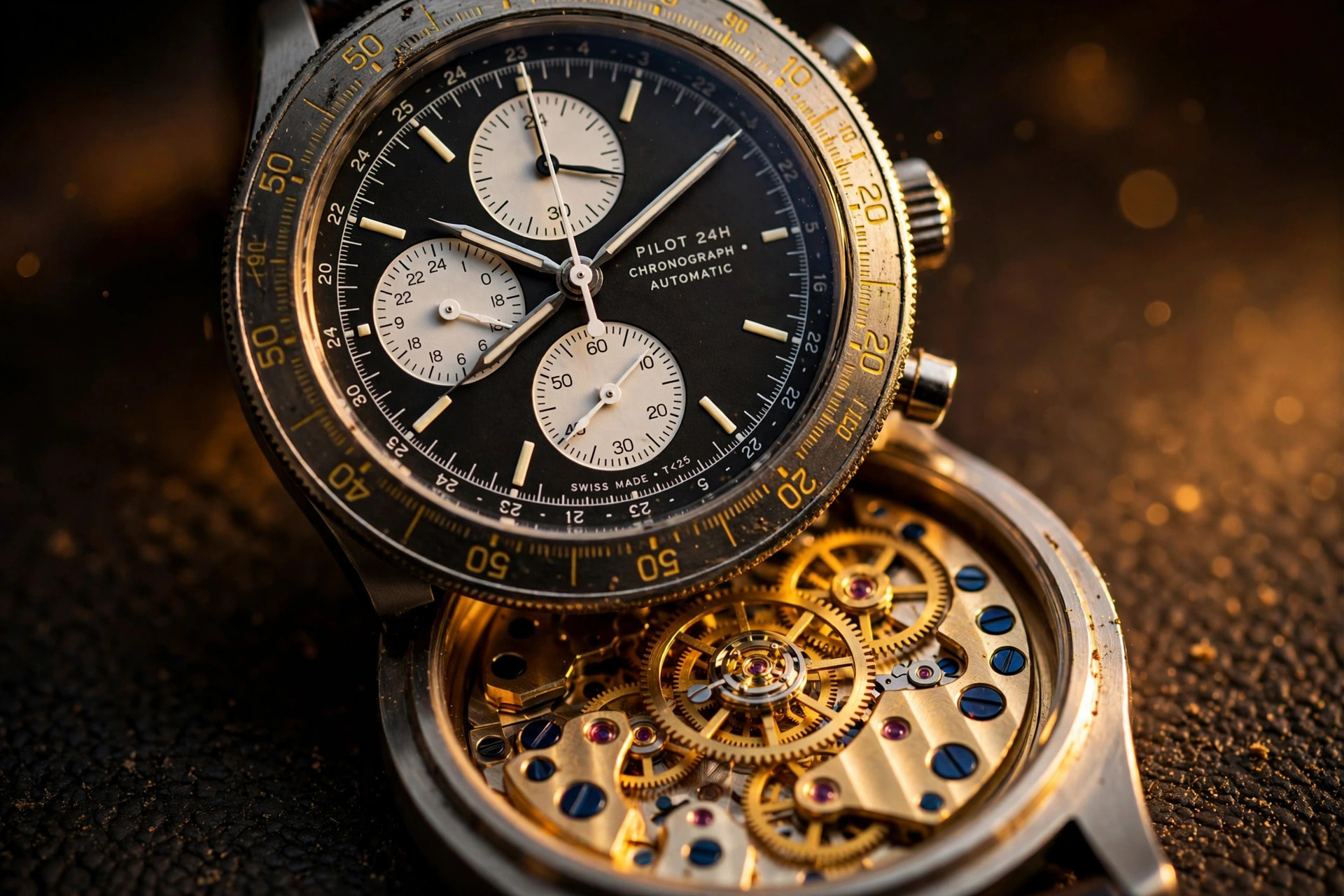
For four years, the only way to buy Breitling's most famous watch was to win a race. Scott Carpenter's wrist carried it through three orbits in 1962; for the past four years, the Navitimer Cosmonaute lived the way collectibles live: in small numbered batches, at ascending prices, gone before most people knew they existed. A 362-piece anniversary. A red gold 250. A platinum 50. A meteorite-dial 450 tied to Artemis II. Every one of them sold through, which is the polite way of saying demand was rationed on purpose.
On October 22, 2026, Breitling ended the rationing. Joining the core collection: the Navitimer B02 Chronograph 41 Cosmonaute, priced at £7,950 on leather or £8,150 on bracelet, available to anyone with the money and the patience to walk into a boutique. Alongside it came a second new watch, the Navitimer B09 Chronograph 41, a hand-wound take on the classic 12-hour formula at £6,750 on strap. Both run manufacture calibres, and both are COSC-certified. Neither has a production cap.
Breitling says this is the first time in its modern history that the Cosmonaute has been offered outside an anniversary or limited-production context. Put plainly: after sixty-four years as an icon and four years as a product strategy, the space watch is just a watch again. That is a bigger story than the spec sheet, though the spec sheet deserves its due first.
A Movement Built for One Dial
The B02 exists for exactly one purpose. Breitling developed it specifically for the Cosmonaute, and the specification reads like a list of deliberate choices rather than a catalogue of features: 30 millimeters across, 6.83 millimeters thick, 273 components, hand-wound, column wheel, vertical clutch, 30-minute and 12-hour totalizers, quarter-second chronograph, 28,800 vibrations per hour, roughly 70 hours of power reserve, COSC certification. Swisswatches Magazine, covering a retailer edition earlier this year, noted the finishing: rhodium plating, stripe finishing on the bridges, sunburst work on the gear train and balance bridge, blued screws. This is a movement Breitling wants you to look at, and the sapphire caseback obliges.
Seventy hours from a hand-wound chronograph at 4 hertz is the number that earns a second look. Power reserve is stored energy, and energy density in a mainspring barrel is a packaging problem: more hours means either a longer or stronger spring, a bigger barrel, or a movement that sips rather than gulps. Three days of autonomy in a 6.83-millimeter stack is evidence that the barrel and gear train were designed together rather than assembled from parts-bin habits. Worth a second look: the vertical clutch. In a lateral-clutch chronograph, engaging the seconds hand drags the going train through a friction interface and perturbs the balance; a vertical clutch engages on-axis, with essentially no jump in the running seconds and no amplitude hit on the balance. It is the chronograph architecture you choose when you have column-wheel money and you intend to run the chronograph often.
Then there is the 24-hour train, which is the whole reason this caliber exists. A conventional dial needs the hour hand to turn at one twelfth the speed of the minute hand, which the motion works achieve by reducing the cannon pinion's rotation 12-to-1 through the minute wheel and hour wheel. Half that rate is what the Cosmonaute needs: one rotation per day, 24 hours, through a 24-to-1 reduction instead of 12-to-1. It sounds trivial until you remember that every wheel ratio in a watch is a negotiation between tooth counts, module size, and available space inside a 30-millimeter plate. Breitling could have faked it with a 24-hour subdial, the way lesser "GMT" watches fake world time with an extra hand. Instead the hour hand itself runs at half speed, which is what Carpenter asked for in 1962 and what makes the dial legible rather than decorative. The original modification was to a Venus 178, Breitling's supplier chronograph of the era; the B02 is the same idea, executed from a blank plate with modern metallurgy and a COSC certificate.
One detail deserves credit for restraint: the date hides inside the 6 o'clock subdial, color-matched to the subdial so the layout stays symmetrical. Dates on chronographs are usually layout vandals, punched through a dial where nothing wanted them. Here the aperture sits inside a counter that was already there, at the cost of making the date harder to read. Breitling chose composition over legibility, which is a defensible call on a dial this busy, and the reverse-panda counters (white against black) are the right choice anyway. A 24-hour dial asks more of a reader than a 12-hour one; maximum contrast is not decoration here.
The B09: Hand-Winding for the Purists
The second watch is the quieter release and, for some wrists, the more interesting one. The Navitimer B09 Chronograph 41 takes the classic 12-hour Navitimer formula and removes two things: the date and the rotor. Inside is the hand-wound B09 calibre, a column-wheel chronograph with 244 components and the same 70-hour reserve as the B02, COSC-certified. Black or blue reverse-panda dials, white rehaut, slide rule intact. £6,750 on strap, £7,150 on bracelet.
Removing the automatic winding system from an existing caliber is the kind of change that sounds like subtraction and behaves like design. A rotor adds a moving mass that needs clearance over the bridges, and its bearing and reverser gears add thickness and a winding noise some collectors actively dislike. At 13 millimeters, the B09's case is only modestly thinner than the automatic B01 Chronograph 41, per Who Watch Wear's reporting, so the gain here is not really dimensional. It is tactile and visual: the daily ritual of winding, and a dial with no date window breaking the symmetry. Breitling is nodding at the 1960s Navitimers worn by Jim Clark and Graham Hill, racing drivers who also flew and would have understood the model as an instrument rather than jewelry. Instruments get wound. Jewelry gets a rotor.
Both new watches share the hardware: 41-millimeter steel case, 47.09 millimeters lug to lug, bidirectional slide-rule bezel, cambered sapphire crystal with anti-reflective coating on both sides, sapphire display back, non-screw-down crown, 30 meters of water resistance. Thirty meters is honest rather than impressive, and suits a cockpit instrument. Nobody is timing decompression stops with a slide rule. Both dials carry the gold Twin Jet logo, tied to Breitling's emblem from 1957 and worn on Navitimer dials from 1965; it is the kind of period detail that costs nothing to get right and everything to get wrong, and they got it right.
Four Years of Numbered Scarcity
The limited-edition arc is worth reconstructing, because it explains what Breitling is walking away from. The B02 debuted in June 2022 in a 362-piece limited edition marking 60 years since Carpenter's flight, the number nodding to three orbits and the year 1962, with a platinum bezel and an all-black dial. Breitling even displayed Carpenter's original watch from its archives on the occasion, which was either heritage storytelling or a reminder of what the new pieces were priced against. Then came the 2024 red gold edition, limited to 250 pieces, carrying the B12 automatic movement: the first automatic Cosmonaute, and therefore the first one that broke the manual-wind lineage reaching back to Carpenter's Venus 178. The 2025 centenary edition, 50 pieces in platinum with a deep blue dial, marked what would have been Carpenter's 100th birthday; he was born May 1, 1925. And in 2026 the Artemis II edition: 450 pieces, galaxy-blue meteorite dial at €11,750, its caseback engraved with the mission patch, worn by several of the mission's own astronauts.
Add them up: 362 plus 250 plus 50 plus 450 equals 1,112 watches, every one numbered, every one sold. That is a halo product managed with real discipline, and the discipline worked. Which makes the core-collection move the interesting decision, because scarcity is only valuable while you maintain it. Breitling looked at four years of sold-out limited editions and concluded the Cosmonaute's appeal would survive contact with availability. That is either confidence or the realization that the limited-edition well was running dry. Both readings can be true, and the market will tell us which one it believes.
Why Hand-Wound Is the Honest Answer
Here is the opinion part. The 2024 red gold Cosmonaute with its automatic B12 was the outlier, not the template. Carpenter's watch was manual-wind because every chronograph in 1962 was manual-wind; the Cosmonaute that matters, the one in the archives, is a hand-wound instrument with a slide rule you operate yourself. An automatic module on this watch is a convenience the original concept never asked for, and it adds rotor mass to a movement whose entire identity is mechanical directness. Breitling clearly agrees, because the core-collection Cosmonaute returns to the hand-wound B02, and the automatic experiment stays quarantined in its 250-piece red gold edition.
There is also the thickness argument, and it cuts against the obvious reading. The B02 is 6.83 millimeters, yet the case is 13 millimeters, roughly what the automatic B01 version needs. A hand-wound movement in a case built for an automatic is not a packaging triumph; it is headroom Breitling chose not to spend. I would rather have the headroom than a thinner watch. Thirteen millimeters wears fine on a 41-millimeter case with a 47-millimeter lug span, and the alternative, a wafer-thin dress chronograph, would be wrong for a tool watch with spaceflight pretensions. Restraint in one dimension is not a failure. It is a choice, and this one is correct.
The 24-hour hand sharpens the point. A hand-wound watch is a watch you touch every day, and a 24-hour dial is a dial you read differently from every other watch you own: midnight at the bottom or top depending on the layout, noon opposite, the whole day laid out in one sweep. Winding it daily is not a chore. It is the interaction the dial design assumes. Automatics are for watches you want to forget. Nobody should forget what this dial is for.
A Legend Becomes a Product
Watch brands love to announce that a limited edition sold out, because it converts a commercial fact into a prestige signal. What they almost never announce is the inverse: that the prestige object is now just inventory. Breitling did that on October 22, and the framing matters. "First time in modern history offered outside an anniversary or limited-production context" is a sentence that only gets written when a company has decided that accessibility is the new luxury, or at least that the Cosmonaute's mythology is sturdy enough to survive being buyable.
Compare it to the obvious reference. Omega's Speedmaster is the other great space chronograph, and it has been a core-collection watch for decades; its mythology grew through availability, not despite it. Breitling ran the opposite experiment for four years, monetizing the Cosmonaute's legend in numbered tranches, and the experiment's success is precisely what makes the pivot possible. You cannot put a watch in the core collection until you are sure people want it when it is not scarce. The 1,112 numbered pieces were, among other things, market research. The market answered.
Carpenter's original request had three parts: a 24-hour dial for orbital day-night confusion, a simplified slide rule with the space-irrelevant scales removed, and a wider bezel for gloved hands. Breitling delivered the prototype days before the May 24, 1962 liftoff, and Carpenter orbited Earth three times in under five hours wearing it. The production version became the reference 809. John Glenn and James McDivitt wore Cosmonautes too, and mission commander Reid Wiseman was spotted with one on Artemis II, which is how the 2026 meteorite edition earned its mission patch. One correction the legend always needs: Carpenter's was the first Swiss wristwatch in space, not the first watch. Yuri Gagarin's Sturmanskie beat it by a year on Vostok 1. Breitling's own press materials say "first Swiss wristwatch in space," and the precision is admirable. Legends that survive fact-checking are the ones worth keeping.
So now the Cosmonaute sits in the catalogue next to the ordinary Navitimers, at £7,950 on leather, with a hand-wound manufacture chronograph and a dial that still does something no other mainstream watch does. The limited editions will not lose their value; numbered scarcity and core availability are different markets, and collectors understand the difference. What changes is the story Breitling gets to tell. For four years the story was "you cannot have this." Now the story is "this is what we make." The second story is harder to tell, because it has to survive comparison with everything else at the price. It is also the story worth telling, because a watch that only exists in numbered editions is a collectible, and a watch that exists in the catalogue is a watch. Welcome back to the shelf, Cosmonaute. It took you sixty-four years.
Limitations, Honestly
I have not handled either watch, and everything here rests on the October 22, 2026 reporting plus Breitling's published specifications and the historical record, so treat the wearability judgments as informed reasoning rather than witnessed fact. The claim that this is the first modern-era Cosmonaute outside anniversary or limited production is Breitling's own, and I have not independently audited every Cosmonaute reference since the quartz crisis for a non-limited production run. The 24-hour gearing analysis follows standard motion-works arithmetic: 12-to-1 for a conventional dial, 24-to-1 for the Cosmonaute, and I am inferring the B02 implements it through the motion works rather than a separate module because Breitling describes the caliber as developed specifically for the Cosmonaute with the 24-hour display as its defining feature.
Prices are quoted in pounds sterling from the launch reporting; regional pricing will differ, and the Artemis II edition's €11,750 is included for the limited-edition arithmetic, not as a current offer. The B09's derivation from the B01 architecture is my reading of the component counts and Breitling's positioning, not a stated fact from the brand. Everything else, the Carpenter history, the edition counts, the movement dimensions, comes from the sources below.
Sources
- Who Watch Wear, October 22, 2026, "Breitling Brings the Navitimer Cosmonaute and Hand-Wound B09 Into the Core Collection," reporting both models joining the core collection from October 22, full specifications (41mm steel, 13mm thick, 47.09mm lug to lug, bidirectional slide-rule bezel, cambered sapphire, sapphire display caseback, non-screw-down crown, 30m WR), B02 with 273 components and column wheel plus vertical clutch, B09 with 244 components and column wheel, 70-hour reserve and COSC certification on both, gold Twin Jet logo tied to the 1957 emblem and 1965 Navitimer dials, pricing £6,750-£8,150, and Breitling's statement that this is the first time in modern history the Cosmonaute has been offered outside anniversary or limited production. https://whowatchwear.com/breitling-brings-the-navitimer-cosmonaute-and-hand-wound-b09-into-the-core-collection/
- Haute Time, October 22, 2026, "Breitling Navitimer B09 and B02 Cosmonaute Debut," confirming B02 specifications (273 components, 28,800 vph, 70 hours, column wheel, vertical clutch, 30-minute and 12-hour totalizers, screwed sapphire caseback) and noting the B09's cue from the 1960s Navitimers of Jim Clark and Graham Hill. https://www.hautetime.com/breitling-navitimer-b09-b02-cosmonaute-core-collection/
- Fratello Watches, October 22, 2026, "Breitling Introduces Two New Manual-Wind Navitimer Models," covering the 1962 origin (Breitling adapting the Navitimer for Carpenter's orbital flight with a 24-hour display), the B02 as developed specifically for the Cosmonaute, and the brown gradient calfskin and seven-row bracelet options. https://www.fratellowatches.com/breitling-adds-two-new-manual-wind-navitimers-to-the-core-collection/
- Europa Star, June 1, 2022, "Breitling presents the Navitimer Cosmonaute Limited Edition," with full B02 technical specifications: 30mm diameter, 6.83mm depth, hand-wound, approximately 70-hour reserve, 28,800 a/h, column-wheel vertical-clutch chronograph with 1/4-second, 30-minute and 12-hour totalizers, COSC certification; the 362-piece 60th anniversary edition with platinum bezel, caseback engraved with the mission date and "First Swiss wristwatch in space." https://www.europastar.com/time-keeper/1004093509-breitling-presents-the-navitimer-cosmonaute.html
- Breitling press release (April 2026), "Navitimer Cosmonaute Artemis II," confirming the 450-piece limited edition, galaxy-blue meteorite dial, hand-wound manufacture calibre B02 with column wheel and vertical clutch at 28,800 vph and approximately 70-hour reserve, COSC certification, and the 1962 Carpenter origin story. https://press.breitling.com/navitimer-cosmonaute-artemis-ii-en/?lang=eng
- Revolution Watch (April 2026), "Breitling Navitimer Cosmonaute Artemis II: The Race to Space," covering the 2022 362-piece edition, the 2024 250-piece 18-karat red gold edition with the automatic B12 (a first for the Cosmonaute), the 50-piece 2025 Scott Carpenter Centenary platinum edition, John Glenn and James McDivitt as Cosmonaute wearers, Reid Wiseman's Artemis II wrist check, and Gagarin's Sturmanskie as the first watch in space ahead of Carpenter's first Swiss wristwatch. https://revolutionwatch.com/breitling-navitimer-cosmonaute-artemis-ii-the-race-to-space/
- Esquire Singapore, "Only 50 Exist: Breitling's New Navitimer Watch Revives a Lost Chapter of Space History," on the Scott Carpenter Centenary edition (platinum, 50 pieces, Carpenter born May 1, 1925), the May 24, 1962 Aurora 7 flight of three orbits in under five hours, Carpenter's requests (24-hour dial, wider bezel for gloved hands, stretch bracelet), and delivery days before liftoff. https://esquiresg.com/50-exist-breitling-new-navitimer-watch-revives-lost-chapter-space-history/
- Breitling product page, Navitimer B02 Chronograph 41 Cosmonaute Scott Carpenter Centenary (LB0240211C1P1), confirming the May 24, 1962 Mercury-Atlas 7 flight details, the wider bezel, stretch-metal bracelet, 24-hour dial, and "First Swiss wristwatch in space" caseback inscription. https://www.breitling.com/np-en/watches/navitimer/navitimer-b02-chronograph-41/LB0240211C1P1/
- Mr. Stateless (April 2026), "Breitling Celebrates Artemis II With A New Navitimer Cosmonaute," confirming the 450-piece Artemis II edition at €11,750, hand-wound B02 with vertical clutch, COSC certification, and the acid-etched Widmanstätten meteorite dial. https://mrstateless.com/breitling-celebrates-artemis-ii-with-a-new-navitimer-cosmonaute/
- Crown Vintage (January 2025), "The first Breitling in space," on Carpenter's three design requests (24-hour dial via modified Venus 178 with the hour hand at half speed, simplified slide rule, widened bezel) and the commercial launch of the Cosmonaute as reference 809. https://crownvintage.com.au/blogs/vintage-stories/the-first-breitling-in-space