Invisible Teeth: How Breguet Built the First Contactless Escapement from Samarium-Cobalt and a Century-Old Failure
Every mechanical watch ever made, from Abraham-Louis Breguet's first tourbillon in 1801 to the most advanced Swiss chronometer certified last week, runs on controlled collision. A ruby pallet catches an escape wheel tooth. Energy transfers through sliding contact between synthetic corundum and hardened steel. Lubricant degrades. Surfaces wear. Accuracy drifts. After two hundred and fifty years of incremental refinement, the fundamental transaction at the heart of every mechanical timepiece remains the same: a jewel crashes into a tooth, absorbs energy from the mainspring, and kicks it into the balance wheel.
In December 2025, for its 250th anniversary, Breguet introduced a watch that eliminates that collision entirely.
Caliber 7250 inside the Expérimentale 1 replaces ruby pallets with samarium-cobalt magnets and substitutes physical teeth with magnetic field gradients shaped like invisible ramps. Impulse travels across a gap. Nothing touches. And because the energy delivered comes from stored magnetic potential rather than direct mechanical transfer, every single beat carries identical force regardless of mainspring tension. Not approximately constant. Not "within chronometer tolerance." Identical.
Seventy-five pieces. CHF 320,000. And a decade of Swatch Group R&D solving a problem that had defeated every engineer who attempted it since the 1930s.
A Problem Built for Torpedoes
Cecil Frank Clifford did not care about watches. A fellow of the British Horological Institute working in the mid-twentieth century, Clifford was trying to build a silent timing mechanism for naval torpedoes. Conventional clockwork escapements click. In a torpedo guidance system, acoustic signatures matter, and any mechanism that produces periodic mechanical impacts radiates detectable sound into the water column. Clifford wanted a timing oscillator with no physical contact between the impulse-delivering components.
His solution, patented in 1954, centered on a sinusoidal escape wheel machined from "Mumetal," an alloy of approximately 80 percent nickel and 20 percent iron with added molybdenum, chosen for its extremely high magnetic permeability. Instead of conventional teeth, the wheel's rim undulated in a continuous wave. On either side of this wheel, magnetized vibrating blades oscillated back and forth, driven by the interaction between their permanent magnetic fields and the varying reluctance created by the Mumetal wave profile as it rotated. Energy transferred from the wheel to the blades through changing magnetic flux density in the gap, with no component ever touching another.
On paper, it was elegant. Clifford had identified the core principle that Breguet would eventually refine: magnetic potential energy could replace mechanical contact as the medium of impulse delivery. But Clifford's implementation suffered from problems he could not solve with the materials available to him.
Hamilton Watch Company fitted two 992B pocket watch movements with Clifford-type escapements. Maximum runtime reached ten hours before the mainspring depleted. Shock resistance was poor: any sharp impact could displace the vibrating blades from their optimal magnetic coupling position, and without a physical safety mechanism, the blades had no way to self-correct. Robert Hooke had attempted a magnetic oscillator centuries earlier, but no drawings of his design survive.
Junghans tried next, at commercial scale. Starting in 1959, the German clockmaker produced roughly 30,000 "Silent" alarm clocks using a Clifford-derived magnetic escapement. Silent, as promised. Also unreliable. Dust particles accumulating in the magnetic gap disrupted the precisely calibrated field geometry, and without physical teeth to enforce discrete stepping, a contaminated escapement could enter runaway acceleration where the escape wheel spun freely rather than advancing in controlled increments. Junghans recalled all units.
Clifford's idea died commercially in the early 1960s. It remained dead for fifty years.
Ten Years Inside Swatch Group R&D
Breguet belongs to Swatch Group, which means Breguet has access to Swatch Group's central research infrastructure: metallurgical laboratories, silicon fabrication (shared with Omega's co-axial development), magnetic materials expertise built up across multiple brands, and patent lawyers who file in every jurisdiction that matters. When Swatch Group R&D began revisiting the magnetic escapement concept around 2014, they brought resources that Clifford, Hamilton, and Junghans could never have marshaled.
Patent EP3208667, filed in 2016, shows the first generation of what would become the Expérimentale escapement. A single ferromagnetic arm extends from the lever, interacting with "energy ramps" on the escape wheel: strips of magnetic material whose thickness increases gradually before terminating at a square barrier, creating an asymmetric potential energy profile that accumulates force as the escape wheel rotates and releases it abruptly when the lever unlocks. Barrier studs on the escape wheel rim provide the discrete stepping that Clifford's continuous sinusoidal profile lacked.
It worked, technically. But the 2016 patent reveals a critical vulnerability. Without any physical safety mechanism, the lever had no backup system to prevent catastrophic failure during shock events. A sharp wrist impact could throw the lever past its intended range of motion, and without physical stops to catch it, the magnetic coupling would break entirely. Self-starting was also unreliable: the magnetic geometry had to be precisely aligned for the oscillation to initiate from rest, and if the watch stopped in an unfavorable position, winding the mainspring might not restart it.
Four years of additional development produced the breakthrough. Patent EP3882713, filed in 2020 and published in 2022, introduced a component that solved both problems simultaneously: a physical safety wheel sandwiched between two mirrored magnetic wheels.
Three Layers, Zero Contact
Understanding the Expérimentale escapement requires understanding its three-dimensional architecture, because the escape wheel is not a single disc but a vertical stack of three separate wheels rotating on the same axis.
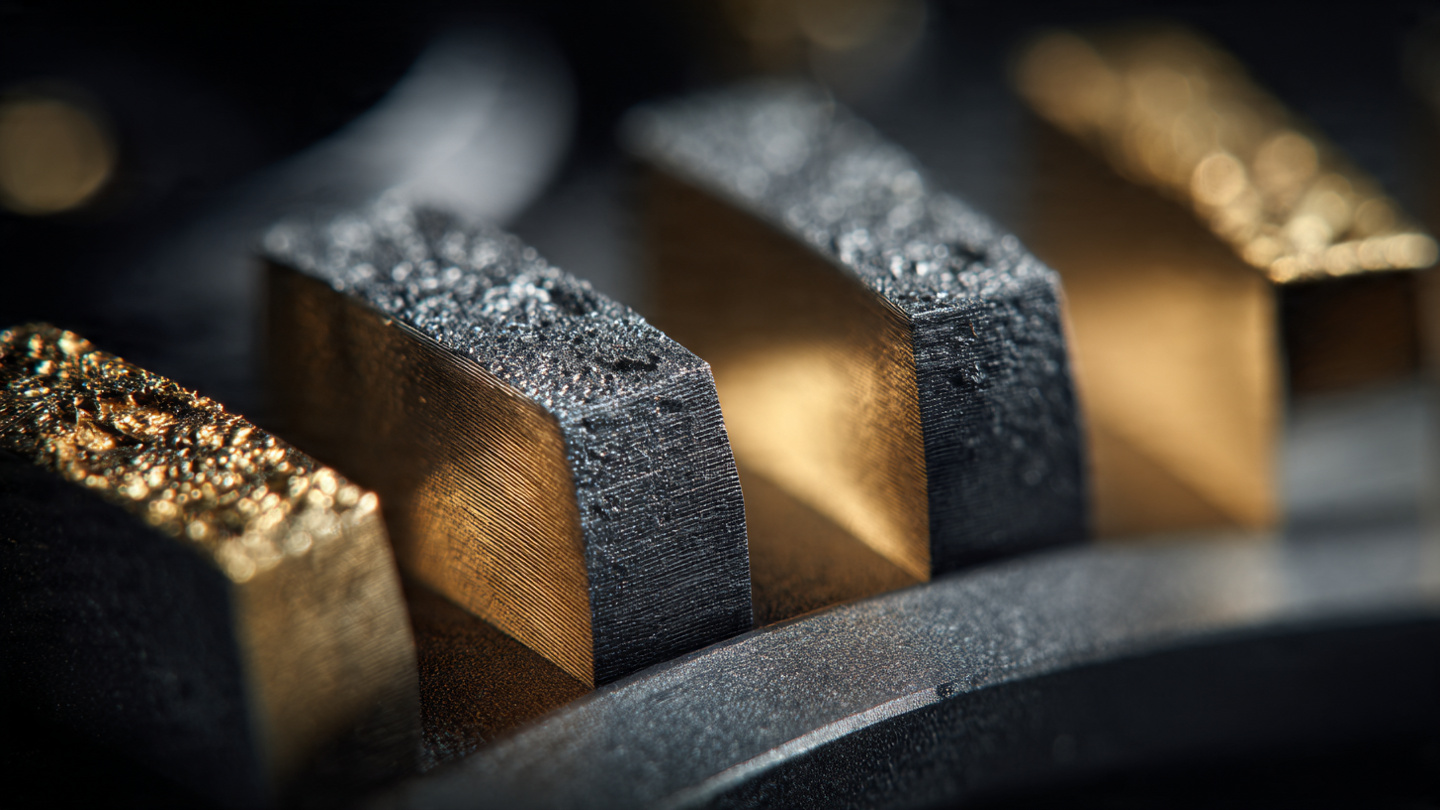
On top: a magnetic wheel. Grade 2 titanium substrate carrying samarium-cobalt magnet segments bonded to its rim, oriented with north poles facing outward. Twelve segments, twelve barriers, twelve discrete energy ramps per revolution.
On the bottom: a mirrored magnetic wheel. Same titanium construction, same samarium-cobalt segments, oriented with south poles facing outward. A magnetic mirror image of the top wheel, creating a field that wraps around the lever's pallet magnets from both sides simultaneously.
Between them: the safety wheel. Conventional physical teeth, twelve of them, machined from metal. No magnets. Pure mechanical backup.
Now consider the lever. In a conventional Swiss lever escapement, the lever carries two ruby pallets: an entry pallet and an exit pallet, each positioned to intercept escape wheel teeth at precisely calculated angles. Breguet's lever replaces both rubies with samarium-cobalt magnet blocks. Same geometry, same angular relationship, completely different physics.
When the escapement is running normally, only the magnetic layers participate. Here is the energy cycle, step by step.
First: the escape wheel rotates under mainspring torque. As it turns, the magnetic material thickness along each energy ramp increases gradually, building a progressively stronger magnetic field that pushes against the samarium-cobalt block embedded in whichever pallet currently faces the wheel. Magnetic potential energy accumulates in the gap between the ramp's square barrier and the pallet magnet. Think of it as compressing an invisible spring: the closer the barrier approaches the pallet magnet, the more repulsive force builds between them, and the more potential energy gets stored in the field geometry.
Second: the balance wheel completes its oscillation and its impulse pin strikes the lever fork, unlocking the lever from its current rest position. At this instant, the accumulated magnetic potential energy releases. Because the lever is far lighter than the escape wheel assembly, the stored magnetic repulsion accelerates the lever first while the escape wheel, with its greater rotational inertia, barely moves. Magnetic potential converts to kinetic energy in the lever, which swings across to its opposite banking position and delivers impulse to the balance wheel through the fork.
Third: only after the lever has completed its transit and locked against the opposite banking pin does the escape wheel begin rotating again under mainspring torque, advancing one tooth position on the safety wheel (one-twelfth of a revolution) and beginning to build magnetic potential energy against the opposite pallet magnet for the next cycle.
Jack Forster of Hodinkee documented a crucial nuance that Breguet's own diagrams do not fully illustrate. During each cycle, the safety wheel's teeth do make brief physical contact with the pallet. Contact occurs after the magnetic impulse phase: the pallet reaches its new position, touches the safety wheel tooth, then recoils very slightly under magnetic force and settles against a banking pin on the lever shaft. During the actual unlocking and impulse phases, no physical contact exists. Sliding friction during energy transfer is zero.
Why This Creates Constant Force
Constant force in a mechanical watch means delivering identical impulse energy to the balance wheel on every oscillation, regardless of how much tension remains in the mainspring. Every conventional escapement fails this test because the impulse energy comes directly from the mainspring through the gear train. As the spring unwinds, torque drops, impulse weakens, and amplitude decreases, which changes the rate. Chronometer-grade watches minimize this variation through isochronous balance spring design. They do not eliminate it.
Gravity escapements, invented in the nineteenth century for tower clocks, offered one historical solution. A weighted arm, lifted by the escape wheel between each tick, delivers impulse by falling under gravity. Since gravitational potential energy at a fixed height is constant (mass times gravitational acceleration times height), the impulse is independent of escape wheel torque. Robin and Mudge and Grimthorpe each built gravity escapements that kept tower clocks accurate through decades of municipal neglect. Scaling them down to wristwatch dimensions proved impractical because the arm's weight would dominate the movement's mass budget.
Girard-Perregaux found a different solution in 2013 with its Constant Escapement, which uses a buckled silicon blade that stores elastic potential energy in a binary state: it snaps from one buckled configuration to the other, delivering a fixed quantum of energy per transition regardless of input torque. Brilliant in concept, brutal to manufacture, and limited to a handful of watches.
Breguet's magnetic approach achieves constant force through a different mechanism entirely, and the key insight is that escape wheel rotation speed has no effect on impulse magnitude.
Consider what happens at the magnetic barrier. As the escape wheel rotates, magnetic material thickness along the ramp increases until it reaches the barrier's square edge, where the field gradient is steepest. Potential energy stored in the repulsive field between the barrier and the pallet magnet depends on two variables: the magnetic field strength of the samarium-cobalt material (fixed by manufacturing) and the geometric relationship between the barrier and the pallet (fixed by the lever's banking position). Neither variable changes with mainspring tension. A fully wound mainspring pushes the escape wheel faster, but the potential energy accumulated at the barrier before each unlocking event is determined by geometry, not by velocity. A nearly depleted mainspring pushes the escape wheel slower, but the barrier still reaches the same geometric relationship with the pallet, storing the same magnetic potential, before the balance wheel triggers the next unlocking.
Mainspring state affects only the rate at which the escape wheel approaches the barrier. It does not affect the amount of energy stored when it gets there. Every beat, identical energy. True constant force, without gravity, without buckled silicon, without any mechanical intermediary. Just shaped magnetic fields and the mathematics of potential energy in a gap.
Banking, Draw, and Why the Safety Wheel Matters
Forster's analysis exposed an engineering subtlety that explains why Swatch Group's 2016 patent failed and the 2020 patent succeeded.
In a conventional Swiss lever escapement, "draw" is the angular geometry of the pallet stones that pulls the lever tight against its banking pin after each impulse. Without draw, the lever would sit loosely between beats, vulnerable to any vibration that might accidentally unlock it. Draw creates a restoring force that actively holds the lever in its locked position.
Breguet's magnetic escapement generates an analogous effect through what Forster calls "magnetic draw." As the energy ramp approaches the pallet magnet, the ramp's geometry creates a lateral repulsive force component that pushes the lever sideways against its banking pin. This lateral force is not a design afterthought; it is an intrinsic consequence of the ramp's three-dimensional magnetic field profile, engineered to keep the lever firmly locked between beats just as mechanical draw does in a conventional lever.
But magnetic draw alone cannot guarantee stability, because magnetic repulsion creates an oscillatory response when no physical reference surface exists. Without a hard stop, the lever would bounce back and forth around its equilibrium position after each impulse, introducing timing jitter that would destroy accuracy at 10 Hz. Banking pins on the lever shaft provide the hard stop: the lever swings, hits the pin, and stays there, held by magnetic draw against the pin's surface.
Now consider shock. A sharp wrist impact delivers enough force to overcome magnetic draw and throw the lever off its banking pin. In the 2016 design, nothing catches it. Magnetic coupling breaks, the escapement fails, and the watch stops. In the 2020 design, the safety wheel intervenes. Its physical teeth catch the displaced pallet before it can travel far enough to break magnetic coupling entirely. Magnetism then pushes the components back apart, the lever returns to its banking pin, and normal operation resumes. Even after a shock severe enough to cause momentary pallet-to-safety-wheel contact, the impulse phase remains contactless because the pallet separates from the safety wheel tooth before the next unlocking event occurs.
Self-starting also depends on the safety wheel. When you wind the Expérimentale from rest, the mainspring drives the escape wheel, which pushes the safety wheel teeth against whichever pallet is in position, mechanically kicking the lever into motion. For the first few oscillations, the escapement runs with physical contact, essentially functioning as a crude conventional lever while amplitude builds. Once balance amplitude reaches the threshold where magnetic coupling takes over, the safety wheel teeth disengage from normal operation, and the contactless regime begins.
Materials for a Magnetic Heart
Samarium-cobalt was not an obvious choice. Neodymium-iron-boron magnets are stronger in terms of raw energy product (measured in megagauss-oersteds), cheaper, and more widely available. Every hobbyist who has ever ordered magnets online has bought neodymium. Samarium-cobalt costs more, measures lower in peak energy product, and requires more careful handling during manufacturing.
But neodymium magnets have a critical weakness for horological applications: thermal instability. Neodymium-iron-boron loses roughly 0.11 percent of its remanent flux density per degree Celsius of temperature increase. A wristwatch cycling between a cold January morning and a hot summer afternoon might experience a 40-degree temperature swing, which translates to roughly 4.4 percent variation in magnetic field strength. For an escapement that depends on precise field geometry for constant-force impulse, that variation is unacceptable.
Samarium-cobalt magnets exhibit a temperature coefficient roughly one-third that of neodymium: approximately 0.03 to 0.04 percent per degree Celsius. Across the same 40-degree swing, field variation stays below 1.6 percent. Additionally, samarium-cobalt offers superior resistance to demagnetization (higher coercivity), which matters for a component subjected to repeated magnetic stress cycles at 72,000 per hour. Service life extends to decades without measurable degradation in field strength, matching or exceeding the replacement intervals typical for conventional escapement components.
Grade 2 titanium serves as the substrate for the escape wheel's magnetic layers. Commercially pure, non-magnetic, low density (4.51 g/cm³ versus 7.87 for steel), and chemically inert, it contributes minimal rotational inertia to the escape wheel assembly while providing a mechanically stable platform for bonding samarium-cobalt segments. Grade 5 titanium (Ti-6Al-4V), stronger but slightly heavier, appears in the tourbillon cage blanks where structural loads are higher.
Nivagauss antimagnetic alloys, developed by Nivarox (another Swatch Group subsidiary), shield the movement's non-magnetic-escapement components from the samarium-cobalt fields. External magnetic resistance reaches 600 Gauss, well above the ISO 764 standard of 200 Gauss for antimagnetic watches, though the rating is somewhat academic given that the movement intentionally contains some of the strongest permanent magnets used in any mechanical timepiece. If somehow demagnetized by an external field strong enough to overcome samarium-cobalt's coercivity (which would require laboratory equipment, not a refrigerator magnet), only the escapement and pallet fork need replacement. All other movement components remain functional.
Silicon appears in the hairspring, flat rather than overcoiled, manufactured using deep reactive ion etching. LIGA-fabricated NiP12 (nickel-phosphorus alloy from Nivarox's electroforming process) forms the fixed fourth wheel. Both materials are non-magnetic and contribute to the movement's overall resistance to the very fields it generates internally.
72,000 Vibrations per Hour
Standard Swiss mechanical watches run at 4 Hz (28,800 vph). High-beat movements from Zenith and Grand Seiko operate at 5 Hz (36,000 vph). A handful of experimental calibers from TAG Heuer and Zenith have reached higher frequencies, but none in a tourbillon configuration.
Caliber 7250 runs at 10 Hz: 72,000 vibrations per hour. At this frequency, the balance wheel completes twenty oscillations per second, each lasting 50 milliseconds. Higher frequency confers a direct accuracy advantage because external perturbations (wrist movements, orientation changes, shock) affect each individual oscillation for a shorter duration, reducing their accumulated impact on timekeeping. A 10 Hz escapement is five times less sensitive to positional disturbances than a 4 Hz movement, purely from frequency scaling.
Conventional escapements at 10 Hz would self-destruct. Ruby pallets impacting steel teeth twenty times per second would generate friction heat, accelerate lubricant breakdown, and erode contact surfaces within months rather than years. Contactless impulse eliminates all three failure modes. No impact, no friction, no lubricant needed at the escapement interface. Caliber 7250's service intervals will ultimately be determined by the mainspring and gear train, not the escapement.
Power comes from four mainsprings housed in two barrels. Each barrel contains two parallel springs offset 180 degrees and separated by a sapphire disc to prevent inter-spring friction. Coupling the barrels in series doubles torque delivery while the parallel spring arrangement within each barrel doubles energy storage. Total power reserve: 72 hours, certified to Breguet's "Scientific" hallmark standard, which guarantees accuracy within plus or minus one second per day across the full power reserve.
Because caliber 7250 includes a tourbillon, the seconds display is integrated into the rotating cage visible at 12 o'clock. No hacking mechanism exists: you cannot stop the tourbillon cage to set the seconds hand precisely, which is standard for tourbillon movements where the cage's continuous rotation makes instantaneous stopping mechanically risky. Hours display at 6 o'clock and minutes on the peripheral chapter ring complete a regulator-style layout that separates each time indication onto its own axis for maximum legibility.
43.5 Millimeters of Anniversary Gold
Breguet housed caliber 7250 in a redesigned Marine case, 43.5 mm in diameter and 13.3 mm thick, with more angular facets than previous Marine references. Gold construction throughout, with the triple-lug architecture that has defined Breguet's sport-adjacent lineup since the Marine collection launched. A coin-edge band wraps the case middle.
A sapphire dial reveals the full movement, with blue ALD (atomic layer deposition) coating on bridges creating a distinctive color contrast against the gold-toned plates and the silver-grey titanium of the tourbillon and escape wheel components. Super-LumiNova on the chapter rings and hands provides low-light legibility, applied in a restrained style consistent with Breguet's design language rather than the aggressive lume plots typical of dive watches.
Water resistance reaches 100 meters, respectable for a tourbillon in a precious metal case with a sapphire dial. A blue rubber strap with quick-release spring bars and a pin buckle (not a deployant clasp) keeps the watch secured. At 75 pieces and CHF 320,000, the Expérimentale 1 prices between Grand Seiko's Kodo constant-force tourbillon (CHF 382,000, 40 pieces) and A. Lange & Söhne's Richard Lange Tourbillon "Pour le Mérite" with its fusée-and-chain constant force system (approximately $270,000).
Constant Force Is a Crowded Conversation
Breguet is not the only manufacturer pursuing constant-force impulse delivery, and the competitive landscape helps contextualize what makes the magnetic approach distinct.
A. Lange & Söhne's fusée-and-chain mechanism, adapted from marine chronometer technology, uses a conical drum and a miniature chain to continuously vary the mechanical advantage between mainspring barrel and gear train, compensating for decreasing spring torque as the barrel unwinds. Mechanically ingenious and historically authentic, but the chain requires periodic lubrication and introduces dozens of additional wearing surfaces.
Grand Seiko's Kodo, introduced in 2022, combines a constant-force mechanism with a tourbillon running at 8 Hz. Its constant-force device uses a remontoire: a small secondary spring that gets rewound by the mainspring once per second, delivering consistent torque to the escapement for that one-second interval regardless of mainspring state. Physically elegant, but the remontoire's rewinding event creates a periodic discontinuity in torque delivery that the magnetic approach avoids entirely.
Urban Jürgensen's UJ-1, at CHF 368,000 and already sold out, uses a different constant-force tourbillon architecture. Girard-Perregaux's buckled silicon blade represents perhaps the most radical alternative, storing elastic potential energy in a binary mechanical state. Each approach solves the same fundamental problem through a different branch of physics: gravitational potential, elastic potential, mechanical advantage modulation, or magnetic potential.
Only Breguet's solution eliminates physical contact during impulse delivery. Every other constant-force mechanism still relies on jewel-to-metal, metal-to-metal, or silicon-to-metal contact somewhere in the impulse chain. Contactless operation at 72,000 vibrations per hour is not just a different engineering philosophy; it is a different category of machine.
Where the Magnetic Escapement Goes Next
Gregory Kissling, Breguet's CEO, has been unusually direct about the Expérimentale's commercial trajectory. In interviews following the launch, Kissling drew an explicit parallel to Omega's co-axial escapement, which debuted in 1999 in a limited-production watch and within twenty years had migrated to Omega's entire collection from Speedmaster to Seamaster to Constellation.
"When you come out with such a breakthrough technology, you have to test it, homologate it," Kissling said. "Cannot do 10,000 escapements a year. Takes time to increase production and test."
Prototypes of the magnetic escapement running at 3 Hz, 4 Hz, and 5 Hz have been cycling in Swatch Group laboratories for years, validating the concept at conventional frequencies where production volumes would be higher and price points lower. Kissling has stated publicly that "the goal is to take the heart of the Expérimentale and plug it into other products," with stainless steel versions planned "for the near future." An Expérimentale number two is already in the pipeline.
Consider the implications. If the magnetic escapement scales to 4 Hz production movements in steel cases, Swatch Group could deploy it across Omega, Longines, or Tissot within a generation. A contactless escapement that never needs lubrication at the impulse interface, that delivers constant force by geometry rather than by mechanical complexity, and that eliminates the failure mode (lubricant degradation) responsible for the majority of mechanical watch service calls could fundamentally alter the economics of Swiss watchmaking. Service intervals extend. Warranty claims decrease. Accuracy improves. And the competitive moat around the technology stays wide as long as Swatch Group's patents hold.
Breguet itself has its 225th anniversary of the tourbillon approaching, connecting Abraham-Louis Breguet's 1801 invention to this 2025 reimagination of how a tourbillon's escapement could work. From the first tourbillon to the first contactless escapement, the same maison, separated by two centuries of engineering and the stubborn persistence of a problem that Cecil Frank Clifford saw clearly, attempted heroically, and could not solve.
Samarium-cobalt solved it. Not because the magnets are powerful, though they are. Because they are stable. Stable enough to maintain a precise field geometry through decades of thermal cycling and 72,000 daily shock events, delivering the same invisible kick to the same balance wheel at the same frequency, beat after identical beat, while the escape wheel and the pallet magnets never once touch.
Twelve barriers. Zero contact. Constant force. A torpedo engineer's dream, realized 70 years late, in a gold watch case with a blue rubber strap.
Sources
- Forster, Jack, "The Breguet Expérimentale, Part 1: Understanding the World's First Magnetic Escapement," Hodinkee, December 2025.
- Forster, Jack, "The Breguet Expérimentale, Part 2: The Safety Wheel and Constant Force," Hodinkee, December 2025.
- Mak, Andrew, "Breguet Expérimentale 1: First Look at the Magnetic Escapement Tourbillon," SJX Watches, December 2025.
- Monochrome Watches, "Breguet Expérimentale 1 Tourbillon with Magnetic Escapement," December 2025.
- Fratello Watches, "Hands-On: Breguet Expérimentale 1 Tourbillon with the Magnetic Escapement," December 2025.
- European Patent Office, EP3208667, "Magnetic escapement mechanism for timepiece," Swatch Group Research and Development Ltd, filed 2016.
- European Patent Office, EP3882713, "Magnetic escapement mechanism with safety wheel," Swatch Group Research and Development Ltd, filed 2020, published 2022.
- Clifford, Cecil Frank, "Magnetic Escapement for Timepieces," British Horological Institute publications, 1954.
- Kissling, Gregory, CEO interviews, Breguet press events, December 2025.
- Campbell, Peter, "Permanent Magnet Materials and Their Application," Cambridge University Press, 1994. (Samarium-cobalt thermal coefficient data.)