Eleven Missing Links: The Billet Toe Links That Define the Blackwing
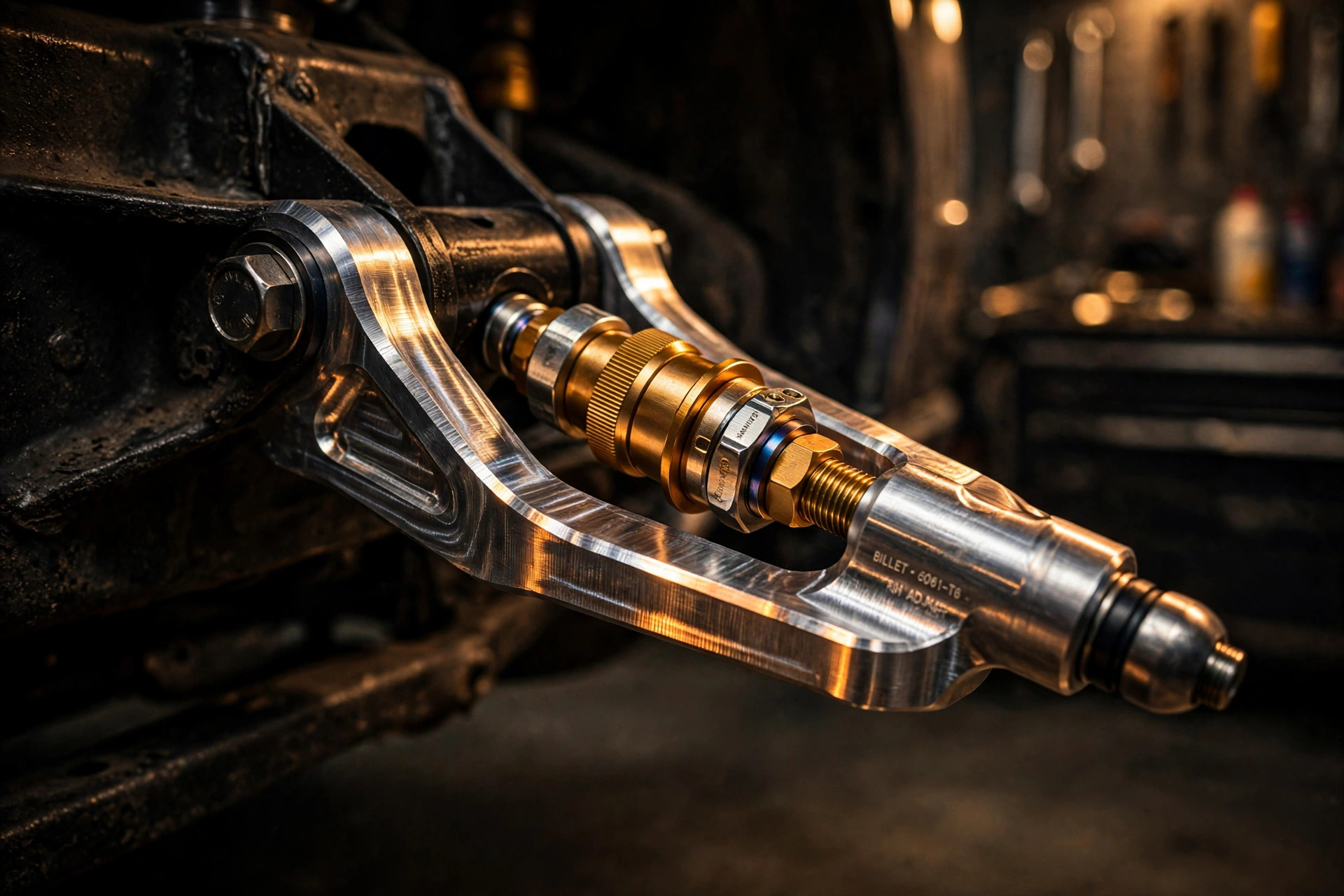
A toe link is about as unglamorous as hardware gets. It is a short bar that ties the rear knuckle to the subframe, locating the wheel fore and aft and setting the static toe angle, which is to say, whether the wheel points a hair inward or outward at rest, and nothing about it photographs well. And yet the entire Precision Package alignment window depends on it, because a toe link is also the part that decides whether your alignment survives the first corner.
Every suspension link flexes under load: corner, brake, hit a bump mid-apex, and the forces running through the rear suspension try to twist the knuckle around every bushing and joint in the chain. When the toe link deflects, the wheel steers itself without any input from the driver, a phenomenon suspension engineers call compliance steer. A little of it is benign; too much of it makes the rear feel vague at exactly the moment you are asking it for grip, and then unpredictable a heartbeat later when the load comes off and the geometry snaps back. Stiffness in the right places is the cure: not every link, just the ones in the load paths that define the geometry you care about.
This is why the missing parts were billet aluminum, not the factory steel pieces they replace. A machined billet link carries two advantages over a stamped or welded steel one, and only one of them is weight. Machining from a solid billet means tighter dimensional tolerances and no welds to fatigue, which means the link behaves the same on every car, in both directions, hot or cold. Stiffer and more repeatable geometry is what lets Cadillac spec a more aggressive track alignment in the first place. That aggressive alignment is impossible with the standard link because the standard link would not hold it. Take that sentence seriously, because it is the whole story: the Precision Package does not include the billet toe links as jewelry. It includes them because the alignment the package sells cannot exist without them. Which is also why eleven cars shipped without them triggered a customer satisfaction program rather than a shrug. GM is not going to let eleven $18,000 alignment promises drive around on steel.
The $18,000 chassis, itemized
Read the Precision Package's parts list and it stops reading like an option sheet and starts reading like a manifesto: stiffer springs, a larger front stabilizer bar, revised bushings throughout, front knuckles redesigned to accept more aggressive camber, rear knuckles with increased-rate bushings on the upper and lower trailing links, revised bushings on the front ride links and rear lateral links for reduced compliance, recalibrated Magnetic Ride Control dampers, revised steering and chassis calibrations, adjusted electronic limited-slip differential mapping, carbon ceramic brakes, and the billet aluminum rear toe links that Cadillac's own materials describe as "unique" to the package.
Notice what is not on the list: power. Package or no package, the LT4 makes 668 horsepower and 659 pound-feet, and the package never touches it. That restraint is deliberate, and it is the opposite of how this segment usually works, where the expensive chassis option always drags along a power bump to justify itself on a spec sheet. Cadillac instead spent the eighteen thousand on geometry, damping, and the calibration of everything between the steering wheel and the contact patch. What that restraint produces is a car whose track advantage comes from what the driver feels, not what the brochure prints. Reviewers keep noticing this, which is presumably the point: The Drive named the Blackwing its Best Performance Car of 2026 and then its overall 2026 Car of the Year, and you do not win both of those on horsepower.
One man, one engine
The engine deserves its own paragraph because GM builds it like nobody else builds a mass-produced V8. Every LT4 destined for the Blackwing is assembled by a single technician at the Performance Build Center inside the Bowling Green Assembly plant, the same facility that builds the LT6 for the Z06 and the LT7 for the ZR1. One builder, start to finish, and when they are done they sign a plaque that gets mounted on the supercharger lid, in a machined spot Cadillac cut specifically for it. Your engine comes with a name on it.
Cadillac borrowed the philosophy openly from AMG's "one man, one engine" program, and it raises an honest question: does a single builder make a better engine than an assembly line? The engineering answer is narrower than the marketing suggests. A single builder does not produce tighter clearances than a good automated line. What it produces is accountability and a different failure distribution, because every engine gets the same pair of hands through every step, and the signature makes the work personal. The plaque is not metrology; it is a contract. And in a car that also asks you to row your own gears, the contract fits: this machine keeps asking a human being to take responsibility for something.
The gearbox nobody else would build
Speaking of asking humans to take responsibility. The six-speed manual is standard equipment, a Tremec TR-6060 with no-lift shifting and active rev matching, and roughly half of Blackwing buyers chose it in 2023, a take rate that would make a European product planner weep, which Cadillac kept through the facelift anyway. On paper the manual is $6,275 cheaper than the ten-speed automatic, once you account for the transmission cost and the Super Cruise the auto requires, and it gives up not a single horsepower. That math runs backward from the usual enthusiast tax, and it has produced a strange little fact reported this October: as of an August inventory check, only 64 new manuals existed nationwide, with production of this generation ending by year-end 2026, so scarcity is doing what scarcity does.
None of this is nostalgia marketing: a manual in this car is an engineering decision with a technical defense. The TR-6060's torque capacity comfortably exceeds what the automatic needs a torque converter to manage, no-lift shift keeps boost on during gear changes in a way no torque-converter car can match, and active rev matching removes the only part of heel-and-toe that actually requires practice. It is not a heritage gesture; the Blackwing's manual is the transmission the chassis was tuned around.
We are not competing head-to-head with anyone anymore
Which brings us to the interview. On The Drivecast in mid-October, Tony Roma, the executive chief engineer for Corvette and GM performance cars, was asked how GM sees the brand value of a V8-powered luxury sedan with a manual transmission in 2026. His answer deserves quoting in full, because it is the clearest statement of product philosophy any Detroit executive has made in years: "We're not competing head-to-head with anyone anymore. Name me another rear-wheel drive manual, nimble sedan?" Then this: "With Blackwing and with CT5 in general, we're making a car that we want to buy."
Read that twice, because it inverts the usual logic. For thirty years the American performance sedan existed to beat the Germans at their own game: same benchmarks, same lap times, same comparison-test victories, usually with more displacement and less refinement. Roma is announcing the end of that project. The Blackwing is not the answer to the M5. It is the car Cadillac's engineers would build if nobody were comparing it to anything, which is why it has a hand-built supercharged V8 and a manual gearbox and billet suspension links in 2026, a combination no benchmark would ever produce. Benchmarks converge, and taste does not.
This is also why the toe-link bulletin matters more than it looks. A company chasing benchmarks does not issue a customer satisfaction program for eleven missing toe links. It quietly ships the cars and fixes the paperwork. GM did the opposite, and the program runs through October 31, 2028, which is a long time to keep a promise about a part nobody photographs. The bulletin is the institutional version of Roma's quote: the car is what it is, down to the last link, and the people building it refuse to ship the version that is not.
What survives
The current car is the final send-off for the combustion V series, and this generation's production ends with 2026. But Roma confirmed more than a philosophy on that podcast. A next-generation CT5 family, including the CT5-V and the Blackwing, is confirmed on a rear-wheel-drive platform, and the CT5-V is slated to keep a naturally aspirated V8 with a manual option. Cadillac's Jaclyn McQuaid said it separately and more bluntly: future Cadillacs may someday arrive without steering wheels, and when that day comes, "if someone wants to drive a V Blackwing, they're going to be able to drive a Blackwing."
Do not misread that as a guarantee of the current formula. McQuaid's promise covers the ability to drive a Blackwing, not the hand-built supercharged V8 and the Tremec that define what driving one means today. The next car gets a naturally aspirated V8, which is a different engineering answer to a different regulatory world. Supercharging buys torque density and response at the cost of complexity and heat. A naturally aspirated V8 in 2027 or 2028 will be about throttle linearity and character, and possibly about surviving emissions rules that a blown 6.2 cannot. The formula changes; the intent, if Roma is telling the truth, does not.
And here is the uncomfortable thought that follows the philosophy to its conclusion: if Cadillac is really building the car its engineers want to buy, then the missing toe links were a defect in exactly the way that matters most. Not a safety defect but a philosophical one. Eleven cars left the factory as the benchmark-chasers' version of the Blackwing, aligned for the steel link, missing the part that makes the Precision Package's geometry real. GM is now spending two years putting the missing links back. You could call that overkill, or you could call it the billet standard.
| Specification | 2026 Cadillac CT5-V Blackwing |
|---|---|
| Engine | LT4 6.2L supercharged V8, hand-assembled by a single builder at the Bowling Green Performance Build Center; signed plaque on supercharger lid |
| Output | 668 hp, 659 lb-ft of torque; 0-60 mph ~3.4 seconds; top speed 200 mph |
| Supercharger | Eaton TVS R1740, 1.7L, direct injection only (covered in our Eaton TVS piece) |
| Transmission | Tremec TR-6060 six-speed manual standard (no-lift shift, active rev matching); 10-speed automatic optional; ~50% manual take rate in 2023 |
| Platform / assembly | GM Alpha 2; Lansing Grand River Assembly, Michigan |
| Precision Package | $18,000 option (2025 MY onward): stiffer springs, larger front stabilizer bar, revised bushings, redesigned front knuckles for aggressive camber, increased-rate rear knuckle bushings, unique billet aluminum rear toe links, recalibrated Magnetic Ride Control, revised steering/chassis calibrations, eLSD adjustments, carbon ceramic brakes |
| Service bulletin N262573420 | Issued October 8, 2026; 11 units delivered without the billet aluminum rear toe links; remedy: part 85829248 (two assemblies) plus four bolts, free through October 31, 2028 |
| Accolades | The Drive 2026 Car of the Year and Best Performance Car of 2026 |
| Next generation | Confirmed: next-gen CT5 family on RWD platform; CT5-V slated for naturally aspirated V8 with manual option (per Tony Roma, Oct 2026) |
| Unresolved | Next-generation timing, displacement, and output unannounced; McQuaid's "drive a Blackwing" promise does not lock in the current powertrain formula; 0-60 mph quoted as 3.4 s by one dealer spec chart and 3.7 s by another outlet |
Honesty block: This article is based on reporting from gmauthority.com (service bulletin N262573420, October 26, 2026), thedrive.com (Tony Roma Drivecast interview, October 15, 2026), stickshifting.com (Jaclyn McQuaid remarks, October 23, 2026), carbuzz.com (last manual V8 sedan, October 25, 2026), hotcars.com (manual pricing analysis, October 25, 2026), cadillac.com (CT5-V Blackwing Precision Package contents), and topspeed.com (single-builder LT4 assembly, March 2021, via Blackwing chief engineer Mirza Grebovic). I have not driven the CT5-V Blackwing, and the compliance-steer explanation is standard suspension engineering applied to the published Precision Package hardware, not a measurement. Earlier Efficient Design coverage of this car: the hand-built LT4, the Eaton TVS supercharger, and the F1 Collector Series Precision Package variant. The next-generation powertrain claims are per Roma's interview and remain unannounced by GM as formal product specifications.
Eleven cars, one bulletin, zero compromises. The Blackwing's whole argument is that the details nobody photographs are the ones that make the car, and now there is a service bulletin to prove it. Somewhere in Michigan, eleven toe links are riding in trunks toward their dealerships, and when they are bolted on, eleven cars become what they were supposed to be all along. Cadillac quit chasing BMW. What it is chasing instead is harder to photograph and, on the evidence, harder to let go.