The 888-Horsepower Refusal: Bentley's First EV Is Built Around Restraint
Bentley unveiled the Torcal on September 23, its first fully electric car in a century-plus of building cars. It shares its bones with the Porsche Cayenne Electric, rides on the first fully active suspension the company has ever fitted, and deliberately leaves horsepower on the table. This is a car engineered around what it refused to do.
What matters is the number that is missing
Read the launch coverage and the headline is 888 PS. Then 1,350 Nm of torque, the highest figure any Bentley has ever produced, with launch control engaged. Then 2.8 seconds to 60. All true, all beside the point. What caught my attention in the September 23 reveal was quieter: Bentley admits the platform could support well over 1,000 horsepower, and chose not to build that car. Most buyers, the company said, find anything faster uncomfortable in a car this size.
An automaker publicly announcing it left power on the table is rare enough to treat as an engineering decision rather than modesty. Every system on the Torcal reads that way. Every major system is a refusal. A battery sized for dynamics, not the spec sheet. A suspension with no anti-roll bars, on purpose. A cabin that rejects the passenger screen everyone else is installing. A soundtrack composed by musicians instead of synthesized in a lab. If the 2020s had a design philosophy for luxury EVs, it was more: more power, more range, more screens, more theater. Bentley built the counterargument.
I should be clear about what this article is not. Nobody outside Crewe has driven the Torcal, myself included, and every figure below is a launch claim, not a measurement. What interests me here is not whether the numbers are true but what the choices behind them reveal about how a century-old luxury brand thinks an electric car should behave.
Same bones, opposite brief
Under the floor sits Volkswagen Group's Premium Platform Electric, the same PPE hardware that carries the Porsche Cayenne Electric. Sharing platforms inside the group is old news. What is unusual is how openly the two cars diverge from identical starting material.
Porsche's brief for the Cayenne Electric is clinical German precision and razor-sharp lap times, to borrow the industry shorthand. Bentley took one look at Stuttgart's hyper-stiff chassis tuning and decided all that aggression was the wrong brief entirely. Chassis engineers softened the dual-valve active suspension and intentionally reintroduced controlled body roll and pitch, so the car heaves progressively through a corner like a living thing instead of cornering flat like a slot car.
Read that again, because it is genuinely strange. Consider the roll that every performance chassis for thirty years has been tuned to eliminate: it is being tuned back in, deliberately, as a luxury feature. Body roll is information. It tells your inner ear where the weight is going before the tires run out of opinions. A Bentley has always been a car that moves with its mass rather than against it, and the engineers decided that feeling was worth protecting even when the hardware could erase it.
The magic carpet with no roll bars
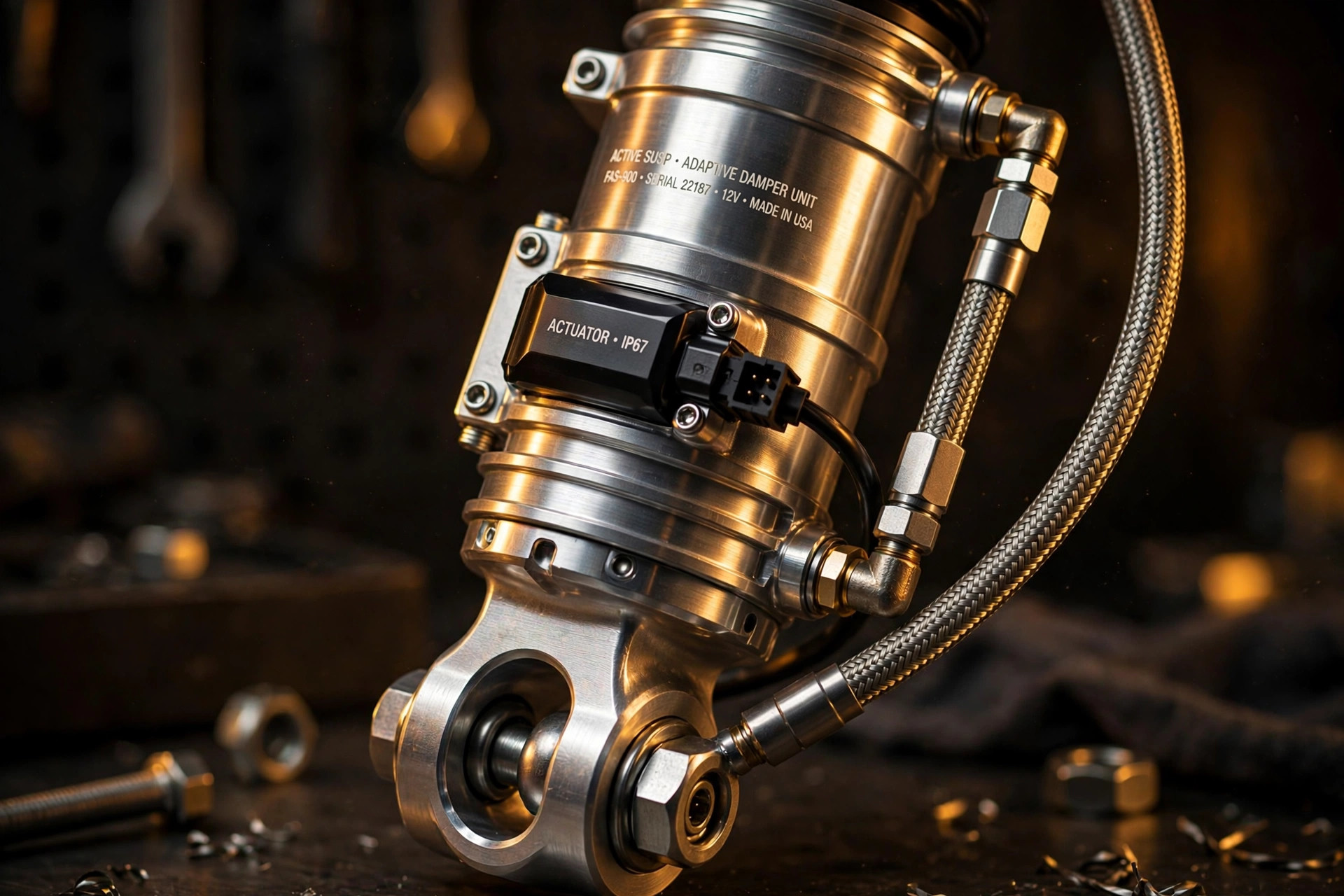
This is the first Bentley with fully active suspension, and it deletes the anti-roll bars entirely. Each damper raises and lowers its corner independently, which means roll control happens through software and hydraulics rather than a steel bar tying the left and right sides together. The adaptive dampers are two-valve units, and the brief, as Bentley describes it, is the comfort of a Flying Spur combined with the dynamic character of a Continental GT Speed.
That is an ambitious sentence for a car that weighs 2,700 kg. Ambitious, and maybe honest, because the hardware to back it up is real: standard electronic all-wheel steering with up to five degrees of rear-axle angle shrinks the turning circle to 11.1 meters, roughly what a compact hatchback needs, on a car five meters long. Brakes are 420 mm iron discs up front and 370 mm at the rear, with an optional Carbon Silicon Carbide system stepping up to 440 mm and 410 mm.
There is a deeper engineering point here about what active suspension actually buys you. A conventional anti-roll bar is a compromise cast in steel: stiff enough to control roll in corners, soft enough to ride over bumps, and wrong for both most of the time. Fully active dampers let each corner do what the road under it demands, in real time, with no mechanical coupling forcing the left side to care what the right side is doing. That magic carpet glide is not marketing language for soft springs. It is what you get when the suspension stops being a fixed argument and starts being a conversation.
Restraint as a specification
Two permanent-magnet synchronous motors drive all four wheels. They are oil-filled units with dry sumps, a detail that matters more than it sounds: the oil bath cools the windings and bearings directly, which is how you sustain repeated hard acceleration without the thermal derating that quietly kneecaps lesser EVs on their third launch. In base form, the Torcal makes 821 PS and 1,194 Nm, good for 3.3 seconds to 60 and 155 mph. Step up to the Torcal S and those figures become 888 PS and 1,350 Nm with launch control, 2.8 seconds, 162 mph.
Respectable. And then the refusal: the platform could do more, and Bentley stopped. I find this admirable, and I am not sure the market will reward it, because the entire EV era has trained buyers to read bigger numbers as better engineering. Bentley's bet is that its buyers read restraint as confidence. Whether the spec-sheet race ends at Crewe's door is an open question, and I will not pretend the answer is obvious.
Same story with the battery. A 113 kWh pack built from 192 pouch cells on an 800-volt architecture, good for 375 miles on the WLTP cycle, charging at up to 400 kW for a 10-to-80 percent stop in about 16 minutes. Some long-range rivals quote theoretical figures near 500 miles. Bentley refused to install the oversized battery that would have bought that number and ruined the car's dynamics. Weight is the enemy of everything a Bentley is supposed to be, and 2,700 kg was apparently as far as they were willing to go. The pack carries a 10-year, 100,000-mile warranty, which is the quietest flex in the whole specification.
A V8 soundtrack, performed by actual humans
Sound is where electric luxury cars usually embarrass themselves. Most attempts default to a synthesized whoosh that sounds like a video game with the physics turned off. Bentley went the eccentric route and hired musicians.
Bentley's Dynamic Symphony was built in a studio with bass guitars, violas, and drums, and the baseline tempo is the deep rhythmic cadence of the historic 6.75-liter pushrod V8, the engine that defined Bentley's sound for decades. A low-frequency mechanical pulse rises with speed and throttle demand. It can be silenced with a tap. Even the turn signal is a recording of a hammer striking leather in the upholstery shop. If you do not smile at that detail, this car is not for you.
Worth noting the contrast with Ferrari's approach on the Luce, which uses sensors on the powertrain to amplify the actual vibrations of its motors rather than playing any composed soundtrack at all. Two philosophies, both recent, both from brands whose identities were built on engine noise: Ferrari captures what is there, Bentley composes what it misses. I lean toward Bentley's, if only because amplifying real motor whine treats the EV powertrain as interesting, and composing a pulse admits it is not, which is at least honest about what a 6.75-liter V8 was actually doing for the cabin.
The cabin as materials science
Step over the illuminated treadplates and the refusals continue. There is a sweeping curved OLED screen ahead of the driver, and pointedly no passenger display. Bentley's interior team argued, on the record, that front-seat copilot monitors add zero value until cars can drive themselves at Level 4 autonomy. Fair point, and a brave one to make out loud in 2026.
What your fingers find instead is cold knurled metal: real knobs, traditional mechanical bullseye vents, physical toggle switches. Then the materials work, which is where Mulliner earns its keep. Bentley collaborated with the historic Somerset mill Fox Brothers to weave what it calls the world's first automotive-certified 100 percent Merino wool fabric, offered alongside 15 shades of olive-tanned hides and Dinamica microfiber. Then there is the Ombré Walnut veneer, which compresses up to 1,000 wafer-thin layers of scrap walnut and recycled craft paper, sliced under 0.04 inches thick, into a seamless gradient from deep smoky black to warm natural timber. Waste wood and craft paper, cut thin enough to become a luxury surface. That is materials science wearing a Savile Row suit.
Context and the close
The name comes from El Torcal de Antequera, a series of rock formations in Spain. Yasu Jordan Sato designed the car, with design director Robin Page pulling cues from last year's EXP 15 concept: an upright nose that nods to the legendary Turbo R, twin vertical LED elements framing horizontal running lamps, an illuminated grille surround that has become the visual signature, and a tapering cabin the designers call the "resting beast," modeled on the muscular stance of Woolf Barnato's 1930 Speed Six. It is also the first Bentley to wear the brand's redesigned emblem. At five meters, it is the shortest four-door Bentley makes.
Business context matters here. Bentley walked back its pledge to go fully electric by 2030, and the Torcal will be the company's only pure EV for the rest of this decade. V8 plug-in hybrids continue alongside it, and the Crewe lines can now assemble electric powertrains next to combustion ones on the same floor. This is not a transition. It is an addition, aimed at buyers who find a Porsche badge too clinical and would never park a mass-market German commuter in their driveway.
So what is the argument here? That the most interesting engineering in a 2026 luxury EV is subtractive. Bentley took a platform that could have been a 1,000-horsepower spec-sheet weapon and tuned it for heave and roll. It took a battery format that could have chased 500 miles and sized it for 2,700 kg. It took the industry's screen maximalism and answered with knurled metal. Every other luxury EV on sale is an argument that the future is more. It is also the first luxury EV built on the suspicion that the future might be less, done properly.
Whether that suspicion survives contact with the market, I cannot tell you. I can tell you that in a year when every launch was louder than the last, the most technically ambitious chassis Bentley has ever built was tuned to feel like a wave. That is worth paying attention to.
| Specification | Torcal | Torcal S |
|---|---|---|
| Motors | 2x oil-filled permanent-magnet synchronous, dry sump | 2x oil-filled permanent-magnet synchronous, dry sump |
| Power | 821 PS (810 bhp / 604 kW) | 888 PS (876 bhp / 653 kW), launch control |
| Torque | 1,194 Nm | 1,350 Nm (highest of any Bentley) |
| 0-60 mph | 3.3 s | 2.8 s |
| Top speed | 155 mph (250 km/h) | 162 mph (260 km/h) |
| Battery | 113 kWh, 192 pouch cells, 800 V | |
| Range (WLTP) | 375 miles (600 km) | |
| Charging | 400 kW DC, 10-80% in ~16 min, ~100 mi in 7 min | |
| Suspension | Fully active, adaptive two-valve dampers, no anti-roll bars | |
| Rear steering | Electronic all-wheel steering, up to 5 degrees, 11.1 m turning circle | |
| Brakes | 420 mm / 370 mm iron standard; 440 mm / 410 mm Carbon Silicon Carbide optional | |
| Dimensions | 5,008 mm L x 2,025 mm W x 1,677 mm H, 3,023 mm wheelbase | |
| Kerb weight | 2,700 kg | |
| Cargo | 460 L boot + 90 L frunk | |
| Price (US) | $238,000 | $273,700 |
Sources: Bentley Torcal, specifications and debut (September 23, 2026); ArenaEV, Torcal chassis and launch detail; HiConsumption, Torcal active suspension and Dynamic Symphony; ThrustZone, Torcal technical specifications; MotorShow.me, London debut report.