Cars / Endurance Engineering
The Le Mans Car You Can Buy
Aston Martin's Valkyrie LM is the racing Hypercar with the ballast, muffler and FIA electronics removed. It makes 697 horsepower from a lean-burning Cosworth V12, carries no hybrid system, and ten will exist. Top Gear drove one at Monza this month. Getting closer to a Le Mans car turns out to mean much more than adding power.
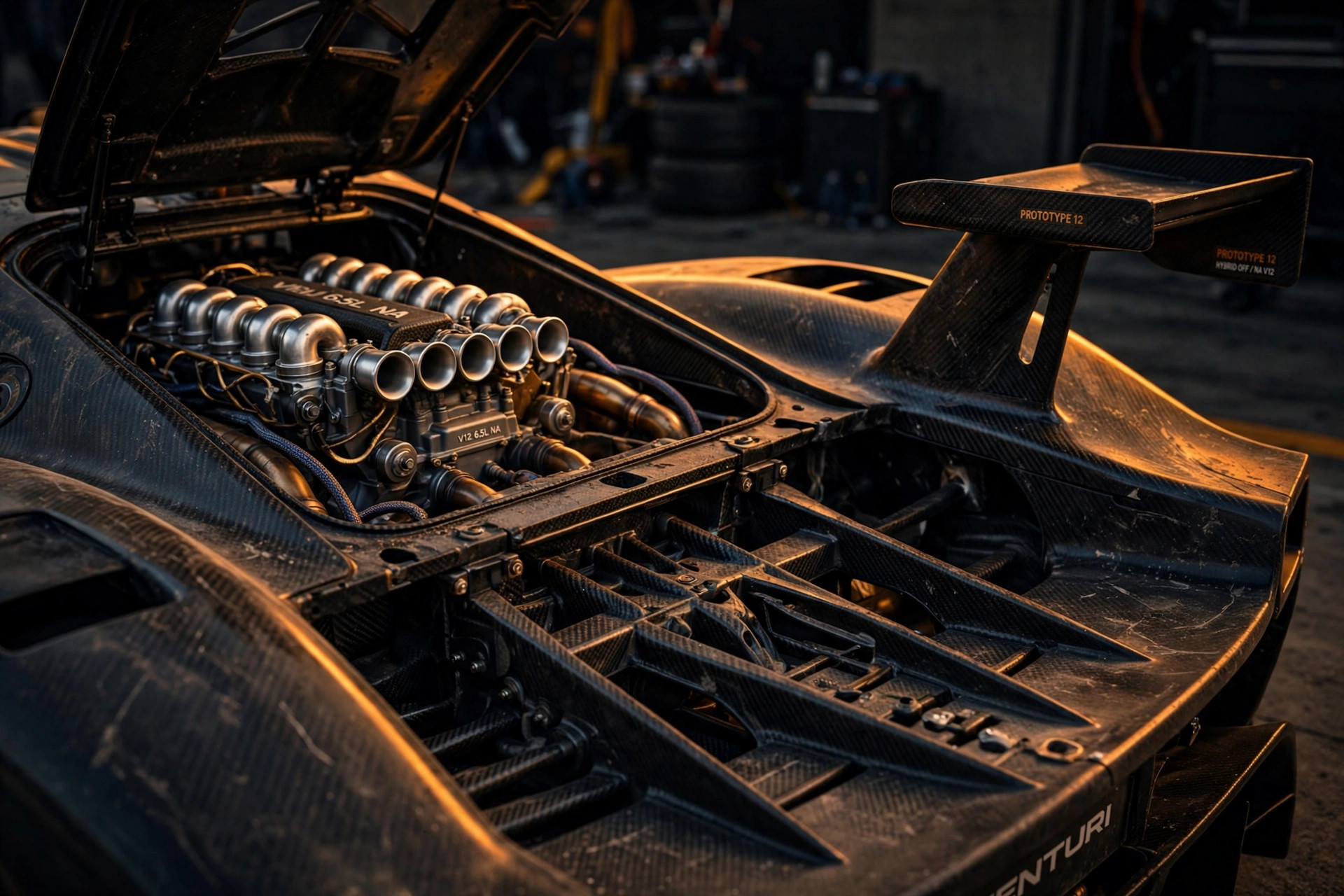
Five months after the racing version finished eighth at Le Mans, its best result yet, Top Gear took the customer version to Monza. Ollie Marriage drove the Valkyrie LM on a reduced-power engine map first, then turned it up, and the report that came back was not about speed. It was about workload: downforce pulling at his neck and face while the controls added another job to driving through the bends, with development driver Darren Turner comparing their telemetry afterward. More extreme, in this case, did not mean faster. It meant harder to drive well.
That is the honest pitch for this car, and Aston Martin deserves credit for making it. Valkyrie LM exists because the race car exists, and the race car exists because Aston Martin revived a cancelled programme in October 2023 and committed to the one idea nobody else in the Hypercar class would touch: a production-derived car, powered by a naturally aspirated V12, with no hybrid system at all.
697 horsepower, on purpose
Start with the number that looks like a mistake. A road-going Valkyrie makes 1,160 horsepower, its Cosworth 6.5-liter V12 backed by a hybrid system. LM makes 697. Nearly five hundred horsepower, gone, and the hybrid hardware with it.
Nothing here is broken. Hypercar regulations cap system output at 500 kW, about 680 PS, and the race car runs a lean-burning tune of the same RA V12 to sit inside that window and survive 24 hours flat out. LM carries the same lean-burn calibration, which is the entire point of the car: it is the race engine, not a detuned road engine pretending to be one. Adam Carter, Aston's head of endurance motorsport, put it plainly at the reveal: LM is close to identical to the race car currently competing in WEC and IMSA, with only a few minor deviations to make it a non-homologated variant customers can actually use.
What those deviations buy is worth spelling out, because each one is a piece of racing regulation deleted. Ballast is gone, so the car runs at its natural weight instead of the 1,030-kilogram regulated minimum plus mandated ballast. FIA-spec electronics are gone, replaced by open-loop torque control instead of the closed-loop system that limits torque delivery in racing trim, and the torque sensors that enforce it are gone too. Muffler is gone, which is why the LM runs straight-through exhausts and sounds the way a 11,000 rpm V12 should. And the engine runs on regular fuel instead of race-specific grades, which is the least glamorous change on the list and possibly the most telling: this is a car designed to be used at track days, not just admired in a collection.
Torque stands at 719 Nm, delivered exclusively to the rear wheels through a seven-speed sequential gearbox from Xtrac, controlled by paddle shifters. No front axle, no electric motor, no battery. In a class where every rival carries hybrid hardware, Aston Martin looked at the weight and complexity of relocating the road car's hybrid system to the front axle, adding the cooling it would need, and redesigning the car around it, and simply declined.
A V12 in a hybrid class
Refusing the hybrid was a packaging decision before it was a philosophical one, but the philosophy is what people will remember. Valkyrie AMR-LMH is the first sports prototype to race with a V12 in top-class endurance racing in 14 years, since the Peugeot 908 and the Lola-Aston Martin B09/60 in 2011. It is also the only Hypercar derived from a pre-existing production car, and the only one contesting both the FIA World Endurance Championship and IMSA. Every other car on the grid was drawn from a blank sheet as a racer. This one started life as a road car Adrian Newey co-developed, then got turned into a racer, then got turned back into something a customer can buy.
That lineage shows in the hardware. Underfloor Venturi tunnels do the downforce work, the way they do on the road car, rather than a bolted-on wing doing it all. Suspension is double wishbones front and rear with pushrod-actuated torsion bar springs and adjustable side and central dampers, which is racing-spec geometry tuned for kerbs and bumps rather than showroom ride quality. Tires are bespoke Pirelli slicks on forged aluminum wheels, 18-inch items measuring 12.5 inches wide at the front and 14 at the rear. Inside, a six-point FIA harness, fire suppression, a custom carbon fiber racing bucket, and a racing wheel with an integrated display and shift lights, because at 11,000 rpm you do not want to be guessing.
One detail deserves more attention than it gets. Despite having no hybrid system, the car can launch from a standstill without engine power, using a combined starter and alternator motor Aston Martin calls a starternator. It is a small piece of engineering that solves a real problem, getting a race car moving in the pits without a push, and it is exactly the kind of detail that separates a car built by people who race from a car built by people who only design.
What a season of racing bought
LM is not a launch-day fantasy. It is a car whose racing twin has now done two full seasons, and the results give the customer car a credibility no brochure can. Valkyrie AMR-LMH debuted at the Qatar 1812 km in February 2025, run by the Aston Martin THOR team, and in 2026 it finished eighth overall at Le Mans with Tom Gamble, Ross Gunn and Harry Tincknell in the number 007 car, the best Le Mans finish by a car derived from a production hypercar, and its fifth consecutive points finish in the championship. Sister car 009 qualified seventh and was running inside the top ten before a late technical issue dropped it to 14th. Earlier in the season the car took fourth at Spa and ninth at Imola, and at COTA in September Tincknell put the 007 on top of the Hypercar order in free practice.
None of that makes it a front-runner yet. Daily Sportscar's Le Mans preview said so directly: on paper the car has a way to go, it struggles on bumpy surfaces and over brutal kerbs, and long-run pace as conditions change will decide its races. But the trajectory is the story. A car that finished its first Le Mans in the midfield came back a year later with its best result, its best qualifying, and a season of points finishes behind it. Aston Martin is already drawing up plans to update the car for 2027. LM buyers are buying into a programme that is still climbing, not one that has peaked.
There is also the sound. Nobody who has heard the Valkyrie at full chat down the Mulsanne straight talks about anything else first. In a field of turbocharged hybrids, a naturally aspirated V12 revving past 11,000 rpm is not a performance choice. It is an identity, and it is the reason this car has fans before it has wins.
Ten cars, and a programme
Only ten Valkyrie LMs will be built, with deliveries beginning in the second quarter of 2026. Aston Martin has not announced a price, which in this segment means the number is a conversation, not a figure. What the buyers do get, beyond the car, is the Unleashed driver programme: simulator sessions, onboard video analysis, gear fitting, and F1-grade track days fully supported by Aston Martin's race engineers. Marriage's Monza test was run with exactly that support structure around it, and his verdict, that the car demands more thought the faster it goes, reads less like a warning than a description of the product. This is not a car you buy to show people. It is a car you buy to learn.
That distinction matters, because the obvious comparison is the Valkyrie AMR Pro, the earlier track-only special. AMR Pro has more power and more downforce, and it was developed before the racing programme existed. LM has less of both and something AMR Pro never had: a racing twin that finished eighth at Le Mans. Miles Hulford, who runs the programme, described the aim as creating the closest thing customers can buy to the Le Mans car, with assistance to help them manage it, rather than making it tame. Stripped bodywork at Monza exposed the LM's suspension, cooling ducts and low-mounted engine, and the message was the same one the spec sheet sends. Nothing here is hidden behind a wing or a badge. It is a race car with the rulebook items removed and a training programme attached.
Aston Martin has won Le Mans outright exactly once, in 1959, with Roy Salvadori and Carroll Shelby in a DBR1. Sixty-seven years later it is trying again with a car that started as a road car, became a racer, and is now, in ten examples, a customer car again. Most manufacturers would call that a circle. Aston Martin calls it a programme. Either way, it is the only V12 on the Hypercar grid, the only production-derived car in the class, and now the only Le Mans car you can actually buy. That is a lot of onlys for one car. They are all true.
Valkyrie LM: key figures
| Engine | Cosworth RA 6.5L naturally aspirated 65-degree V12, lean-burn tune |
|---|---|
| Power / torque | 697 bhp, 719 Nm |
| Hybrid system | None (road car: 1,160 hp combined with hybrid) |
| Transmission | Xtrac 7-speed sequential, paddle shift, rear-wheel drive |
| Suspension | Double wishbones front and rear, pushrod-actuated torsion bars, adjustable dampers |
| Tires / wheels | Bespoke Pirelli 18-inch slicks; forged aluminum, 12.5 in front, 14 in rear |
| Race weight | 1,030 kg regulated minimum (AMR-LMH); LM runs without ballast |
| Production | 10 units; deliveries from Q2 2026 with Unleashed driver programme |
| Racing record | 8th overall, 2026 Le Mans (No. 007); 5th consecutive WEC points finish; 4th at Spa 2026 |
| Distinction | Only non-hybrid Hypercar; only production-derived car in the class; only car in both WEC and IMSA |
Sources: CarBuzz, "Aston Martin Valkyrie LM Revealed," June 2025; Top Gear / Trari, "Aston Martin's Valkyrie LM gives Top Gear a mental workout," Nov 12, 2026; SportsCarDigest, "Aston Martin Podiums at Le Mans 24," Nov 20, 2026; Wikipedia, "Aston Martin Valkyrie AMR-LMH," updated Nov 2026; Motor Authority, "2025 Aston Martin Valkyrie LMH race car revealed," Feb 2025; Daily Sportscar, "2026 Le Mans Preview: Hypercar," June 2026; Goodwood, "The Aston Martin Valkyrie will race at Le Mans in 2025," Oct 2023; Top Gear India, Valkyrie LM specifications, June 2025.