Roof Off, Snorkel Fed: How Aston Martin Made the Valhalla Spider Lose Almost Nothing
Take the roof off a mid-engined supercar and three things usually go wrong at once, which is why most open-top versions read like apologies with better weather. Stiffness falls, because a coupe's roof is a structural member whether the brochure admits it or not, and engineers answer with heavy bracing in the sills and tunnel. Cooling suffers, because airflow that used to travel obediently over a fixed roofline now wanders wherever turbulence takes it. Aerodynamics change character, because a rear wing that used to sit in clean air now sits in the wake of an open cockpit. Any one of those problems is solvable. Solving all three without adding meaningful weight is the hard part, and it is exactly the claim Aston Martin is making for the Valhalla Spider.
Start with the number that frames everything else. With the roof removed, the Spider still reaches the coupe's electronically limited 217 mph, and it does so with the same plug-in hybrid powertrain: a 4.0-litre twin-turbocharged flat-plane-crank V8 sending 817 bhp to the rear wheels through an eight-speed dual-clutch transmission with an integrated electric motor, plus two more electric motors on the front axle for all-wheel drive and torque vectoring, for 1,064 bhp combined and 811 lb-ft, with 0 to 62 mph in 2.5 seconds. Nothing in that sentence changed from the coupe. That sameness is the story. A convertible that keeps the hardtop's headline numbers has either been engineered with unusual discipline or measured with unusual generosity, and the details Aston Martin has released so far point, encouragingly, toward discipline.
A tub that did not need rescuing
Convertible conversions normally begin with reinforcement, and the Valhalla Spider begins, unusually, by skipping most of it. Chief engineer Andrew Kay told evo and Magneto at a private preview that the coupe's carbon fibre tub was so stiff to begin with that Aston Martin added no heavy bracing to the sills or the transmission tunnel, and left the resin-transfer-moulded lower section unchanged. Only the upper structure was redesigned to suit the new roofline, replacing the coupe's T-bar section between the door shut-lines with a fully open cockpit. Kay's summary is worth quoting because it is refreshingly unmarketed: there is always a small change when you take the roof off, that is just physics, but a carbon tub does not really make a great deal of difference.
Weight tells the same story, with one asterisk that deserves daylight rather than a footnote. Dry weight rises from 1,655 kg for the coupe to 1,680 kg for the Spider with lightweight options fitted, a 25 kg headline gap. Kay puts the real-world increase at under 20 kg, explaining that part of the gap comes from lightweight options that are simply not offered on the Spider, plus the roof mechanisms and the extra stowage described below. Readers should hold both numbers at once: 25 kg is the like-for-like specification-table difference, under 20 kg is the engineering team's estimate of what the roof removal itself actually cost. Neither figure includes a bracing penalty, because there was almost none to include, and suspension changes are limited to fine tuning for the slight differences in weight and balance, with a slight retune of stability control to match.
What Aston Martin has not published matters as much as what it has. No torsional stiffness figure for the Spider, no percentage loss against the coupe, no deflection number at any load case. Kay says the penalty is minimal, and the absence of added bracing supports that claim structurally, since a tub that needed rescuing would show its rescue work in the sills. Still, minimal is a word, not a measurement, and this article will not convert it into one. Until an independent test twists a Spider on a rig, or at least drives one hard over broken tarmac with a coupe back to back, stiffness stays in the credible-but-unmeasured column, alongside the many launch claims that sound right and await a second witness.
Feeding a snorkel with no roof above it
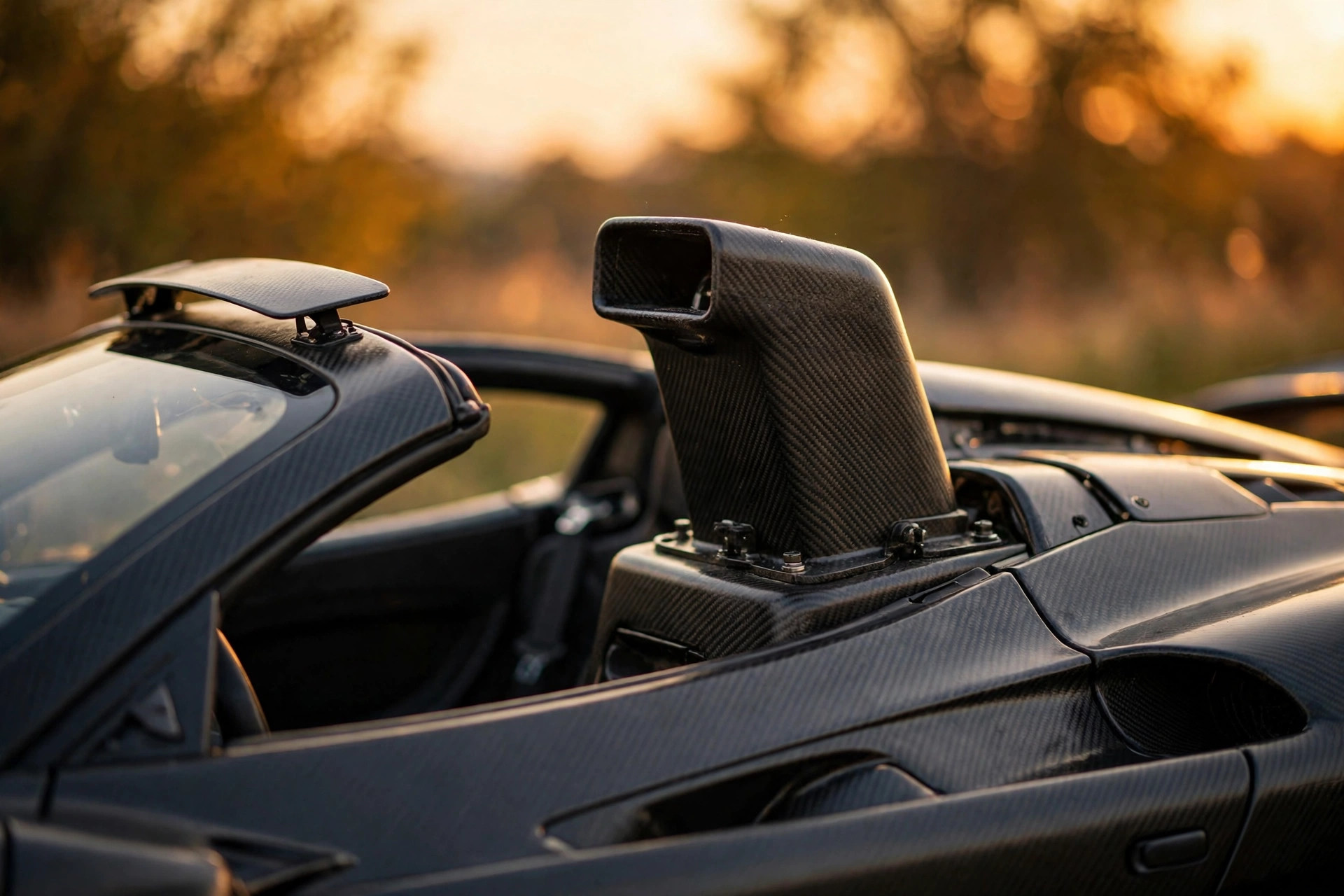
If stiffness was the problem Aston Martin expected, cooling was the problem that actually fought back. Readers of this site's earlier Valhalla article will remember the coupe's thermal architecture: a roof snorkel feeds the turbochargers through air boxes and two large charge-air coolers mounted directly above the V8, plus further cooling elements, all hidden inside bodywork that doubles as ducting. Remove the roof and that carefully marshalled airflow stops cooperating. Air coming off the windscreen lifts up and over the car instead of funnelling into the intake, and Kay is blunt about the consequence: the car does not work unless you feed that snorkel, which he calls probably the single greatest challenge in creating the Spider.
One obvious fix would have been to move the intake, or to accept a power cut with the roof off, and Aston Martin did neither. Instead, the Spider gets a snorkel reprofiled and raised 35 mm, plus a clip-on wind deflector at the top of the windscreen that does two jobs that rarely share a part. It lifts air over the occupants' heads for comfort, which is what a wind deflector normally does, and it channels cooling air down into the snorkel, which is what an intake duct normally does. Kay says occupants can actually feel the shape of the airflow in the cabin, and that the reworked snorkel draws in slightly more air than the coupe's. Comfort device and engine component, fused into one clip-on panel: that is a neat piece of packaging, and also a revealing one, because it makes a small piece of trim load-bearing for the powertrain in a way no coupe owner ever has to think about.
Follow that logic to its sharp edge, because it is the Spider's most honest detail. Without the wind deflector installed, evo reports, the Valhalla Spider is restricted to parking speed only. Not reduced power, not a warning light, but parking speed, which tells you everything about how seriously the snorkel problem was taken and how completely the deflector solves it. A part that can be forgotten in a garage now gates the car's entire performance envelope, and Aston Martin's answer to forgetfulness is stowage: the deflector folds into three parts and slots into the new sill compartments, so it travels with the car rather than living on a shelf. Clever. Also, for any owner who has ever left a removable roof panel at home on a sunny day, faintly ominous.
Rebalancing aero instead of chasing downforce
Aero, the third problem, got the most philosophically interesting answer. With the roof off, airflow over the rear turns messier, depriving the rear wing of the clean air it needs, and a lazy engineering response would be to add front downforce until the numbers look familiar again. Aston Martin did the opposite. Because the car detects whether a roof is fitted, its active aerodynamics and stability control continuously rebalance themselves, and when the rear wing gets less switched on, the front aero is wound down to match. Kay's target is a 40:60 aero balance, front to rear, deliberately the same as the car's weight distribution, so the car keeps feeling natural through the speed range instead of suddenly changing character as speed rises.
Pause on that choice, because it inverts the usual supercar instinct. Maximum downforce is easy to sell and easy to measure, and the Spider's headline figure, more than 600 kg, is available only with a roof fitted, per Magneto's preview reporting. Roof off, Aston Martin publishes no downforce total at all, only a balance target and a promise of consistency. That restraint is either admirable engineering honesty or a convenient way to avoid an unimpressive number, and readers should keep both readings open until instrumented testing exists. What can be said now is structural: a car that holds its balance by giving up front downforce will feel more predictable than a car that chases a big total with a lopsided split, and predictability at 217 mph with no roof is worth more than a brochure figure. Character, in this case, is a measurable handling property, not a marketing word.
Wind management helps the aero story in a second, subtler way. The same deflector that feeds the snorkel also pulls air down through the centre of the car, helping flow reattach to the rear more quickly after the cockpit disturbance, which is why Magneto describes it as pulling double duty for both cooling and rear-wing behaviour. One small panel, three jobs: occupant comfort, intake feed, and flow reattachment. When a single component carries that much of a car's open-top behaviour, its design deserves more attention than the roof panels it replaces, and the Spider's deflector may be the most consequential piece of plastic on any supercar launched this year.
Three roofs, three different cars
Roof choice, meanwhile, turns the Spider into three different cars depending on what is fitted, and buyers should understand the trade before the romance of open-air driving papers over it. A single-panel carbon fibre hardtop, standard in the United States and optional elsewhere, carries no top-speed penalty at all: 217 mph, roof on or roof off. A semi-soft roof, with solid cant rails and a solid element in the middle, stows behind the passenger seat at the cost of some seat travel and limits top speed to 124 mph (200 kph). An emergency shower cover protects the interior when parked and is not intended to be fitted while driving. None of the roofs stow in a boot, because there is no boot, a Valhalla trait the Spider inherits without apology.
Packaging engineers found consolation in the sills. Going over the package with a fine-tooth comb, Aston Martin discovered unused volume in the sill area behind the doors, inboard of the ducts feeding the transmission oil cooler on one side and engine cooling on the other, and turned it into a 15-litre cubby on each side. Those cubbies house the folded deflector, a first-aid kit, and a warning triangle, and they explain part of the Spider's weight gain: stowage space, like roof mechanisms, is mass that the coupe never had to carry. Fifteen litres per side will not swallow a weekend bag, and nobody should pretend otherwise, but as a home for the one part the car cannot be driven hard without, the sill cubby is the right answer to the right problem, found in space that was already there.
Fixing the coupe's annoyances while the roof was off anyway
With the structure already open for surgery, Aston Martin used the Spider to fix complaints coupe owners had already voiced, which is the kind of opportunistic improvement that separates a thoughtful variant from a cynical one. Dihedral doors are now frameless, with revised kinematics that make them easier to swing closed than the coupe's muscle-demanding originals, while the hinge line stays unchanged. Door glass top edges rise by approximately 20 mm, easing entry and exit with a roof fitted. Inside, new carbon fibre Touring seats come as standard, with lower-cut bolsters that stop digging into larger drivers' hips on the climb in, while the original sports seats remain available at no extra cost. None of this is headline engineering. All of it is the difference between a car that impresses on a preview stand and a car that stays pleasant on the third hour of ownership.
One more usability detail deserves a paragraph, because it shows how far forward the Valhalla's cabin already sits. Kay notes that the low, cab-forward windscreen header height has been maintained from the coupe, so the header sits far forward rather than directly overhead, giving what he describes as lots of sunshine and a more open, airy feeling than typical convertibles, where the header hovers right over the occupants' heads. Roof off, that geometry means the open-air sensation starts before the wind does: less roof structure in the sightline, more sky in the periphery, and a deflector doing the wind management instead of a tall header doing it by obstruction. Small geometry, large sensation, and a reminder that convertible pleasure is as much about sightlines as about airflow.
What is not settled yet
Three open questions deserve space, because launch coverage mostly skips them in favour of the 217 mph headline. First is stiffness, already flagged: no published figure, only a credible structural argument and a chief engineer's assurance. Second is roof-off downforce: the 600 kg-plus total belongs to the roof-fitted configuration, the roof-off total is unpublished, and the 40:60 balance target is a design intent, not a measured curve at speed. Third is the deflector's real-world robustness: a clip-on panel that gates full performance will face kerbside handling, luggage-loading knocks, and owners in a hurry, and its latches, seals, and three-part fold will either survive that life or become a service story. Winter testing, which Kay jokes was bloody freezing, proves cold-weather development happened; it does not prove the deflector enjoys being folded by cold hands in a hurry.
Production context rounds out the honest picture. Total Valhalla production stays capped at 999 cars, with the Spider accounting for around one in four, and customer deliveries begin around autumn 2027, with private viewings already underway ahead of the October 30 public debut. Development took approximately four years, according to evo, which reframes the Spider as a parallel programme rather than a late afterthought, and explains why its solutions feel integrated instead of bolted on. No independent drive review exists yet, no instrumented test has verified the balance claim or the snorkel airflow at speed, and this article, like every other account published in the reveal week, is working from manufacturer briefings and preview access, not from a car driven at its limit. Saying so is not false modesty. It is the difference between engineering analysis and press-release transcription.
| Specification | Aston Martin Valhalla Spider |
|---|---|
| Reveal | October 27, 2026; public debut October 30, 2026 at the Concours at Wynn Las Vegas; private viewings already underway |
| Powertrain | 4.0-litre twin-turbocharged flat-plane-crank V8, 817 bhp to rear wheels via eight-speed dual-clutch transmission with integrated electric motor; two front electric motors for all-wheel drive and torque vectoring; 1,064 bhp combined, 811 lb-ft |
| Performance | 0 to 62 mph in 2.5 seconds; 217 mph electronically limited, roof off or with carbon hardtop; 124 mph (200 kph) with fabric soft top fitted |
| Weight | 1,680 kg dry with lightweight options fitted, against 1,655 kg for the coupe; real-world increase under 20 kg per chief engineer Andrew Kay, with part of the headline gap from lightweight options not offered on the Spider |
| Structure | Coupe carbon fibre tub retained; resin-transfer-moulded lower section unchanged; no added sill or transmission-tunnel bracing; upper structure redesigned, coupe T-bar replaced by open cockpit; no published stiffness figure |
| Snorkel and deflector | Roof snorkel feeds turbochargers and charge-air coolers above the V8; Spider snorkel reprofiled and raised 35 mm; clip-on windscreen-top deflector lifts air over occupants and channels cooling air into the snorkel, drawing slightly more air than the coupe; without deflector, parking speed only; deflector folds in three and stows in sill cubbies |
| Aerodynamics | Active front and rear aero plus stability control recalibrated and roof-aware; front aero wound down when rear wing loses clean air roof off; 40:60 front-to-rear aero balance target matching weight distribution; more than 600 kg downforce with a roof fitted; roof-off downforce total unpublished |
| Roofs | Single-panel carbon fibre hardtop (standard in the United States, full 217 mph); semi-soft roof with solid cant rails and solid centre element, stows behind passenger seat, 124 mph limit; emergency shower cover for parked use only; no boot |
| Stowage | 15-litre cubby in each sill, inboard of engine and transmission oil-cooler ducts; houses folded deflector, first-aid kit, warning triangle |
| Doors and seats | Frameless carbon fibre dihedral doors, hinge line unchanged, revised kinematics for easier closing; door glass top edge raised approximately 20 mm; carbon fibre Touring seats standard with lower-cut bolsters, original sports seats optional at no extra cost |
| Production | Within 999-car total Valhalla run, Spider around one in four; customer deliveries around autumn 2027; development approximately four years |
| Unresolved | No published torsional stiffness figure; no roof-off downforce total; no independent drive review or instrumented test yet; deflector durability in daily use unproven |
Honesty block: This article is based on coverage from Magneto Magazine (October 28, 2026), evo (October 28, 2026), PistonHeads, and Auto Express (October 28, 2026), plus Aston Martin preview briefings as reported by those outlets, with chief engineer Andrew Kay as the principal engineering source. I have not driven this car, and no independent review exists yet. Stiffness, roof-off downforce, and snorkel airflow at speed are manufacturer claims and design targets, not independently measured results, and the under-20 kg weight figure is Kay's estimate against a 25 kg specification-table difference. This site's earlier Valhalla article covers the coupe's seven cooling paths in detail; the Spider article focuses on what removing the roof changed.
Most convertibles ask you to accept a compromise and then dress it up as character. Aston Martin's Spider asks a sharper question instead: what if the roof was never load-bearing for the car's identity, only for its airflow, and what if airflow could be managed by a smarter panel rather than a heavier structure? A tub that needed no rescue, a deflector that feeds an engine, and aero that gives up downforce to keep its balance: the Spider answers with engineering, not adjectives, and if the independent tests confirm even most of it, the fastest open-top Aston Martin ever will also be one of the least compromised convertibles ever built.