Sixty-Five Facets in the Second-Hardest Material on Earth: How ArtyA Sculpted a Watch Case from Silicon Carbide
Sapphire cases are difficult. Moissanite cases are borderline impossible. ArtyA made one anyway, carving a tonneau from a crystal that sits half a Mohs point below diamond and decomposes before it melts.
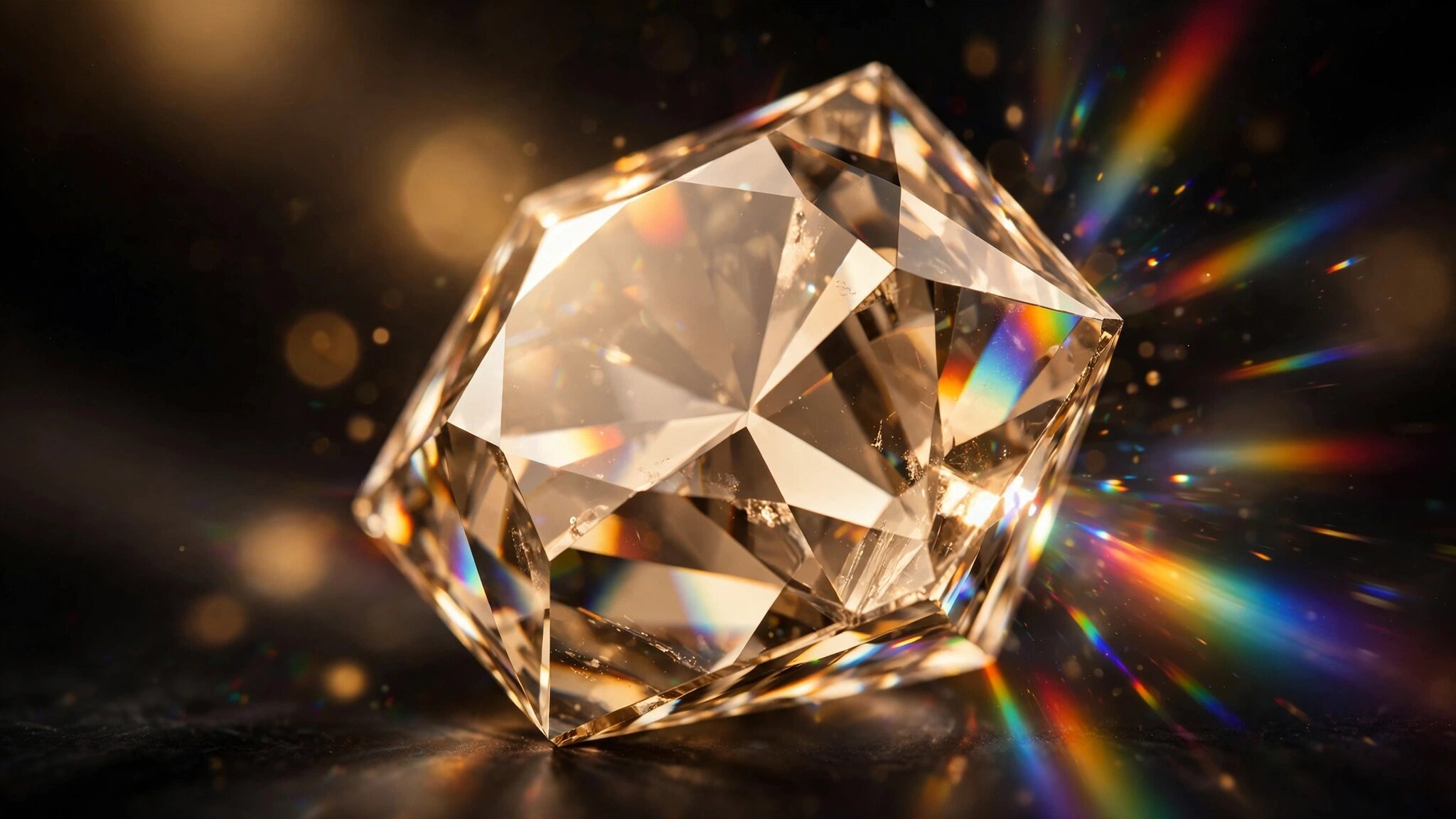
A Mineral from a Meteor Crater
In 1893, French chemist Henri Moissan was sorting through rock samples collected from the Canyon Diablo meteorite crater in Arizona when he found a cluster of tiny, brilliant crystals. He assumed they were diamonds. Eleven years of analysis proved him wrong: the crystals were silicon carbide, a compound of silicon and carbon bonded in a tetrahedral lattice so rigid that only diamond surpasses it in hardness. Moissan received the Nobel Prize in Chemistry in 1906 for his broader work on isolating fluorine and developing the electric arc furnace. By then, Edward Acheson had already synthesized the same compound industrially in 1891, selling it under the trade name Carborundum as an abrasive for grinding wheels and cutting tools.
For more than a century, silicon carbide remained an industrial material. It grinds steel, polishes glass, lines the brake rotors of supercars, and forms the substrate of power semiconductors in electric vehicle inverters. It is not the sort of material that shows up on a wrist. Moissanite, the gem-quality form of SiC, entered the jewelry market in 1998 when Cree Research developed a method for growing colorless, optically clean crystals large enough to facet. Charles & Colvard commercialized those stones as diamond alternatives, marketing moissanite's superior fire and lower price against diamond's unmatched hardness and cultural cachet.
Nobody tried to make a watch case from it. Not because moissanite lacks appeal, but because machining it would be an exercise in controlled destruction. Sapphire cases, already at the extreme edge of horological manufacturing, are made from aluminum oxide at Mohs 9.0. Moissanite sits at 9.25 to 9.5. That half-point gap is not linear, and it fundamentally alters how the material responds to tooling.
What Makes SiC So Difficult to Cut
Mohs hardness measures scratch resistance on a relative scale, but the intervals between numbers are not uniform. Between 9 and 10, the jump in absolute hardness is enormous. Sapphire (corundum, Al2O3) rates a 9. Diamond rates a 10. Moissanite sits between them. In Knoop hardness, sapphire measures roughly 2,000 kg/mm2, moissanite roughly 2,480, and diamond roughly 8,000. SiC is closer to sapphire than to diamond in absolute terms, but the practical consequence for machining is the same: the only material that can cut SiC is diamond, and the hardness gap between diamond tooling and moissanite is narrower than the gap between diamond and sapphire. Diamond tools that last months when cutting sapphire wear down in hours when cutting SiC.
Hardness is only part of the challenge. Moissanite decomposes at 2,730°C rather than melting cleanly, which means it cannot be cast or molded. Its thermal conductivity sits near 490 W/m·K, roughly twelve times that of sapphire, so cutting heat propagates rapidly through the workpiece rather than staying localized at the tool tip. And its fracture behavior is conchoidal, the same smooth, curving crack pattern seen in broken glass. Under cutting stress, a misaligned tool or excessive feed rate does not chip the surface gradually. It initiates a crack that propagates through the crystal lattice at the speed of sound in the material, destroying weeks of machining in microseconds.
Academic literature on SiC machining overwhelmingly focuses on semiconductor wafer production, where the goal is to polish flat 4H-SiC or 6H-SiC substrates to sub-nanometre roughness. Researchers at institutions from Nanjing University of Aeronautics to Harbin Institute of Technology have published extensive work on diamond abrasive selection, ultrasonic-assisted grinding, and chemically enhanced diamond turning as methods for removing SiC material without inducing subsurface damage. In wafer fabrication, material removal rates are measured in micrometres per minute. A watch case requires removing cubic centimetres of material from a solid boule while maintaining geometric tolerances tight enough for a wearable object. No semiconductor lab has attempted anything like it.
From Round to Tonneau
ArtyA, a Geneva-based independent founded by Yvan Arpa in 2009, has built its reputation on materials that other watchmakers refuse to touch: meteorite-struck steel, insect wings embedded in resin, cases carbonized by lightning. In 2023, for the Only Watch charity auction, Arpa's son Stanislas directed a project to sculpt a round watch case from moissanite. Working with Télôs SA, a specialized case manufacturer, they developed proprietary machining protocols specifically for SiC. According to ArtyA, that first round case carried 600 facets across a 45mm diameter. It sold at auction for a sum commensurate with its uniqueness.
For Watches and Wonders 2026, ArtyA escalated. Instead of repeating the round geometry, Stanislas Arpa specified a tonneau shape with compound curves. A round case can be machined on a rotary fixture with a single axis of rotation. A tonneau requires multi-axis CNC operations where the tool path follows doubly curved surfaces that change curvature at every point. In sapphire, this is an established (if expensive) process used by Hublot, Richard Mille, and others. In moissanite, it had never been done.
Every existing protocol for the round case needed revision. Cutting speeds dropped because the compound curves meant the tool engaged the crystal at constantly varying angles of attack, each angle presenting different stress concentrations along the SiC crystal planes. Feed rates fell further. Tool replacement intervals shortened. ArtyA does not publish its exact machining parameters, but the engineering reality of SiC machining provides constraints: diamond grinding wheels operating at surface speeds between 30 and 80 metres per second, coolant flows sufficient to prevent thermal shock in a material that conducts heat as fast as it absorbs it, and real-time acoustic emission monitoring to detect crack initiation before propagation.
Sixty-Five Facets and the Optics of Fire
Why facet a watch case at all? A polished smooth surface would be simpler to produce and less prone to stress concentration at facet edges. ArtyA's answer is optical. Moissanite has a dispersion index of 0.104. Diamond's is 0.044. Sapphire's is 0.018. Dispersion quantifies how strongly a material separates white light into its spectral components, the property gemologists call "fire." At 0.104, moissanite splits light more than twice as aggressively as diamond. Each facet acts as an independent prism, decomposing incoming white light into bands of red, orange, yellow, green, blue, and violet that shift as the viewing angle changes.
With 65 facets on the Curvy Tourbillon case, the arithmetic is straightforward: 65 independent prisms generating spectral output at 65 different angles simultaneously. As the wrist moves through normal daily motion, the pattern of spectral fire constantly rearranges. A polished smooth surface would still produce dispersion, but only at the entry and exit surfaces of the crystal. Facets multiply the optical interactions by creating dozens of internal reflection and refraction events.
Moissanite also has noticeable birefringence: approximately 0.043, with ordinary and extraordinary refractive indices of 2.648 and 2.691 respectively. Birefringence means the crystal splits incoming light into two slightly displaced images traveling at different speeds through the lattice. In a gemstone cut for a ring, lapidaries orient the stone so the viewer looks along the optic axis, where birefringence vanishes. In a watch case, the viewer sees the movement through the case walls at every possible angle. ArtyA cannot eliminate birefringence entirely across all viewing directions. Instead, the 65-facet geometry distributes the doubling effect across many small facets, making it part of the visual texture rather than an optical flaw. At oblique angles through the champagne-tinted crystal, you can see the tourbillon with a faint ghosting, a visual artifact that in this context reads as depth rather than distortion.
Inside the Case: PUR-T3 Calibre
A transparent case demands a movement worth displaying. ArtyA's PUR-T3 Curvy Tourbillon is a manual-wind calibre shaped to follow the tonneau case's curved contours, housed in a crystal enclosure measuring 41 mm wide, 42 mm lug-to-lug, and 13 mm thick. Hours and minutes sit on a subdial at twelve o'clock, offset from the case center. At six o'clock, a one-minute tourbillon rotates in open view, its cage visible through all 65 facets of the SiC enclosure. A tourbillon places the escapement and balance wheel inside a rotating cage, averaging out gravitational errors that affect timekeeping when the watch rests in a single position. Whether this correction matters on a wrist that moves constantly is debated. In a transparent case, the debate is beside the point. A tourbillon is kinetic sculpture, and moissanite gives it a stage that refracts its rotation into spectral light.
Twin parallel barrels provide 65 to 72 hours of power reserve, delivering a flat torque curve that maintains amplitude stability across the full wind-down cycle. At 4 Hz (28,800 vibrations per hour), the escapement operates at a higher frequency than the 3 Hz standard that many Swiss movements use, reducing the timing impact of each individual beat error. Regulation uses timing weights rather than a traditional raquette (regulator index), which eliminates the positional variability that curb pins introduce by constraining the active length of the hairspring. Without curb pins, the full hairspring length participates in every oscillation regardless of the watch's orientation, improving isochronism across positions.
ArtyA's decision to leave the tourbillon at six o'clock, directly opposite the time display, forces the viewer's eye through the full depth of the moissanite case. Looking at the time means looking through layers of faceted SiC. Looking at the tourbillon means looking through different layers, at a different angle, generating a different pattern of spectral dispersion. Every glance at the watch produces a unique optical event.
Scratch-Proof Does Not Mean Indestructible
A moissanite case cannot be scratched by any material other than diamond. It will survive contact with steel, granite, glass, and every other surface encountered in daily wear without marking. Sapphire cases share some of this scratch resistance, but at Mohs 9.0, sapphire can be scratched by silicon carbide itself and by certain industrial abrasives. Moissanite occupies a hardness tier where the only realistic threat is a diamond-set ring on an adjacent finger.
Impact resistance is the tradeoff. Hardness and toughness are inversely correlated in most crystalline materials. Moissanite's conchoidal fracture means that while it resists surface scratching with extraordinary stubbornness, a sharp impact on a facet edge could propagate a crack through the case. ArtyA does not publish drop-test data. A moissanite case is not a G-Shock. It is a material statement for owners who accept that indestructibility on one axis comes with vulnerability on another.
Nine Pieces
ArtyA is producing the Purity Moissanite Curvy Tourbillon as a nine-piece limited edition. At current machining speeds, the constraint is not market positioning but manufacturing throughput. Each case likely requires hundreds of hours of CNC time, with reject rates driven by crack propagation during late-stage faceting, when stress concentrations are highest and a single failure destroys the accumulated work. Sapphire case manufacturing has benefited from decades of refinement with a material that is easier to machine. ArtyA's yields on moissanite, working with a harder material, more complex geometry, and less production history, are almost certainly lower.
What ArtyA has done is not a stunt. It is a genuine expansion of the materials vocabulary available to watchmakers. Sapphire cases became viable in the 2000s and are now produced by at least a dozen manufacturers. If moissanite follows a similar trajectory, the next decade may see SiC cases from brands with the engineering resources to invest in tooling development and process optimization. ArtyA's contribution is not the final product. It is proof that the material is workable, that a tonneau geometry is achievable, and that the optical payoff justifies the manufacturing cost. In a field where sapphire was once considered the ceiling of case-material ambition, silicon carbide has opened a new floor.