0.3 Millimeters: How Audemars Piguet Rebuilt the Chronograph Pusher from First Principles
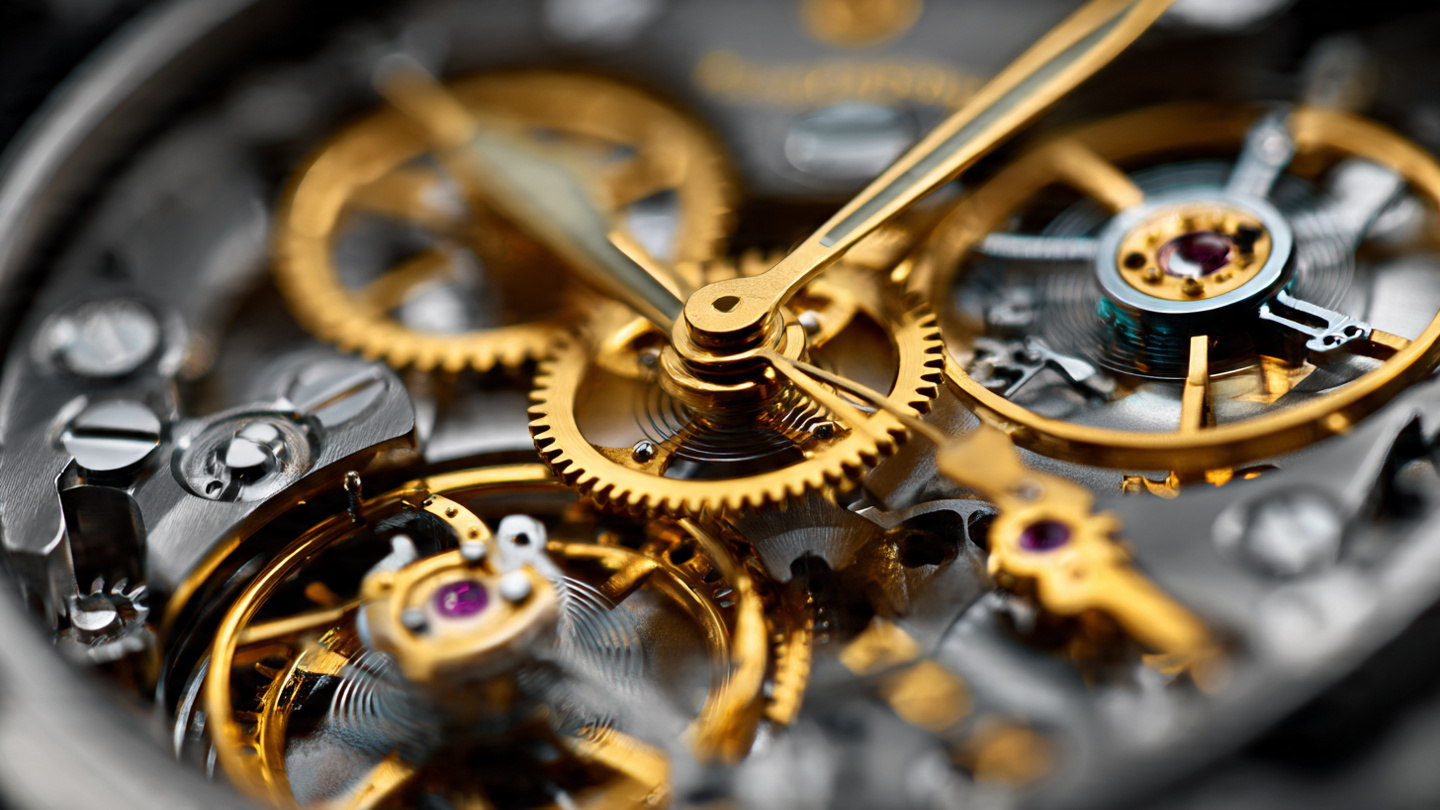
Press the reset button on any chronograph made in the past two centuries, and your finger does the work. A spring-loaded hammer drops onto a heart-shaped cam mounted on the chronograph wheel’s arbor. Regardless of where the cam stopped, the hammer’s force rotates the wheel until the flat of the heart sits flush under the hammer, snapping the hand to twelve o’clock. It is a reliable, universal mechanism. It is also heavy. Conventional chronograph pushers require approximately 1.5 kilograms of force and at least 1 millimeter of travel. Every watchmaker accepts this as a given. Giulio Papi and his team at Audemars Piguet’s Le Locle facility decided not to.
Why Chronograph Pushers Are Stiff
Stiffness in a chronograph pusher comes from three independent sources, and they compound. First, the column wheel. When the start or stop button is pressed, the operating lever advances the column wheel by one step. A jumper spring must lift clear of a ratchet tooth and snap into the next one, and the finger must supply the force to overcome that spring. Second, the clutch. As the column wheel rotates, it raises or lowers levers held in position by their own springs, engaging or disengaging the coupling between the going train and the chronograph wheel. Whether vertical or horizontal, the clutch requires spring energy that is ultimately felt at the pusher. Third, the operating lever itself. In many chronographs, this lever spans a considerable distance from the pusher to the column wheel. Length introduces elasticity. Force is absorbed by the flex of the lever before it reaches the column wheel, requiring additional pressure to produce the same mechanical output.
Reset is worse. Pressing the reset button drives hammers directly onto heart cams. Because the cams can be at any angular position when reset is triggered, the spring must deliver enough energy to snap each wheel back to zero in one clean motion regardless of how far it needs to rotate. When multiple counters are in play, the reset button is almost always the heaviest on the watch.
Chronograph design has optimized around this constraint for generations. Column wheels are smoother than cam-actuated alternatives. Vertical clutches are cleaner than horizontal ones at the moment of engagement. Better materials reduce friction in pivot bearings. But the fundamental architecture, in which the finger directly supplies the energy for engagement, disengagement, and reset through a chain of springs and levers, has remained unchanged since the heart cam was first applied to chronograph wheels in the 19th century.
Separating Indexing from Actuation
Caliber 8100 solves the start/stop problem by decoupling two functions that have been mechanically joined in every prior chronograph. In the conventional architecture, pressing the pusher both indexes the column wheel (advancing it one step) and actuates the clutch (engaging or disengaging the chronograph). In the RD#5, the pusher indexes only. Actuation happens downstream, powered by stored spring energy rather than the finger.
AP positioned the pusher close to the column wheel, shortening the operating lever to minimize elastic play. When the pusher is pressed, the column wheel advances by one step. But instead of directly moving the brake or clutch levers, the column wheel acts on an articulated intermediate control lever. This lever is connected to the clutch lever by a linkage. When the column wheel rotates and releases the intermediate lever, the lever pivots and allows a preloaded clutch spring to push the clutch wheel into engagement. Release the column wheel, and the spring pulls the clutch out again.
What the user feels is only the resistance of the column wheel jumper spring, the small click of the column advancing one step. All of the force required to physically move the clutch and brake is taken up by springs inside the mechanism. A secondary finger formed on the intermediate lever also coordinates the seconds jumper. In stop mode, it presses the jumper into locking engagement with the chronograph seconds wheel. In start mode, it withdraws to release it. Locking and unlocking are synchronized with clutch engagement without adding any load to the pusher.
A Clutch That Moves Both Ways
Caliber 8100 does not use a standard vertical or horizontal clutch. It uses what AP calls a hybrid. In a vertical clutch, two friction discs are pressed together axially. In a horizontal clutch, an intermediate wheel swings laterally into mesh with both the going train and the chronograph wheel. Each approach has clear tradeoffs. Vertical clutches eliminate the hand-jump at start because the friction coupling is gradual, but they take up vertical space, which matters in an ultra-thin movement. Horizontal clutches are more compact but produce a brief tick of the seconds hand when coupling occurs, and the grinding contact between gear teeth at the moment of engagement causes wear.
AP’s hybrid clutch moves vertically, like a vertical clutch, but engages through toothed wheels rather than friction, like a horizontal one. When the column wheel releases the intermediate lever, the clutch wheel drops vertically from a disengaged position above the chronograph seconds wheel into a meshed position below. Beveled edges on the underside of the gear teeth allow the clutch to slide into place without impact. A metal tongue connecting the central bridge to the clutch wheel prevents excessive vertical play that could cause disconnection during timing. On the reverse of the tourbillon, a taller gear maintains engagement throughout the clutch wheel’s vertical travel.
This design occupies less horizontal diameter than a conventional horizontal clutch and less vertical height than a conventional vertical one. In a movement that must fit a flying tourbillon, a flyback chronograph, a peripheral rotor, and instantaneous jumping counters into a 4.0 mm envelope, that dimensional savings is not theoretical. It is the difference between a movement that fits and one that does not.
Replacing the Heart
Every chronograph hand in a conventional caliber, seconds, minutes, and hours if present, sits on a wheel with a heart-shaped cam fixed to its arbor. On reset, hammers press down on the cams, and the asymmetric profile forces each wheel to rotate until the cam’s flat edge aligns under the hammer, which corresponds to the twelve o’clock position. Simple, universal, and dependent on the user’s finger providing enough force to slam three hammers onto three cams simultaneously.
Caliber 8100 has no heart cams. No reset hammers. Instead, each of the three chronograph wheels, seconds, minutes, and hours, is attached to a pinion. Each pinion meshes with a spring-loaded rack. As the chronograph runs and the wheels turn, the pinions gradually push their respective racks against return springs. Energy accumulates. By the time the user presses the reset button, the springs are charged. Pressing reset does not slam anything onto anything. It actuates a six-armed lever that simultaneously lifts all the jumpers and pawls locking the chronograph wheels. Freed from constraint, the racks snap back to zero under their own stored spring energy, dragging the counters with them.
Reset completes in less than 0.15 seconds. An instantaneous jump that is nearly imperceptible to the eye. And the force required at the pusher is only what it takes to move the six-armed lever, which is holding no springs, absorbing no shock, and transmitting no energy to the counters. AP claims the reset requires approximately 300 grams of force and 0.3 mm of travel, roughly equivalent to tapping a smartphone side button.
Making the Minute Counter Jump
Instantaneous jumping minute counters are rare. Most chronograph minute counters advance in a gradual creep, the minute hand slowly sweeping from one mark to the next over the course of 60 seconds. An instantaneous jump snaps the minute hand to the next position in one clean motion the moment the seconds hand crosses twelve. It is easier to read and more satisfying to watch, but it requires additional mechanism and more energy to execute.
In Caliber 8100, the instantaneous minute jump is a free byproduct of the rack system. Each seconds pinion has 12 teeth, but two have been removed and one shortened, creating a truncated sector. As the chronograph seconds wheel rotates, it pushes the seconds rack forward through the toothed sector. When the seconds hand reaches 60, the pinion rotates past the gap where the missing teeth were, and the rack disengages. Released from the drive force, the return spring snaps the rack back to its starting position.
A transmission lever carrying a pawl is attached to the seconds rack mechanism. As the rack flies back, the lever indexes the minute counter wheel forward by one step. One clean jump, powered by the same spring energy that resets the seconds rack every 60 seconds. No additional mechanism required. No additional energy source. A similar chain of racks, pinions, and pawls steps down the minute counter into half-hour increments on the hour counter, using the same principle of stored retrograde energy driving downstream indexing.
Counterweights on the racks ensure balance during the flyback motion, and the return springs simultaneously serve as shock absorbers, preventing stutter when the system advances. In practice, the jumping counter works without visible hesitation. Mark Kauzlarich at Hodinkee reported activating, resetting, and flyback-testing the watch dozens of times while watching the movement through the sapphire caseback and confirmed no stutter in the advance mechanism.
Flyback Without the Weight
Flyback chronographs allow the user to reset and restart the chronograph in a single pusher press, without stopping first. In a conventional flyback, this means the reset lever must simultaneously disengage the clutch, reset the counters via heart cams, and re-engage the clutch when the pusher is released. All of that happens through a single button press, making flyback pushers even heavier than standard reset pushers.
In Caliber 8100, the flyback reset lever is not governed by the column wheel. Pressing the reset pusher directly engages the six-armed lever, which has a dedicated arm that disengages the clutch lever at the precise instant its other arms release the jumpers and pawls. All three racks spring back to zero simultaneously. When the pusher is released, the reset lever returns to its rest position, the clutch re-engages, and timing resumes seamlessly. Because the clutch is spring-loaded and the racks are spring-loaded, neither action requires user-supplied energy beyond what it takes to move the lever mechanism itself.
To reduce inertia and speed up the flyback snap, AP made the chronograph seconds hand and the chronograph wheel from titanium rather than steel. Titanium has roughly 57 percent the density of steel. Less mass on the rotating parts means less kinetic energy to overcome during the instantaneous reset, and faster return to zero.
Everything Else in 8.1 Millimeters
Caliber 8100 inherits its flying tourbillon architecture from the Caliber 2968 developed for the RD#3 in 2022. A peripherally driven titanium tourbillon cage is engaged on its outer rim by the finishing wheel, eliminating the pinion-under-cage arrangement that adds vertical height in conventional tourbillon constructions. Six recessed regulating weights sit within the free-sprung balance rim rather than projecting outward, allowing the rim to extend further for increased inertia while keeping the outer edge smooth to minimize air resistance during oscillation. A long-action lever escapement permits amplitudes beyond 360 degrees without overbanking.
Winding uses a peripheral oscillating weight rather than a central rotor. Because the mass orbits the movement’s perimeter, the entire chronograph mechanism is visible through the domed sapphire caseback with nothing obscuring the view. Gearing at the 1 and 3 o’clock positions transmits rotor motion to the mainspring on the dial side. Power reserve is 72 hours, up from 50 on the tourbillon-only RD#3, achieved through a larger mainspring barrel tucked beneath the dial.
A crown function selector, operated by a coaxial pusher, eliminates the need to pull the crown out. Pressing the selector drives a dedicated column wheel that switches between winding and time-setting modes. A red ring appears around the pusher in time-setting mode as a visual indicator. No crown extension means one fewer potential ingress point for moisture and dust, and one less action that risks damaging a pushed component in a thin case.
Palladium Glass
Bulk Metallic Glass is not new in watchmaking. Omega used it in 2012 for the Seamaster Planet Ocean Liquidmetal bezel. Panerai has applied it in limited editions. What makes AP’s application notable is the alloy composition. Standard BMG alloys are typically zirconium-based. AP developed a palladium-enriched variant for the RD#5, which serves as the bezel, pushers, crown function selector, and studs.
Palladium BMG is produced by cooling molten metal fast enough to prevent crystallization. Atoms freeze in a disordered, amorphous state instead of forming the regular lattice structure of conventional metals. In crystalline metals, grain boundaries between ordered domains create weak points where cracks initiate and corrosion begins. Amorphous metals have no grain boundaries. Hardness is extreme, essentially scratch-proof under normal wear. Elasticity exceeds that of crystalline equivalents, meaning the material can absorb minor impacts and return to its original shape rather than denting or deforming permanently. Visually, palladium BMG resembles platinum but is lighter and harder, with a cool silver-grey luster that polishes to a mirror finish.
Combining a titanium case middle with palladium BMG functional components gives the RD#5 a total case weight substantially below what the same dimensions would produce in steel or gold, while hardness at the most contact-prone surfaces, the bezel and pushers, exceeds what any conventional case metal could provide.
Five Chapters Closed
Audemars Piguet’s RD series began in 2015 with the Supersonnerie concept, which solved the century-old conflict between volume and tonal quality in minute repeaters by adding a copper-alloy resonance membrane between the movement and a pierced titanium caseback. In 2018, the RD#2 collapsed the perpetual calendar’s multi-layer architecture into a single plane by making the program wheel serve as both cam and gear, producing a perpetual calendar movement only 2.89 mm tall. In 2022, the RD#3 fitted a flying tourbillon into the Jumbo case by driving the cage peripherally and offsetting the center wheel. In 2023, the RD#4 Universelle packed 23 complications into 42 mm with labeled pushers that made a grande complication operable without a manual or a stylus. It won the Aiguille d’Or at the Grand Prix d’Horlogerie de Genève.
Each RD watch investigated a different constraint. Acoustics, thinness, integration, usability, and now, with the RD#5, tactile interaction. AP has said the RD series is complete. Caliber 8100’s innovations, like those of its predecessors, will migrate into regular-production models. Future AP chronographs will likely feel different under the finger, and the rack-and-pinion architecture will enable instantaneous jumping counters without the additional mechanism that conventional jumping counters require.
At CHF 260,000 for a limited run of 150 pieces, the RD#5 is not a commercial product in any conventional sense. It is a mechanical argument. For 200 years, every chronograph maker accepted that the energy for reset comes from the finger. Papi and his team, working from patent EP4555385A1, demonstrated that this is a choice, not a constraint. Store the energy while the chronograph runs. Release it when the button is pressed. Make the finger supply only the indexing force for the column wheel, nothing more. Reduce pusher travel from one millimeter to 0.3. Reduce force from 1.5 kilograms to 300 grams.
Whether this architecture reaches a broader price point depends on manufacturing complexity and tolerance requirements that only serial production will test. But the principle is established and patented. A chronograph does not have to feel like a chronograph. It can feel like tapping glass.
Sources
- Hodinkee, “Hands-On: Audemars Piguet Royal Oak Extra-Thin Selfwinding Flying Tourbillon Chronograph RD#5 Review,” November 2025, detailed technical analysis with patent diagram animations and hands-on testing of the rack-and-pinion mechanism.
- Monochrome Watches, “In-Depth: AP Reimagines the Chronograph, with the Royal Oak Jumbo Chronograph RD#5,” October 2025, movement architecture overview and Bulk Metallic Glass material analysis.
- Revolution Watch, “The Five Chapters of the Audemars Piguet RD Series,” March 2026, comprehensive technical walkthrough of all five RD models including clutch separation and six-armed reset lever mechanics.
- Europa Star, “Audemars Piguet RD#5: The Watch That Puts You First,” October 2025, interview with Giulio Papi on rack-and-pinion reset design, pusher force specifications, and jumping minute counter mechanism.
- Watchonista, “Audemars Piguet Unveils the Final Watch of Its RD Series,” October 2025, Caliber 8100 specifications, hybrid clutch technical description, and Lucas Raggi quotes on energy management architecture.
- European Patent Filing EP4555385A1, Manufacture d’Horlogerie Audemars Piguet SA, inventors Julien Martel and Giulio Papi, filed July 13, 2023.