262 Kilohertz, Three Prongs, Seconds Per Year: Inside Accutron's Resonator Era
Accutron's Fall/Winter 2026 collection bets that a faster crystal is the cheapest road to precision: a 262 kHz three-prong tuning fork in the Elevation and Memphis 521, and a minute repeater, perpetual calendar, chronograph, moonphase and day/night indicator combined in the $2,190 Horizon. The frequency choice is a power of two, which matters more than the marketing suggests. One thermal question goes unanswered.
32,768 times 8, exactly
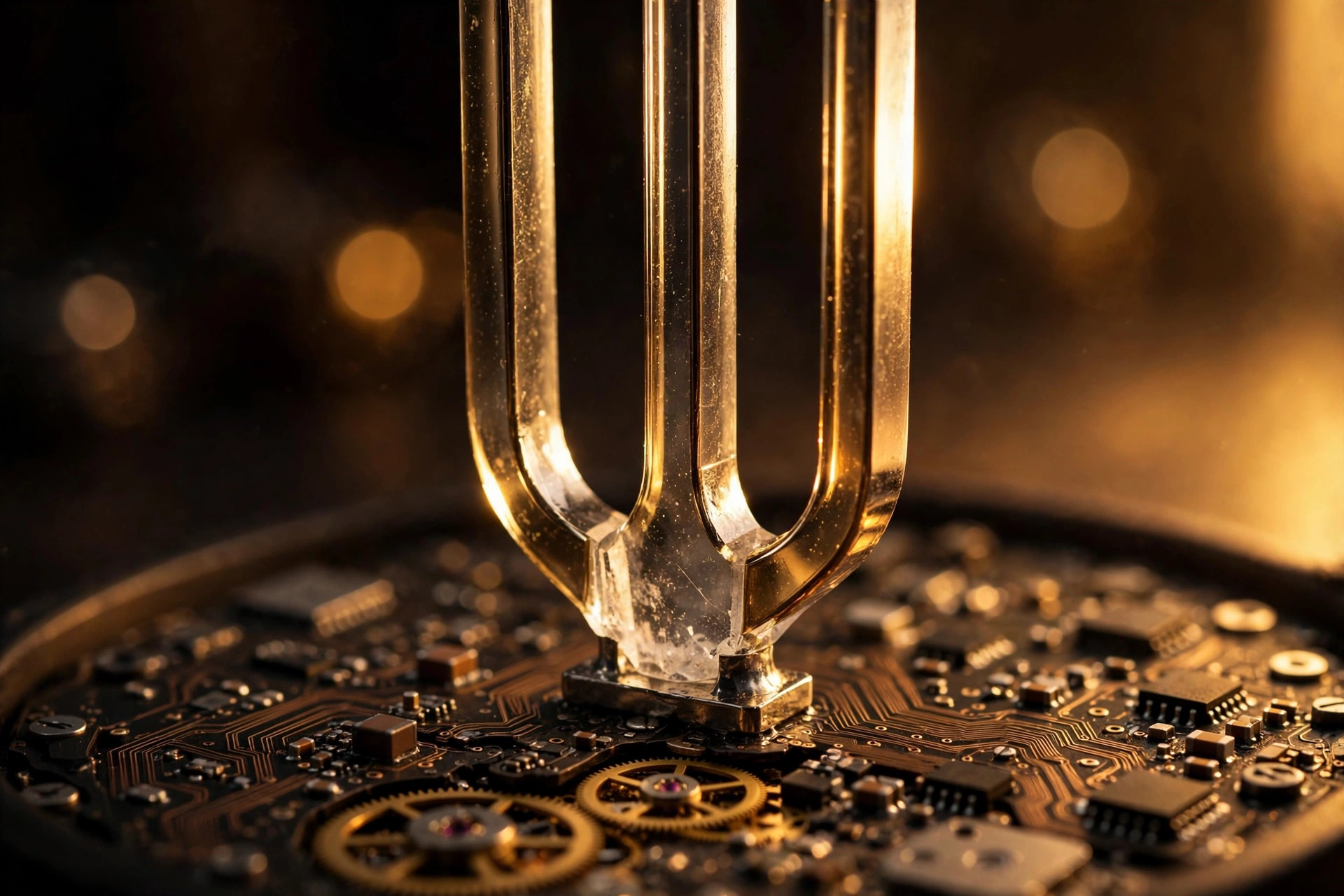
Announced October 6, Accutron's new resonator movement is built around a three-prong tuning-fork-shaped quartz crystal vibrating at 262 kHz, claimed at eight times the frequency of traditional quartz and accurate within seconds per year. Multiply the standard 32,768 Hz watch frequency by eight and you get 262,144, which is not an accident of rounding: it is 2 to the 18th power.
This detail is the whole story, because quartz watches reduce the oscillator frequency down to one tick per second using cascaded divide-by-two counters, and 32,768 Hz survived as the industry standard because it equals 2 to the 15th, which chains cleanly through fifteen flip-flop stages. Accutron picked the next convenient rung on the binary ladder: eighteen stages instead of fifteen, same architecture, same design habit. When Citizen wanted to build the most accurate wristwatch in the world, it reached much further up the ladder, to an 8.4 MHz AT-cut crystal in the Caliber 0100, which is 256 times the standard frequency and holds plus or minus one second per year. Accutron's resonator is the budget version of the same insight: frequency is the cheapest knob in quartz timekeeping.
That knob does real work, because a faster timebase slices each second into finer increments, so any digital correction loop can apply smaller and more frequent trims; the classic trick is inhibition compensation, where the circuit skips or adds a tick at regular intervals to cancel the crystal's known drift rate. More ticks per correction interval means each trim nudges the rate by a smaller fraction. The result is not magic; it is resolution.
The power bill comes due
Nothing in quartz is free. Dynamic power in a CMOS divider chain scales roughly with frequency times capacitance times the square of the voltage, so running the oscillator and its first divider stages at eight times the rate burns meaningfully more current than a conventional 32 kHz movement. Citizen paid this bill in the Caliber 0100 with a low-power crystal cut and aggressive duty cycling, and still achieved a five-year battery life.
Accutron's release says nothing about battery life, power architecture, or whether the resonator watches will need a cell every eighteen months or every five years. That is a hole in the story, and it matters: a seconds-per-year watch that demands annual battery changes is a different proposition than one that runs for a half-decade. The omission is not a scandal; it is a specification we will need before declaring the resonator a win.
Three prongs, not two
Standard watch quartz is a two-tine fork, the shape every 32,768 Hz crystal has worn for fifty years. A third tine is unusual enough to deserve a theory, and there are two good ones.
One is differential sensing. With three tines, the design can dedicate one tine to the drive electrodes and another to the sense electrodes, or run the outer two differentially so that common-mode noise and mechanical vibration cancel electrically. A wrist is a terrible place for a precision oscillator: every door slam and handshake injects acceleration noise, and differential pickup is how you separate the crystal's signal from the world's interference.
The other theory is mechanical. A two-tine fork transmits a small reaction force into its mount on every cycle, and that energy leakage lowers the quality factor, the Q that measures how stubbornly a resonator holds its frequency. A symmetric three-tine arrangement can balance the outer tines' momentum against the center one, keeping net reaction force near zero and letting the crystal ring longer between drive pulses. Longer ring, higher Q, steadier frequency.
Either way, the third tine is doing something the press release does not explain, and both explanations are consistent with the seconds-per-year claim. This is engineering reading, not confirmed design detail: Accutron has not published the crystal's cut, its drive circuit, or its electrode arrangement. I would rather state that plainly than invent a datasheet.
The thermal elephant in the room
Here is the uncomfortable part. A bare quartz crystal drifts with temperature along a parabolic curve, roughly minus a few dozen parts per million across a wrist-worn range from winter mornings to summer dashboards. Seconds per year means single-digit parts per million, held continuously, through every season. No uncompensated crystal does that.
The standard answer is thermocompensation: a temperature sensor on the movement, a characterization curve baked in at the factory, and the divider chain applying a temperature-dependent correction every few seconds. The high-accuracy quartz world runs on this architecture. Grand Seiko's 9F and Citizen's chronometer-grade calibers both live there.
Accutron's release does not mention thermal compensation. It does not mention a sensor, a curve, or a correction loop. Perhaps the compensation is assumed too technical for a press release. Perhaps the seconds-per-year figure is a best-case laboratory number. Either reading is plausible, and only a teardown or a long-term timing test will settle it. Until then, treat the accuracy claim as aspirational rather than measured.
A minute repeater for $2,190
The Horizon's spec sheet reads like a typo. Chronograph, minute repeater, perpetual calendar, moonphase, day/night indicator, sandstone subdials, a Denchu base, from $2,190. In the mechanical world, that combination at that price is a fantasy: a Swiss minute repeater alone starts at six figures, because the striking work is hundreds of hand-fitted parts that only a few dozen watchmakers on Earth can voice.
Accutron is not a mechanical brand, and that is precisely the point. On an electronic platform, a minute repeater is a speaker driver and a timing routine. A perpetual calendar is a counter with a leap-year rule. The complications that cost fortunes in brass and steel cost almost nothing in logic. The Horizon is what happens when grand-complication function gets divorced from grand-complication construction.
That divorce is the most interesting thing Accutron has done. For sixty years, the minute repeater has been a luxury artifact, proof of wealth rendered in sound. Executing one in the electronic domain collapses the price by well over an order of magnitude and moves the complication from jewelry to instrument. Whether the repeater sounds beautiful is an open question, and I have not handled the watch. But the strategy deserves respect: instead of imitating the Swiss at their own game, Accutron attacked the function the Swiss cannot cheapen.
The 314 line gets its Elinvar back
Almost lost in the announcement: the new Alpha 314 and Spaceview 314 models, in 904L steel or Grade 5 titanium, with Silicium and Elinvar components, hand-assembled, still humming, from $5,990. The material pairing closes a loop that runs back to 1960.
Elinvar is the iron-nickel-chromium alloy family with a near-zero thermoelastic coefficient, the reason Max Hetzel's original tuning fork kept its rate across temperatures. Silicon parts are anti-magnetic, corrosion-proof, and need no lubricant. Putting both into the modern tuning fork line is not nostalgia. It is the same two-material answer to the same two enemies, temperature and magnetism, updated with sixty years of fabrication progress.
Four proprietary movements now: tuning fork, electrostatic, resonator, master complication. Most brands would kill for one. Accutron's collection reads like a museum of its own experiments that someone decided to manufacture at scale, and the pricing suggests they mean to sell these to actual humans rather than collectors. Whether the seconds-per-year claim survives contact with a thermometer is the question I will be watching.
| Model | Movement | Key specification | From |
|---|---|---|---|
| Accutron Elevation | Resonator (new) | 262 kHz three-prong crystal, seconds/year claimed | $1,550 |
| Accutron Memphis 521 | Resonator (new) | Same movement, 1960s TV-case revival | $1,650 |
| Accutron Horizon | Master complication (new) | Chronograph, minute repeater, perpetual calendar, moonphase, day/night; sandstone subdials | $2,190 |
| Accutron Alpha 314 | Tuning fork | Shield-shaped case, Silicium and Elinvar, hum | $5,990 |
| Accutron Spaceview 314 | Tuning fork | 904L steel or Grade 5 titanium, hand-assembled | $5,990 |
Sources: Accutron Fall/Winter 2026 collection announcement (PR Newswire, October 6, 2026, corrected release); Watch Insider, quartet of proprietary movements.