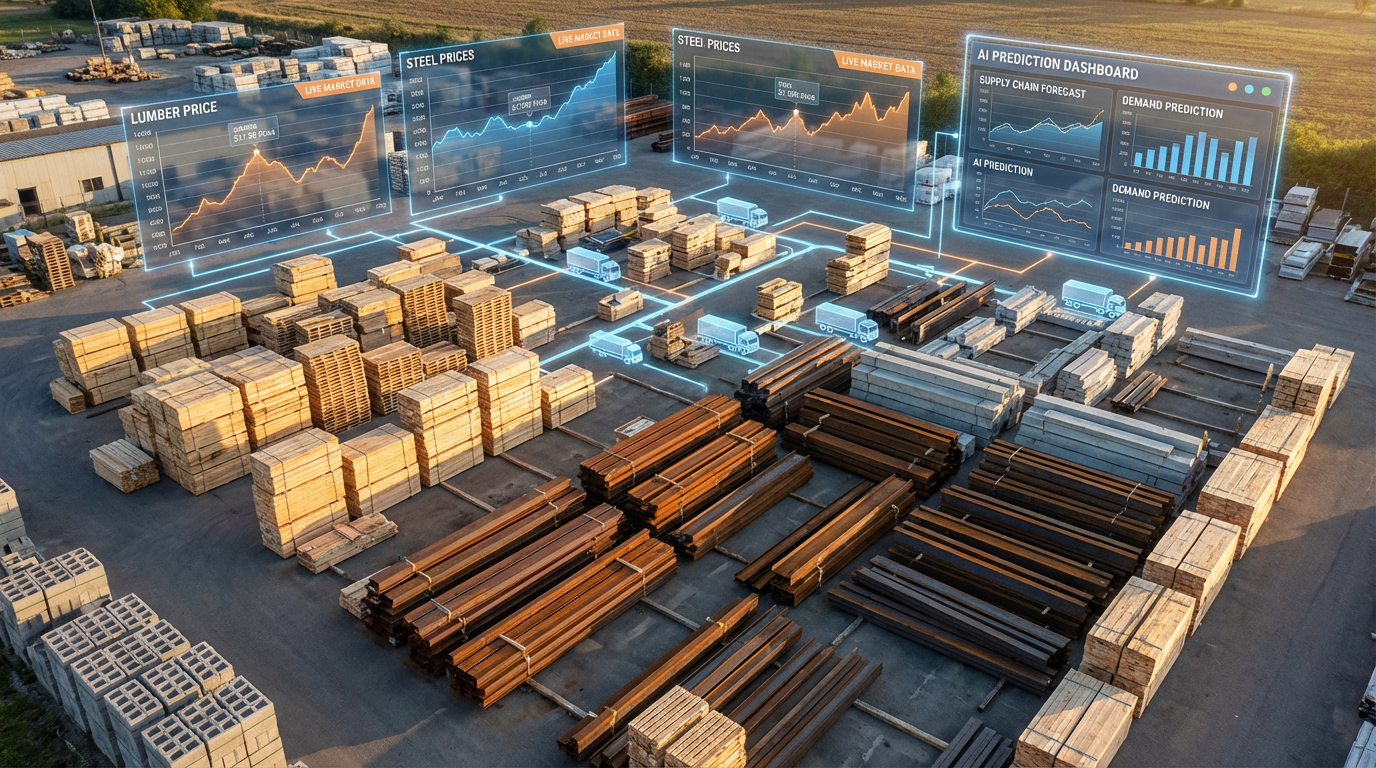
April 2020. I had three houses framed, two more in foundation. My lumber package for a 2,400-square-foot colonial was locked at $42,000. Fourteen months later, the same package — same species, same mill, same distributor — was $119,000.
I ate $77,000 across five houses because my contracts didn’t have escalation clauses. Took me the rest of the year to recover.
That experience — the one every builder who survived 2021 carries like a scar — is why I started paying attention when AI supply chain tools showed up in my inbox. Not because I trust the pitch. Because I remember the alternative.
The Numbers That Keep Builders Awake
The Bureau of Labor Statistics Producer Price Index for construction materials tells a story of four brutal years. From March 2020 to March 2024, according to Skender’s analysis of BLS data:
| Material | 4-Year Change | Status (2025) |
|---|---|---|
| Refined petroleum products | +98.7% | Volatile |
| Steel mill products | +62.6% | Declining |
| Gypsum (drywall) | +50.7% | Elevated |
| Plastic construction products | +48.5% | Elevated |
| Precast concrete | +38.3% | Rising |
| Copper wire & cable | +37.3% | Declining |
| Ready-mix concrete | +33.2% | Steady rise |
Materials account for roughly 50% of a new home’s hard construction cost. On an average $330,000 build — the 2025 national median from NAHB/RSMeans data — that’s $165,000 exposed to commodity swings you can’t control.
But you might be able to predict them. Maybe.
What AI Supply Chain Tools Actually Do
I’ve been building houses for 22 years. My supply chain management system was a guy named Tony at the lumber yard and a spreadsheet I updated when I remembered. That worked when prices moved 3–5% a year. It collapses when they move 62% in eighteen months.
The new AI tools fall into four buckets, and they’re not equally mature:
Demand forecasting. CMiC’s AI-integrated ERP and Briq (which just raised an $8M extension at $150M valuation) analyze your project pipeline, historical usage, and seasonal patterns to predict what you’ll need and when. Briq focuses on the financial side — automating invoices, tracking committed costs, flagging budget drift before the project manager notices. The demand forecasting piece is a byproduct of knowing your financial data cold.
Supplier risk scoring. This is the bucket I find most compelling. The tools evaluate your vendors on delivery timeliness, price consistency, quality defect rates, and financial stability. Score drops below a threshold, you get an alert. After 2021 taught me what happens when your primary lumber distributor allocates stock to bigger customers first, I’d pay real money for this.
Price prediction. Machine learning models trained on BLS PPI data, futures markets, shipping indices, and weather patterns. Several startups claim 30-day forward price accuracy within 5–8%. That’s better than my gut. Whether it’s better than the futures market is an open question.
Just-in-time delivery optimization. Route planning, staging schedules, delivery window compression. ALICE Technologies does this for commercial projects. Residential translation is limited — a custom home doesn’t have the delivery volume to justify the software cost.
The Honest Assessment
Most of these tools were built for commercial contractors running $50M+ project portfolios. A production builder doing 40 houses a year? Maybe. A custom builder doing 6? The ROI math is thin.
Briq charges enterprise pricing. CMiC is a full ERP replacement. ALICE is scheduling software that happens to optimize material logistics. None of them are priced for a GC with a pickup truck and a QuickBooks subscription.
What does translate down is the intelligence layer. Critchfield Construction’s 2025 analysis recommends budgeting 15–25% more time and cost into any build to account for material volatility. That’s not AI — that’s padding. AI could make the padding smarter: instead of a flat 20% contingency on materials, you’d have a model that says “lumber is stable, budget 5%; copper is volatile, budget 30%.”
That granularity changes conversations with clients. Instead of “the house might cost more,” you can say “the plumbing rough-in has $4,200 of copper exposure and here’s what the model says about Q3 pricing.”
Where I’d Spend Money Today
If I were still running crews — I sold the business in 2023, but I still think like a builder — I’d do three things:
First, lock in a futures-tracking feed. BLS PPI data is free and monthly. Random Lengths publishes weekly framing lumber composites. CME lumber futures give you the market’s forward view. None of this requires AI. It requires the discipline to look.
Second, I’d adopt Briq or a similar financial automation tool not for supply chain prediction, but for the budget visibility that makes prediction useful. You can’t manage material cost risk if you don’t know your committed costs in real time.
Third, escalation clauses in every contract. Non-negotiable. Material cost-sharing above a defined threshold. This isn’t AI, it’s survival. The builders who went bankrupt in 2021 weren’t bad builders. They had fixed-price contracts in a volatile market.
Every delay has a root cause. AI just finds it faster. But the supply chain problem isn’t speed — it’s visibility. You can’t manage what you can’t see, and most residential builders are flying blind on material costs until the invoice arrives.
The tools are coming. The pricing will come down. By 2028, I expect demand forecasting and supplier scoring to be table stakes in any construction management platform. For now, the best supply chain AI is still a good relationship with your distributor, a spreadsheet you actually update, and contracts that share risk honestly.
Tony at the lumber yard still answers my calls, by the way. He saw 2021 coming about six weeks before the futures market did. Some pattern recognition doesn’t need a neural network.
Sources
- U.S. Bureau of Labor Statistics — Producer Price Index for Construction Materials
- Skender / Construction Owners Association of America — “Building Costs in Flux: Analyzing Inflation’s Effect on Construction Materials” (BLS data, March 2020–March 2024)
- MultiHB — “Home Building Costs Jump 4.2% as Regions Diverge” (NAHB/RSMeans data, Q2 2025)
- CMiC Global — “How AI Can Address Disruptions in Supply Chain Management in Construction”
- Contxto — “Briq Raises $8M Extension at $150M Valuation for AI-Powered Financial Automation in Construction”
- Critchfield Construction — “2025 Construction Materials: Budget 15–25% More Time and Cost”
- Downtobid — “Best AI Construction Tools: Top 20 Innovations (2026)”
- Random Lengths — Weekly Framing Lumber Composite Price Reports
- CME Group — Lumber Futures Contract Data