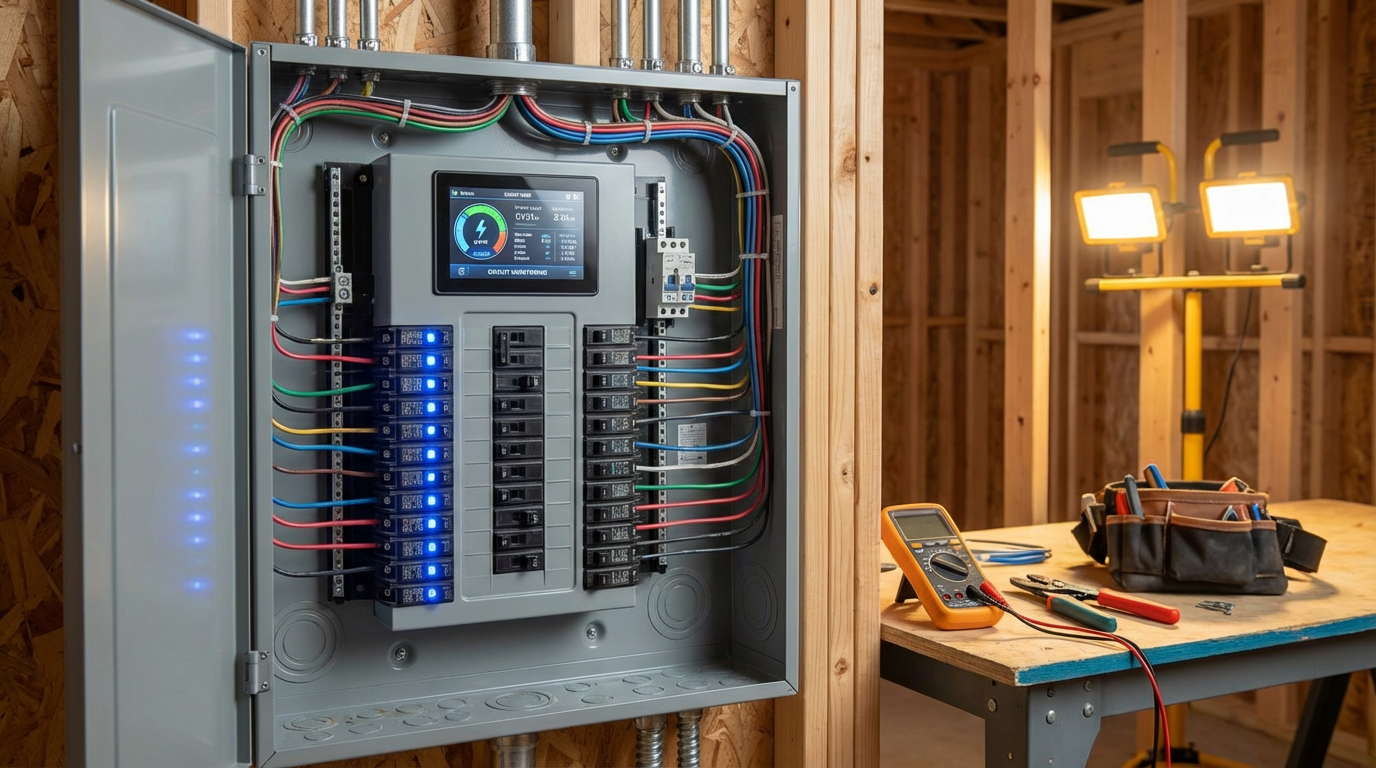
Your breaker panel hasn’t had a meaningful upgrade since Eisenhower was president. While the rest of your home sprouted Wi-Fi, smart thermostats, voice assistants, and solar panels, the electrical panel — the one piece of infrastructure that connects to literally everything — remained a dumb metal box full of mechanical switches. It doesn’t know which circuits are drawing power. It can’t tell you your dryer is pulling 5,400 watts at the same time your EV charger is pulling 7,200. It just sits there, silently tripping breakers when you overload it, like a bouncer with no memory.
That era is ending. And if you’re building a new home in 2026, the wiring decisions you make during framing will determine whether your house is smart-ready or dumb-locked for the next 30 years.
The Smart Panel Revolution
SPAN, the San Francisco startup that launched in 2020, turned the breaker panel into a brain. Their smart panels replace every mechanical breaker with a digitally controlled, individually monitored solid-state switch. Through the SPAN Home App, you get real-time visibility into every circuit in your house — not just total usage, but exactly how much your kitchen, HVAC, garage, and home office are drawing at any given moment.
The real power is in what the software does with that data. SPAN’s PowerUp AI continuously balances loads across your home. On standard 200A service, it lets you add an EV charger, heat pump, and induction range without upgrading your electrical service — which typically costs $5,000–$10,000 from the utility. The AI simply shifts loads in real time, ensuring you never exceed your service capacity.
“SPAN is revolutionizing the 100-year-old electric panel. We’re proud to help builders cut costs, deliver an unparalleled customer experience, and set modern standards for new-build homes.”
— Arch Rao, CEO and co-founder, SPAN
At IBS 2025, SPAN debuted the MAIN 40+MID — designed specifically for new construction, with a built-in microgrid interconnection device that simplifies solar and battery integration, and 25–50% more breaker spaces than the original model. PulteGroup, one of America’s top 3 homebuilders, is already rolling SPAN panels into production homes.
AI Wiring Design: Routing Circuits Like an Algorithm
Smart panels are only half the story. The other half is how the house gets wired in the first place.
Traditional residential electrical design is surprisingly manual. An electrician walks the framing, eyeballs the floor plan, and routes circuits based on experience and NEC code minimums. The result works, but it’s rarely optimized. Wire runs are longer than they need to be. Circuits are grouped by convenience rather than load balancing. And future expansion — the EV charger you’ll want in three years, the home battery you’ll add in five — requires pulling new wire through finished walls.
AI tools like WirePlan Pro are changing that. The software uses NEC-compliant algorithms to calculate optimal conduit paths, minimizing material usage and installation time. Feed it a floor plan, load specifications, and panel location, and it generates a complete wiring schematic with circuit assignments, wire gauges, and conduit routing — accounting for voltage drop, load balancing, and code compliance simultaneously.
Matter and Thread: The Protocol That Changes Everything
Here’s where the wiring-during-construction angle gets critical. Matter — the smart home protocol backed by Apple, Google, Amazon, and Samsung — went live in 2022. Its companion mesh networking protocol, Thread, creates a low-power, self-healing wireless network throughout your home. Together, they promise that every smart device from every manufacturer will just work together.
But Thread border routers need power and strategic placement. Smart switches need neutral wires (many older homes don’t have them). Smart panels need dedicated data lines. And sensors — water leak detectors, motion sensors, air quality monitors — need low-voltage wiring or PoE runs to locations that traditional residential wiring doesn’t serve.
A builder who wires for Matter during framing — pulling neutral wires to every switch box, running Cat6A to ceiling access points, pre-wiring sensor locations, leaving conduit stubs for future expansion — creates a home that’s ready for the next two decades of smart technology. A builder who doesn’t creates a home that will need $15,000 in retrofit wiring the moment the buyer wants something beyond a Nest thermostat.
The Load Explosion Is Coming
The urgency is real. The average American home drew 1.2 kW of average power in 1970. Today it’s pushing 1.5 kW — and electrification is about to spike that number dramatically:
EV charger: 7.2–19.2 kW. Heat pump: 3–5 kW. Induction range: 7.4 kW. Home battery: 5–13.5 kW throughput. Rooftop solar: 4–12 kW generation. All of these are bidirectional, intermittent, and time-dependent loads that a dumb breaker panel cannot manage intelligently.
California’s Title 24 building standards are already nudging builders toward integrated energy monitoring. NEC 2023 expanded requirements for EV-ready circuits. The direction is clear: the home electrical system is becoming a managed microgrid, and the panel is its control center.
What This Means If You’re Building
Specify a smart panel. At $3,400–$4,600 installed, a SPAN or similar smart panel costs less than a single electrical service upgrade later. It pays for itself the moment you avoid that $5K–$10K utility upcharge for adding an EV charger to a maxed-out 200A service.
Wire for the future during framing. Pull neutral wires to every switch box. Run Cat6A to at least 3–4 ceiling locations for Thread border routers and Wi-Fi access points. Leave 1″ conduit stubs from the garage and attic to the panel for future high-amperage runs. The marginal cost during construction is under $500. The retrofit cost after drywall is $5,000+.
Ask about AI-optimized electrical design. If your electrician is still routing circuits from memory and code minimums, you’re getting a wiring layout that works but isn’t optimized for load balancing, future expansion, or material efficiency.
The breaker panel has been the forgotten backwater of home technology for a century. Solar panels, batteries, EVs, heat pumps, and the Matter protocol are converging to make it the most important piece of infrastructure in the house. The question isn’t whether your home will need a smart electrical system. The question is whether you’ll pay to install it now for $4,000 — or pay to retrofit it later for $15,000.