Construction has a labor problem that training programs alone can’t solve. The industry is short 349,000 workers according to the Associated Builders and Contractors, and 41 percent of the current workforce is projected to retire by 2031. The usual answer — recruit more young people into the trades — hasn’t worked for 20 years. So a handful of companies and unions are trying something different: instead of replacing operators with robots, they’re turning operators into robot supervisors.
The REO Certification
In 2020, Built Robotics and the International Union of Operating Engineers (IUOE) launched a first-of-its-kind partnership to train union members as Robotic Equipment Operators, or REOs. The agreement was renewed through 2026, extending training access to the IUOE’s 400,000+ members across the United States and Canada.
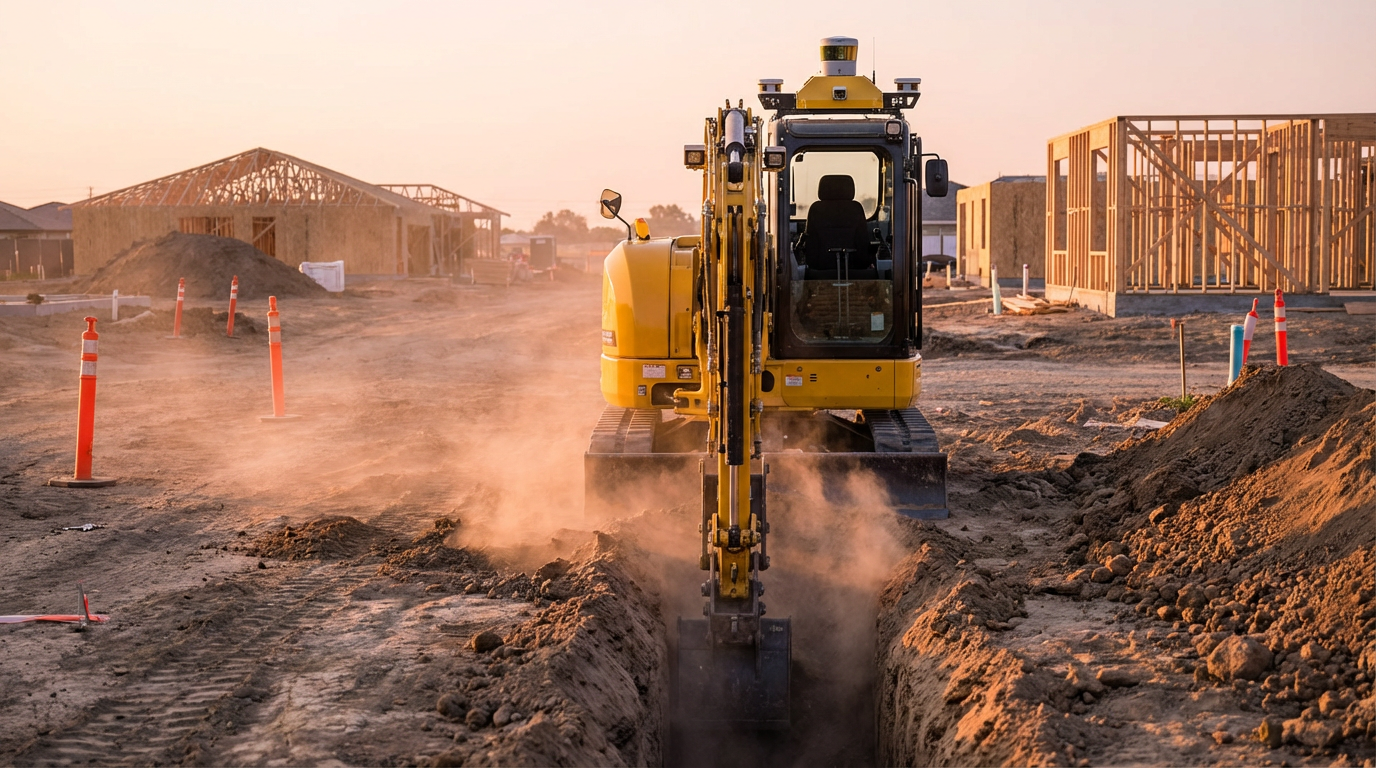
The concept is disarmingly simple. Built Robotics retrofits standard excavators, dozers, and compactors with its autonomous “Exosystem” — GPS, LiDAR, IMU sensors, and an onboard computer that turns a $300,000 machine into a self-driving one. But someone still needs to program the task, monitor execution, and intervene when conditions change. That someone is the REO.
“Together with Built Robotics, we have pioneered a model of engagement between the Union and advanced technology providers to give our members continued opportunities to learn and develop their careers.” — James T. Callahan, General President, IUOE
What the Job Actually Looks Like
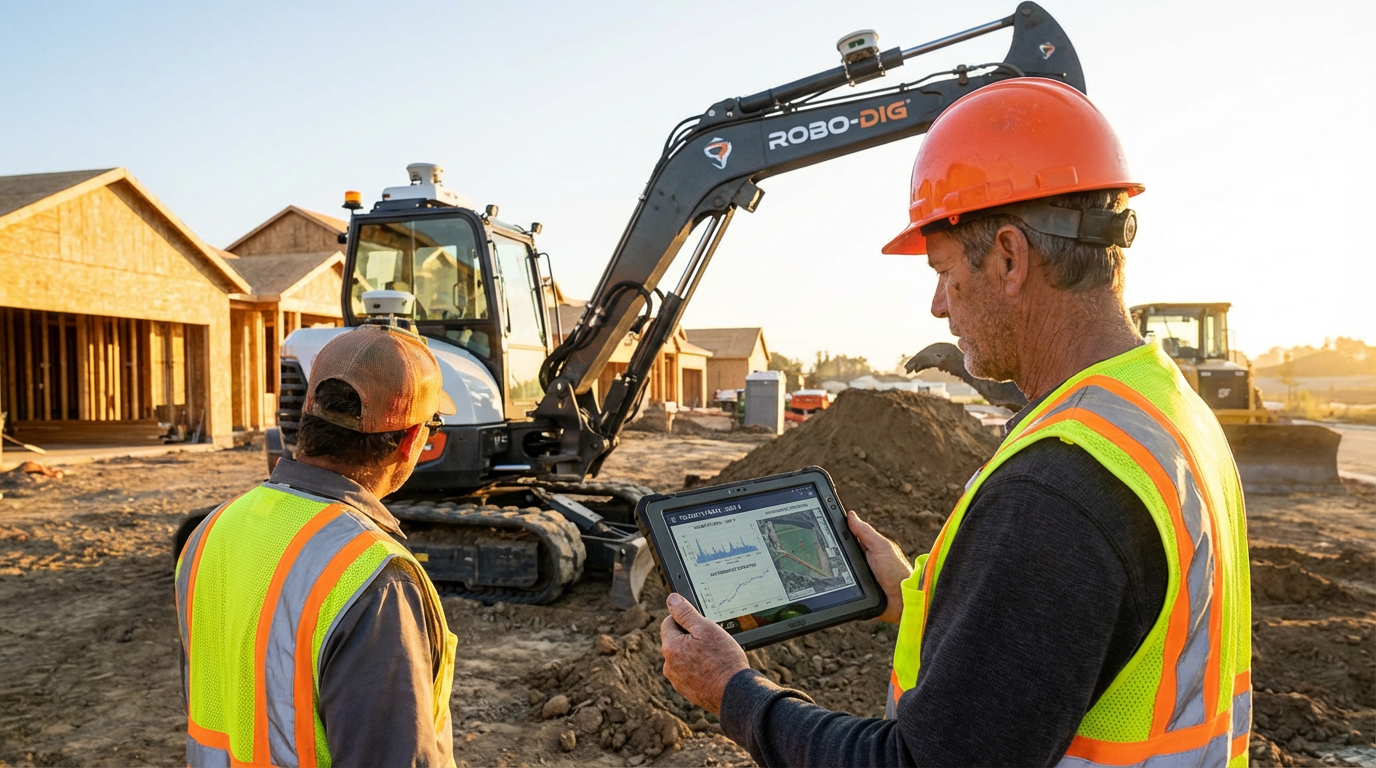
A traditional excavator operator runs one machine for eight hours. An REO supervises three to five autonomous machines simultaneously from a tablet, monitoring telemetry, adjusting dig plans, and stepping in when the AI encounters something unexpected — a buried utility line, an unusually rocky soil pocket, a grade that doesn’t match the BIM model.
The economics are transformative. One REO doing the work of three to five operators doesn’t mean three to five people lose jobs — not in a market that can’t fill 349,000 positions. It means the same crew can take on more projects, and the REO earns a premium for the expanded skill set. Heavy equipment operators currently earn a median of $50,000 to $65,000 annually. Robotics technician roles in adjacent industries command $65,000 to $90,000+, and the gap is expected to widen as demand grows.
The $1-Per-Hour Model
Here’s the detail that makes this more than a PR exercise: for every hour of work performed by a Built Robotics machine, the company contributes $1.00 to the IUOE National Training Fund. The more the robots work, the more money flows into training humans to supervise them. It’s a self-reinforcing loop — the machines literally fund their own operators’ education.
Since the partnership launched, the IUOE and Built have hosted in-person demonstrations, training seminars, and hands-on sessions at the International Training and Education Center (ITEC) and local chapters across the country. Demand for the program has grown every year.
Why This Matters for Home Building
Built Robotics has focused primarily on solar farm earthwork and utility-scale construction, where the terrain is predictable and the scale justifies autonomy. But residential construction is next. Foundation excavation, grading, trenching for utilities, backfill — these are the most labor-intensive, repetitive, and dangerous phases of building a home. They’re also exactly the tasks autonomous equipment handles best.
The construction robotics market is projected to reach $13.8 billion by 2033, growing at 19.4% CAGR. Companies like SafeAI ($67 million raised, retrofitting Komatsu and Cat machines) and Caterpillar’s Cat Command program (5+ billion tons hauled autonomously in mining, now expanding to general construction) are scaling the same model.
What makes the IUOE partnership unusual in the AI-disrupts-work narrative is the sequence: the training came before the displacement. Most industries retrain workers after automation eliminates their jobs. Construction — maybe because it’s union-heavy, maybe because it’s so desperately short-handed — is doing it the other way around. That might be the most important lesson here.