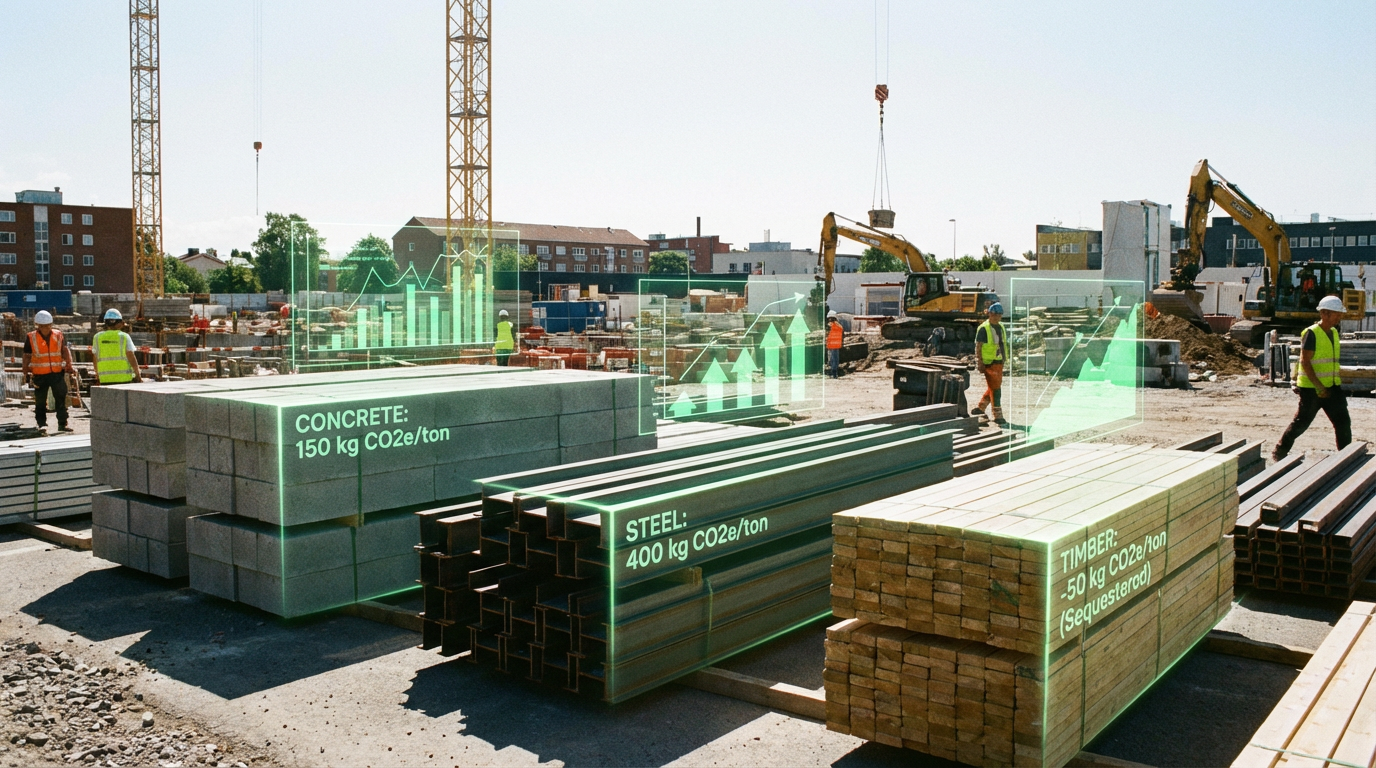
Here’s a number the solar panel salespeople never mention: roughly 11% of global carbon emissions come from manufacturing building materials. Concrete, steel, aluminum, glass — the stuff your house is literally made of generates greenhouse gases long before a thermostat gets set or a light switch gets flipped. This is embodied carbon, and for decades it was essentially invisible. Nobody measured it. Nobody asked about it. Nobody could.
That’s changing fast, and AI is the reason.
The Carbon You Can’t Insulate Away
The building sector accounts for 37% of global energy-related CO₂ emissions, according to the UN Environment Programme. About two-thirds of that is operational — heating, cooling, lighting — the stuff energy codes and heat pumps address. But the remaining third is embodied: the carbon baked into producing concrete, firing steel, transporting lumber. For a new home, embodied carbon can represent 50–70% of total lifetime emissions over a 60-year span, especially as operational efficiency improves.
The problem was never awareness. Architects and engineers knew concrete was carbon-intensive. The problem was data. A typical residential project uses hundreds of distinct materials from dozens of suppliers. Each supplier’s concrete mix, steel alloy, or insulation batch has a different carbon profile. Calculating all of it manually? Weeks of work that nobody was paying for.
EC3: The Tool That Made Carbon Countable
The Embodied Carbon in Construction Calculator (EC3), developed by the Carbon Leadership Forum at the University of Washington, was the first tool to make embodied carbon practically measurable. It cross-references building material quantities from estimates or BIM models against a database of third-party verified Environmental Product Declarations (EPDs) — essentially carbon nutrition labels for building products.
The breakthrough: EC3 doesn’t just calculate total carbon. It shows alternatives. Swap this concrete mix for that one from a supplier 40 miles away, and your foundation drops 30% in embodied carbon at the same structural performance and nearly identical cost. The tool does in seconds what used to require a sustainability consultant and a month of spreadsheets.
AI Takes It Further
One Click LCA, the Helsinki-based lifecycle assessment platform, launched Materials Compass in 2025 — a database of over 250,000 product carbon records that uses machine learning to identify lower-carbon substitutes automatically. A 2025 survey by One Click LCA found that 31% of architecture, engineering, and construction professionals reported achieving carbon reductions of up to 20% through construction lifecycle assessments — and most said the tools paid for themselves in client differentiation alone.
The AI layer matters because the substitution problem is combinatorial. A 2,000-square-foot home might have 400+ material specifications. Finding the lowest-carbon combination that still meets structural, thermal, moisture, and cost constraints is exactly the kind of multi-variable optimization problem that machine learning excels at — and humans are terrible at doing manually.
“Every kilowatt-hour the building wastes is a design failure. But so is every ton of carbon locked into materials nobody thought to question.”
What This Means If You’re Building
California’s Buy Clean Act already requires state-funded projects to meet embodied carbon limits for steel, glass, insulation, and concrete. Colorado, New York, and Oregon have similar legislation in progress. Residential codes are next — the 2030 targets in several state climate plans explicitly include embodied carbon in new construction.
For homeowners and builders, the practical takeaway is straightforward: ask your builder for an embodied carbon estimate. Tools like EC3 and One Click LCA are free or low-cost. A builder who can’t provide one in 2026 is like a builder who couldn’t provide an energy model in 2016 — not necessarily bad, but definitely behind.
The concrete in your foundation, the steel in your beams, the insulation in your walls — they carry a carbon debt that lasts the lifetime of the building. For the first time, AI makes that debt visible before the first truck arrives. The question is whether enough people will look.