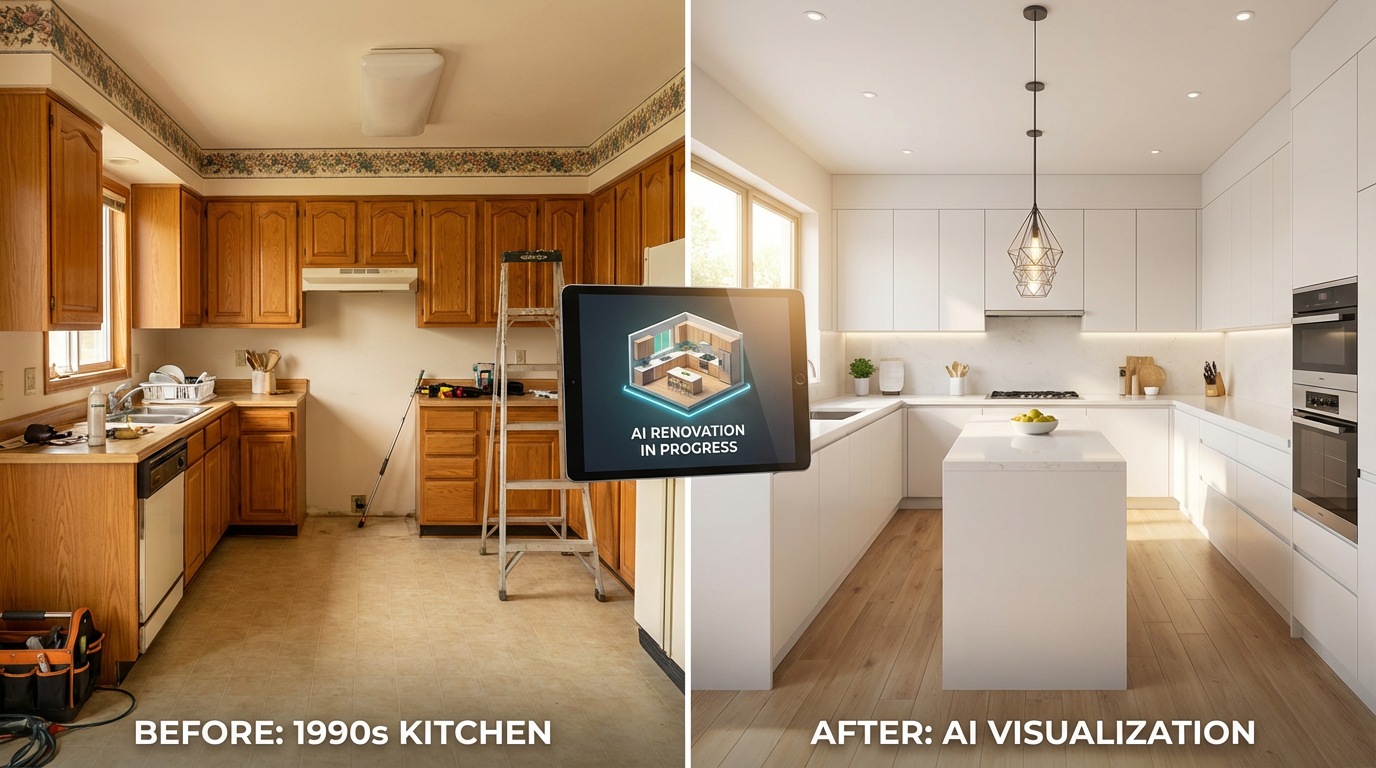
The $450 billion U.S. home renovation market has always run on a peculiar kind of faith. You tear out your kitchen based on a Pinterest board and a contractor's verbal promise, then spend six months hoping the reality matches the vision. Half the time, it doesn't. According to the National Association of Home Builders, 32% of homeowners report dissatisfaction with their renovation outcomes — and the primary reason isn't cost overruns. It's that the finished product didn't look like what they imagined.
That imagination gap is exactly where AI is now inserting itself — and the results are striking.
Snap a Photo, See the Future
HomeDesigns AI, launched in 2023, lets you upload a photo of any room and receive AI-generated visualizations of dozens of renovation styles in under 30 seconds. Modern farmhouse? Mid-century? Japanese minimalist? The tool renders each option with your actual room dimensions, lighting, and architectural features intact. It's surpassed 500,000 users and processes over 80 design styles.
RoomGPT (now Redesign AI) took a similar approach with viral results — over 5 million rooms redesigned within its first year. Users upload a smartphone photo and select a target style. The AI doesn't just swap furniture; it reasons about spatial flow, adjusting layouts to match the chosen aesthetic while respecting structural constraints like load-bearing walls and window placement.
Then there's Palette, which focuses specifically on color and material combinations. Upload your space, and the AI generates coordinated palettes across paint, flooring, countertops, and cabinetry — pulling from actual product catalogs so every suggestion is something you can actually buy. It's solving the problem every homeowner knows: the backsplash that looked perfect on the sample board clashes horribly with the countertop in situ.
From Visualization to Estimation
The real disruption isn't just pretty pictures — it's what comes after. Houzz, the dominant home renovation platform with 65 million monthly users, integrated AI visualization directly into its contractor marketplace. See the kitchen you want, then get matched with local contractors who can build it — with AI-generated cost estimates based on your specific room dimensions, local material prices, and labor rates.
The home remodeling market averaged $22,000 per project in 2025 according to HomeAdvisor, with kitchens running $35,000–$75,000. At those price points, the ability to see — really see — the outcome before committing isn't a luxury. It's risk management.
"We used to lose 40% of renovation leads at the visualization stage — clients couldn't bridge the gap between a mood board and their actual space. AI rendering cut that drop-off to 12%."
— Jamie Torres, principal at Torres Design+Build, Portland
The Contractor's New Sales Tool
Smart contractors aren't threatened by these tools — they're weaponizing them. Renovation AI platforms are becoming the new sales deck. Instead of showing clients photos of other people's kitchens, contractors now generate photorealistic renders of the client's own space in multiple design directions during the initial consultation.
Reimagine Home, backed by $4.2 million in seed funding, specifically targets the professional market. Its API lets contractors embed AI visualization into their own websites and proposal documents. The pitch becomes: "Here's exactly what your home will look like — and here's exactly what it will cost."
The technology also catches expensive mistakes before they happen. AI can flag that the island layout you love would block the traffic triangle between stove, sink, and refrigerator. Or that the pendant lights in your inspiration photo require 9-foot ceilings when yours are 8. These are the kinds of discoveries that traditionally happen mid-demolition.
What's Still Missing
The current generation of AI renovation tools excels at aesthetics but still stumbles on engineering. They can show you a stunning open-concept kitchen but won't tell you whether removing that wall requires a $15,000 structural beam. They generate beautiful bathroom layouts but don't check local plumbing codes.
That's changing. Autodesk's Forma and TestFit are building the bridge between visual AI and structural analysis, though both currently target commercial construction. The residential crossover is inevitable — probably within 18 months.
For now, AI renovation tools do something profoundly simple: they make the invisible visible. And in an industry where the gap between expectation and reality costs homeowners billions in regret every year, seeing the future of your kitchen before you demolish the present one might be the most valuable upgrade of all.