The plumber showed up at 7 a.m. on a Tuesday with a reciprocating saw and a question: “Which side of this stud is the supply line on?”
Nobody knew. The builder retired in 2019. The original blueprints showed a layout that three change orders had made fictional. So the plumber guessed, cut a 16-by-24-inch rectangle out of finished drywall, found the pipe on the other side, cut a second hole, fixed the leak, and left the homeowner with an $1,800 bill — $340 for the actual repair, $460 for exploratory demolition, and the rest for patching, texturing, and paint matching.
The pipe was eleven inches from where the prints said it would be.
Two Weeks of Visibility, Then Permanent Dark
Between rough-in and drywall, every pipe, wire, duct, and framing member in a house is exposed. Photographable. That window lasts about two weeks on a typical single-family build. Then the drywall goes up and the house forgets itself.
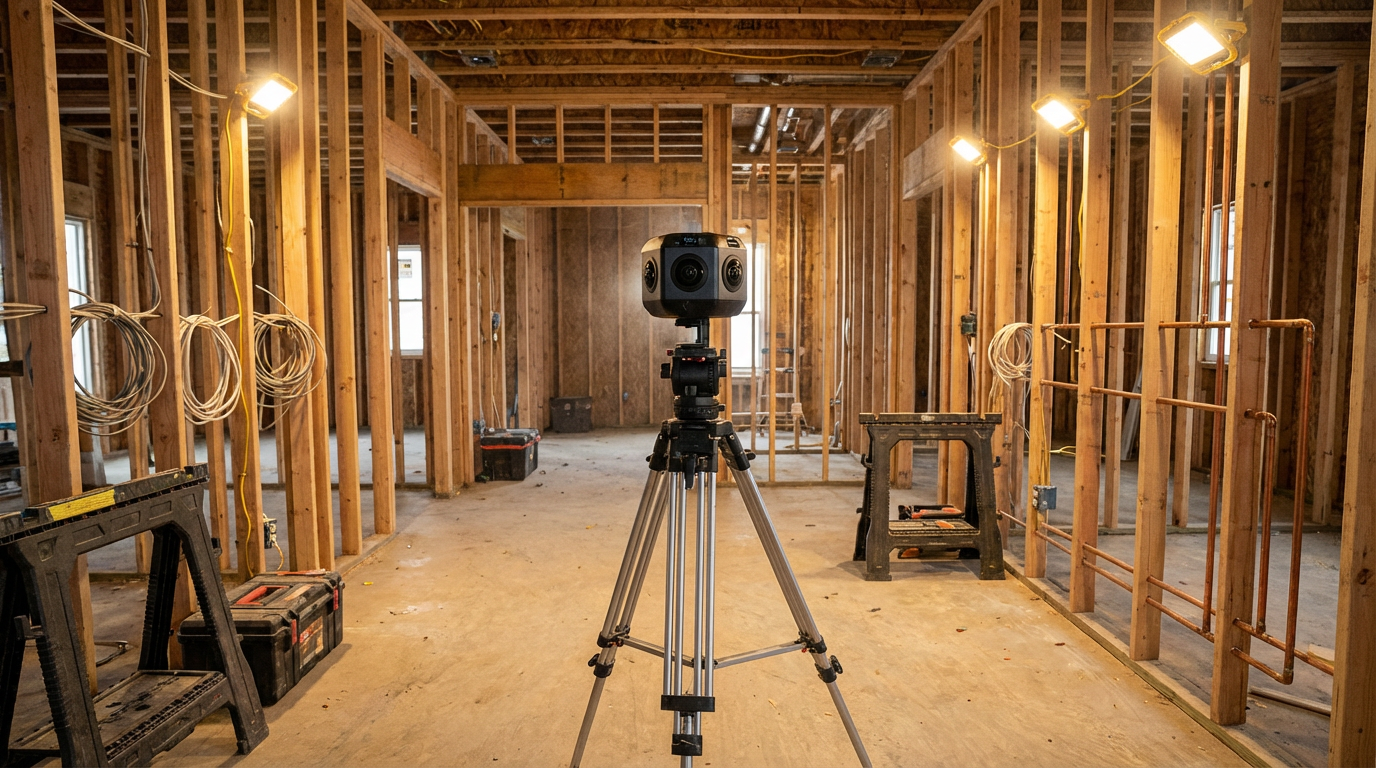
A 360° photo walkthrough of the pre-drywall stage takes forty minutes for a 2,500-square-foot house. An iGUIDE operator charges $300 to $500 and produces dimensionally accurate floor plans plus navigable 360° imagery the homeowner can bookmark forever. Own an Insta360 X4 and a hardhat mount and it costs the camera and your time.
Forty minutes. Three hundred bucks. Almost nobody does it.
When the Camera Gets Smarter Than the Clipboard
OpenSpace takes the concept further. Their system maps 360° images to the floor plan using computer vision, stitches captures across time, and — on jobs with BIM models — auto-flags what’s behind schedule. Plumbing rough-in complete in bathroom two? Tagged. Electrical boxes missing from the north wall? Flagged before the super finishes his coffee.
They raised a $102 million Series D last year across more than 10,000 jobsites. That kind of capital doesn’t chase documentation tools unless the rework numbers justify it. The Construction Industry Institute pegs the average rework event at $8,300 and 3.4 lost days. On a custom home, one event blows a schedule and generates a phone call nobody wants to make.
But OpenSpace isn’t built for you. It’s built for general contractors running $50-million portfolios where per-project cost drops across hundreds of units. Same for Buildots. Same for Doxel. The residential custom builder? Still outside the tent.
The Cheap Version Works Fine
You don’t need AI tagging. You don’t need BIM integration. You need a visual record.
iGUIDE started as a real estate marketing tool and backed into construction documentation because their operators were already inside houses with 360° cameras. Three hundred bucks, dimensionally accurate floor plans, and a navigable walkthrough the homeowner can pull up five years later when something starts leaking. No wizardry. Just a record.
And there’s the phone in your pocket. Every iPhone Pro since the 12 Pro has a LiDAR scanner accurate to about one centimeter at close range. Polycam turns a ten-minute walk into a 3D mesh with pullable measurements. Not engineering-grade. More than enough to tell a plumber which side of the stud the supply line is on.
What a Camera Can’t Catch
A beautiful 360° scan of bad plumbing is still bad plumbing.
Documentation doesn’t replace inspection. A third-party pre-drywall walk — $250 to $500 for a new-construction home, per Angi — catches code violations, missing fire blocking, improperly supported ducts. The scan captures where things are. The inspector catches whether they’re right.
And the scans still aren’t searchable the way you want. You can’t type “show me the cold water supply line in the master bath” and get a pinpoint. You scrub through images manually, same way you’d swipe through vacation photos hunting for one shot. AI tagging of individual pipes and wires in 360° imagery is something OpenSpace and Buildots are both chasing — but residential-grade, component-level recognition isn’t shipping yet. For now, it’s a visual record. Not a queryable database.
The Math After the First Leak
Behind-wall water damage remediation runs $1,500 to $4,000. Knowing exactly where the supply lines sit cuts exploratory demolition roughly in half. Insurance adjusters — paying out 29.4% of all homeowner claims on water damage (Insurance Information Institute) — would love for this documentation to exist on every home they underwrite. Nobody’s offering discounts for it yet. But anyone who’s ever filed a water damage claim knows that the paperwork goes faster when someone can prove where the pipes were supposed to be.
The Plumber’s Next Visit
He’s coming back. Different house, same problem. He’ll bring a saw and a bill, and he’ll ask the same question he always asks: which side of the stud?
A forty-minute walk with a $300 camera would have answered it three years ago.
Sources: Articulate — Real Cost of Construction Rework (CII $31.3B, 52% documentation-related) · IT Digest — OpenSpace $102M Series D Financing · OpenSpace — 360° Jobsite Capture Platform · iGUIDE — Behind-the-Walls Documentation · Angi — Pre-Drywall Inspection Cost and Water Damage Remediation · Insta360 — Enterprise Construction Documentation · Buildots — AI Construction Progress Tracking · Insurance Information Institute — Homeowner Insurance Claims Data