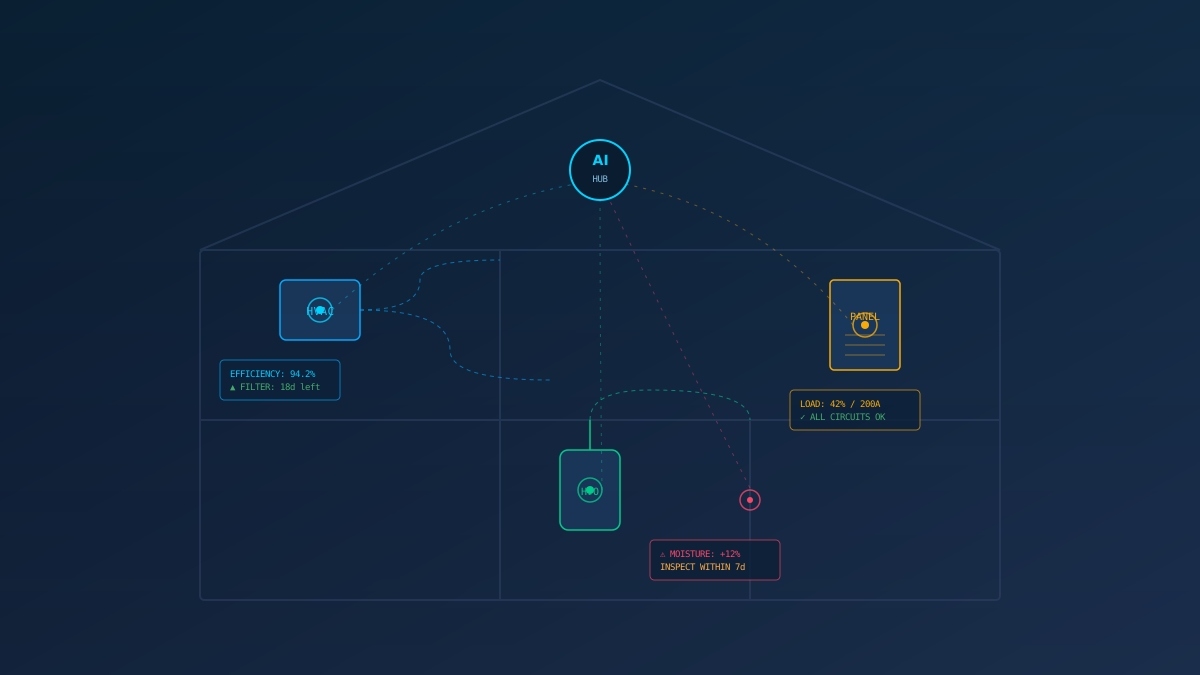
Here is a number that should make every homeowner uncomfortable: the average emergency HVAC repair costs $300 to $600. The average emergency HVAC replacement — the kind that happens when your furnace quits at 2 AM on the coldest night of January — costs $5,000 to $12,000. The difference between those two numbers is almost always a warning sign that nobody heard. AI is learning to hear it.
The $14,000 Leak You Didn’t Know About
Water damage is the single most common homeowner insurance claim in the United States, averaging roughly $14,000 per incident according to the Insurance Information Institute. Most of these aren’t dramatic pipe bursts — they’re slow leaks behind walls, under slabs, inside supply lines that drip for weeks or months before anyone notices the warped floorboard or the mold bloom.
Flo by Moen attacks this problem at the main water line. Its ultrasonic sensor measures flow rate, pressure, and temperature 240 times per second, then feeds that data through machine learning models that learn your household’s water fingerprint. A toilet flush looks different from a shower, which looks different from an irrigation cycle. When the system detects a pattern that matches no known fixture — a slow, constant 0.5 GPM draw at 3 AM — it flags a potential leak and can automatically shut off the main valve.
Hippo Insurance has made the connection explicit: install smart sensors, get lower premiums. Their partnership with ADT puts professionally installed water, smoke, and temperature sensors in policyholder homes. The pitch is straightforward — a $200 sensor kit that catches a leak early saves the insurer $14,000 in claims and the homeowner $5,000 in deductibles and disruption. Hippo now operates across 32 states with what they call a “protective home insurance platform” — AI and data baked directly into the underwriting model.
HVAC: The Biggest Blind Spot
Your HVAC system accounts for roughly 40% of your home’s energy consumption and is the single most expensive system to replace. Yet most homeowners interact with it exactly once a year — when they change the filter (if they remember). Predictive maintenance platforms are wiring into this blind spot.
Modern connected thermostats like Nest and Ecobee already track cycle frequency, runtime, and temperature differential. AI models trained on this data can detect compressor degradation — the system running longer and longer to hit the same setpoint — weeks before it fails entirely. The estimated energy savings from AI-optimized HVAC operation: 10 to 15 percent, which on a $200/month utility bill adds up to $240–$360 annually.
“The data was always there. Your furnace has been screaming into the void for years. We’re just finally building the microphone.” — residential HVAC diagnostics engineer
The Sensor Ecosystem
Notion takes a multi-sensor approach — small pucks that monitor temperature, humidity, water presence, door/window state, and smoke alarm activation. Pair them with a Nest thermostat and you get a crude but functional whole-home monitoring system for under $500. The sensors last 8–12 years on a single battery, which matters for the “set it and forget it” homeowner who will never open a maintenance app voluntarily.
On the electrical side, panel-mounted monitors like Sense use machine learning to disaggregate your home’s total electrical load into individual device signatures. It can tell you that your refrigerator compressor is drawing 15% more power than last month — a classic early indicator of a failing unit — without any sensor attached to the fridge itself.
The Catch: 60% Fail
Industry data suggests roughly 60% of predictive maintenance implementations fail in their first year — not because the sensors don’t work, but because the humans on the receiving end ignore the alerts, misinterpret the recommendations, or simply get tired of the notifications. The gap between “your system detected an anomaly” and “a licensed plumber is at your door tomorrow” remains massive.
Hippo’s ADT partnership is an attempt to close that loop — professional monitoring behind the sensors, with a human response chain when something triggers. But for the DIY smart-home crowd, the last mile is still a text message that says “unusual water flow detected” and a homeowner who has to figure out what to do about it at midnight.
The technology is ready. The sensors are cheap. The AI models are accurate. What’s missing is the connective tissue between detection and action — and that’s a service design problem, not a technology one. The first company to truly solve it will own the most valuable real estate in prop-tech: the moment between “something’s wrong” and “it’s already fixed.”