The wall cavity was sealed on a Tuesday. Drywall up, tape and mud, primer coat by Thursday. Three months later the homeowner noticed a brown stain spreading behind the bathroom mirror. Remediation cost: $14,200. The source was a missed drip at a copper-to-PEX transition fitting that had been leaking at maybe two drops per minute since the day the walls closed.
Two drops per minute. Into a sealed cavity. For ninety days.
I framed houses for six years before I picked up a laptop. In that time I never once saw a builder do a moisture scan before hanging drywall. Not because they didn’t care. Because nobody offered one that made sense for a $400,000 house.
That’s changing.
The Damage Before You See It
Water damage accounts for 29.4% of all homeowner insurance claims, according to the Insurance Information Institute. Average payout: $11,605. Roughly 14,000 Americans file a water damage claim every single day—one in sixty insured homes per year.
Mold remediation, when it gets that far, averages $2,367 nationally according to HomeAdvisor’s 2025 data, with the range running $1,223 to $3,753 for typical jobs. Severe cases—basement flooding, extensive wall cavity contamination—can hit $30,000 or more.
And the NIOSH Dampness and Mold Assessment Tool report, published in 2022, pulled together decades of survey data and landed on a number that should bother everyone in residential construction: a population-weighted average of 47% of U.S. residential buildings showing signs of dampness or mold. Nearly half. The EPA’s BASE study of commercial buildings was worse—85% had experienced past water damage, 45% had active leaks.
None of this is visible when the walls are open. That’s the window.
The $300 Window
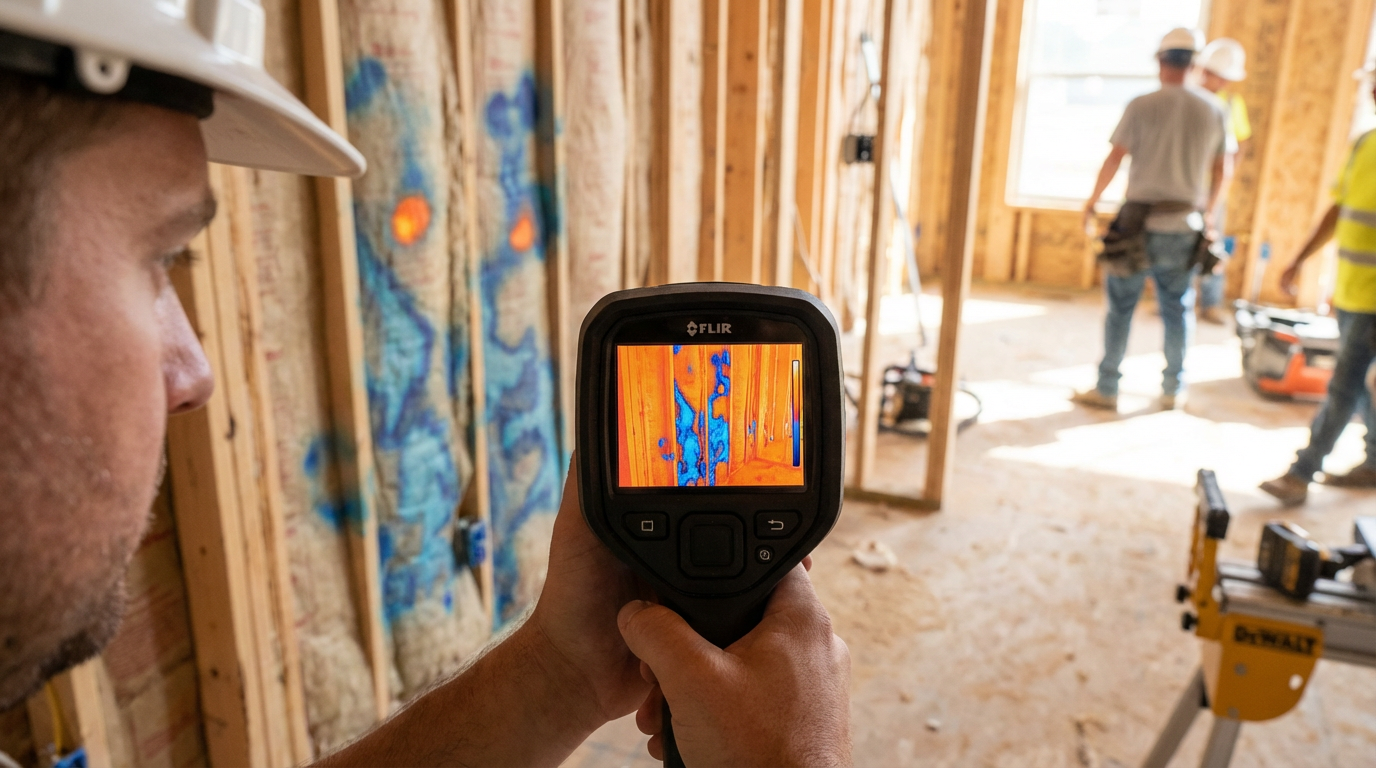
Between the pressure test and the drywall hang, there’s a 48-to-72-hour gap where every pipe, fitting, duct boot, window flashing, and exterior penetration is exposed and testable. A thermal scan of the framing cavities during this window costs $200–$400. After drywall, the same investigation requires cutting holes, and remediation if you find something starts at ten times that price.
| Timing | Method | Cost | What It Catches |
|---|---|---|---|
| Pre-drywall | FLIR thermal + visual + moisture meter | $200–$400 | Active leaks, condensation paths, flashing failures |
| Post-occupancy | Mold remediation | $1,223–$30,000+ | The same problems, three months later |
| Post-occupancy | Insurance claim + repair | $11,605 avg | After the damage is done |
The math is brutal. A $300 scan versus a $15,000 problem. And the scan isn’t theoretical—FLIR One Pro cameras retail for under $400, and a 2025 study published in MDPI Buildings found that deep learning models applied to thermal images achieved 92% precision in detecting moisture anomalies, compared to 72% for conventional visual analysis.
The Machines
| Tool | What It Does | Why It Matters |
|---|---|---|
| Sensor Innovation (Norway) | Hybrid-AI wireless moisture sensors, 30-year battery | Embedded in walls during construction, monitors cavity moisture permanently |
| Sensirion SEN6x | Multi-parameter sensor: VOC, humidity, temperature, particulates | $15 sensor platform for continuous indoor air quality + moisture monitoring |
| Build Test Solutions Heat3D | FLIR One Pro + AI calculates actual U-values (ISO 9869-2) | Turns a $400 camera into a diagnostic tool that quantifies thermal performance |
| Inspekt AI | Drone-based thermal façade scanning | 200+ buildings inspected, catches moisture at building envelope scale |
| Bry-Air BryScan | Continuous moisture monitoring with IoT cloud platform | Commercial-grade, real-time alerts when moisture exceeds thresholds |
The Norwegian company Sensor Innovation stands out. Their sensors are designed to be embedded in wall assemblies during construction—30-year battery life, wireless, hybrid-AI analysis that learns the building’s normal moisture profile and alerts when something deviates. You install them like you’d install junction boxes. Then you forget about them for three decades while they watch the one thing that destroys more homes than fire.
On the cheaper end, Sensirion’s SEN6x platform packs VOC, humidity, temperature, and particulate sensing into a single module for about $15 at volume. Pair six of them with a Raspberry Pi and you have a whole-house moisture monitoring system for under $200 in hardware. It won’t diagnose a hidden leak, but it’ll tell you when the bathroom exhaust fan stops working before the ceiling does.
What Doesn’t Work Yet
Thermal cameras are diagnostic, not prophetic. They see temperature differentials caused by moisture, but they can’t distinguish between a leak and condensation from a temperature gradient. A cold water pipe running through a warm cavity looks exactly like a slow drip on a thermal image. You still need a human with a pin moisture meter to confirm.
Embedded sensors solve the false-positive problem—they measure actual moisture content, not thermal proxies—but they require installation during construction. Retrofit is possible but invasive and expensive. If you’re buying an existing home, you’re back to the thermal camera.
And the coverage gap is residential. Most of these tools were built for commercial buildings, data centers, and hospitals where a moisture failure means millions in downtime. A custom builder doing six houses a year isn’t buying a Bry-Air industrial monitoring system. The residential-grade market is just beginning to form.
What to Actually Do
If you’re building: demand a pre-drywall thermal scan. Budget $300. Tell your builder you want it after the pressure test and before the insulation crew. If they resist, that tells you something about what they expect to find.
If you’re building new and have the budget: embed continuous moisture sensors in high-risk areas—bathrooms, laundry rooms, kitchen sink walls, exterior corners, and anywhere plumbing penetrates the envelope. Add $400–$800 to the build cost. You’ll know about the leak before the stain appears.
If you own an existing home: buy a FLIR One for your phone. Scan around windows, behind toilets, under sinks, and along exterior walls after rain. It’s not a professional inspection, but it’s $400 worth of early warning that most homeowners don’t have.
Water is patient. It doesn’t care about your timeline or your mortgage. Two drops per minute, ninety days, and the wall assembly you sealed last quarter becomes the remediation bill you didn’t budget for this quarter. The sensors exist to see it coming. Use them.
Sources
- NIOSH (2022). “NIOSH Dampness and Mold Assessment Tool (DMAT): Documentation and Data Analysis.” Population-weighted 47% prevalence of dampness/mold in U.S. residential buildings. cdc.gov/niosh
- Insurance Information Institute. Water damage and freezing claims represent 29.4% of all homeowner claims, avg payout $11,605. iii.org
- HomeAdvisor (2025). “How Much Does Mold Remediation Cost?” National avg $2,367, range $1,223–$3,753, up to $30,000+ for severe cases. homeadvisor.com
- MDPI Buildings (2025). Deep learning thermal anomaly detection achieves 92% precision vs 72% conventional. Alexakis et al., “Automated Detection of Rising Damp on Historical Masonries.” mdpi.com/buildings
- Sensor Innovation (Norway). Hybrid-AI wireless moisture sensors with 30-year battery life for permanent structural monitoring. businessnorway.com
- Sensirion. SEN6x multi-parameter environmental sensor platform (VOC, humidity, temperature, particulates). sensirion.com
- Build Test Solutions. Heat3D: FLIR + AI thermal performance measurement (ISO 9869-2 compliant). Referenced in building performance gap research.
- EPA. BASE Study of 100 U.S. commercial office buildings: 85% past water damage, 45% active leaks. epa.gov
- Inspekt AI. Drone-based thermal façade scanning, 200+ buildings inspected. inspektai.com