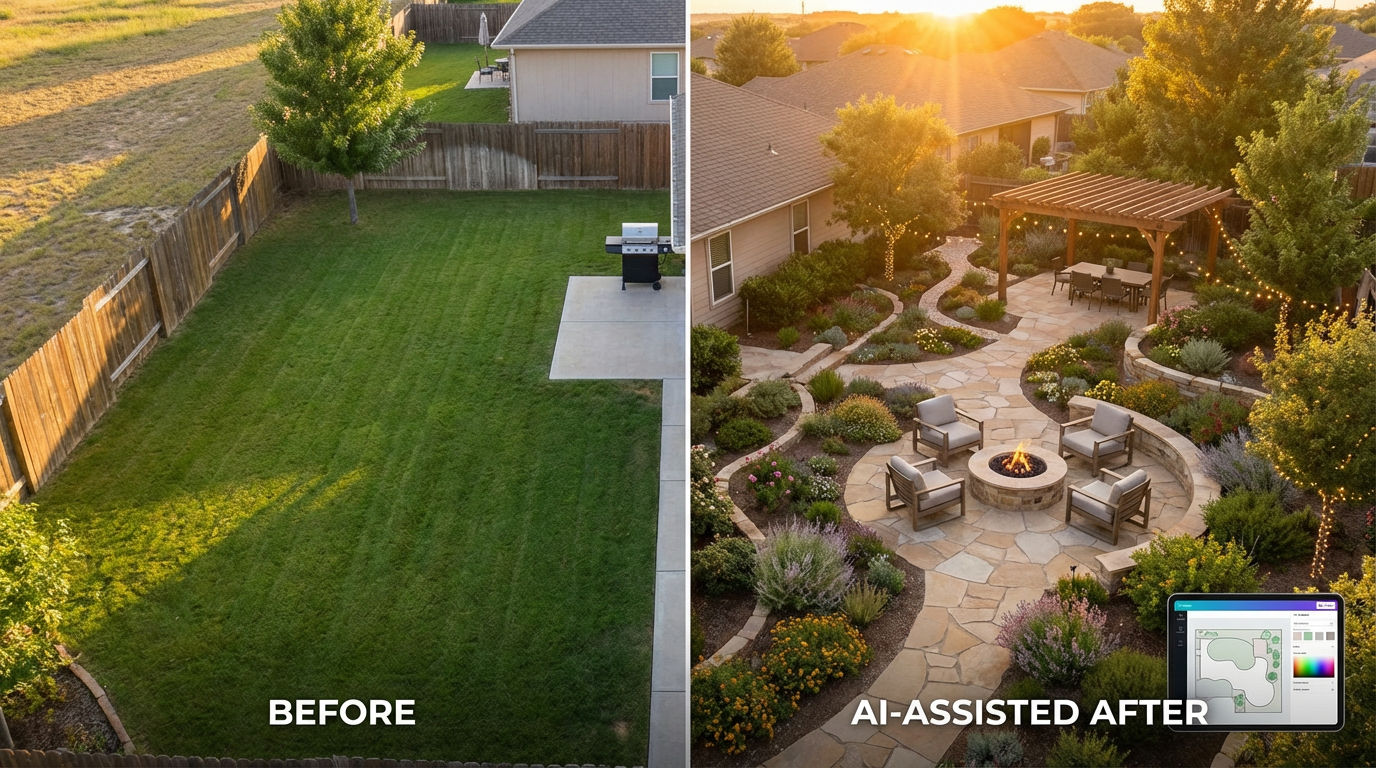
The American landscaping industry is worth $184.1 billion. It employs 1.5 million people across 726,000 businesses. And until very recently, the first step in any residential landscape project was the same ritual it had been for decades: a designer drives to your house, walks the yard, takes some photos, disappears for two to four weeks, and returns with a single concept board. Price for that consultation? $1,800 to $7,500, according to HomeAdvisor’s 2025 data. You haven’t planted a single shrub yet.
That bottleneck is collapsing. A new generation of AI landscape design tools lets homeowners upload a photo of their yard, select a style — modern minimalist, English cottage, drought-tolerant xeriscape, tropical resort — and receive photorealistic renderings of their transformed property in under a minute. Some are free. The most expensive run $30 a month. The professional landscape design industry is about to discover what travel agents learned in 2001.
The Tools: From Phone Snap to Paradise
The market has segmented into four tiers, each attacking a different part of the design workflow.
Instant visualizers are the most accessible. Paintit.ai, RescapeAI, and Neighborbrite accept a single photo of your yard and generate AI-rendered transformations in seconds. These are the tools that make a homeowner say, “Oh — that’s what a flagstone patio would look like here.” Paintit.ai extends this to the whole home — exterior paint, interior rooms, landscaping — in a single ecosystem. The limitation: they produce beautiful images, not construction documents. You’ll still need someone to actually build it.
AR-first platforms add a layer of spatial reality. iScape, the most established mobile app in the category, lets you point your phone at your yard and drag virtual plants, trees, hardscape elements, and furniture into the live camera view. It’s IKEA Place for your backyard. The advantage over flat image generation: you can walk around the space and see how the design looks from every angle. The disadvantage: you’re placing individual items, not generating a cohesive design concept.
End-to-end design platforms bridge visualization and execution. Yardzen, founded in 2018 and acquired by Oldcastle APG (a CRH company) in November 2024, pairs AI-generated design concepts with human designers who refine them, then connects homeowners with vetted local contractors for installation. It’s the full funnel — from “I hate my yard” to “here’s a contractor who can start next month.” The CRH acquisition signals where the building materials industry thinks the demand signal is moving: upstream into design, where product decisions actually get made.
Professional CAD tools remain the top tier. SketchUp, Vectorworks Landmark, and AutoCAD still produce the construction-ready documents that permits require and contractors build from. AI is creeping in here too — automated plant schedules, instant quantity take-offs, AI-suggested layouts optimized for sun exposure and irrigation zones — but the learning curve keeps these in professional hands.
The Economics: Why This Matters More Than It Looks
Landscape design has a conversion problem. The National Association of Landscape Professionals estimates that over 75% of homeowners who consider a landscaping project never start one. The primary barrier isn’t cost — it’s imagination. People can’t visualize what their yard could be, so they live with what it is.
AI visualization attacks that exact friction point. When a homeowner can see their specific yard — not a stock photo, not a neighbor’s yard, theirs — transformed into something beautiful in 30 seconds, the conversion barrier drops dramatically. Yardzen reported that homeowners who saw AI-rendered designs of their own property were significantly more likely to proceed with a project than those shown generic portfolio examples.
This matters economically because outdoor living spending is booming. The U.S. outdoor living structures market is growing steadily, driven by remote work (the backyard became an extension of the home office) and climate adaptation (shade structures, drought-tolerant plantscaping). Smart irrigation alone is projected to reach $5.8 billion by 2033 at 12% CAGR, according to IMARC Group. The EPA estimates smart controllers save an average of 15,000 gallons per household annually — $4.5 billion in aggregate water savings.
The Sustainability Angle: AI as Water Cop
Here’s where the technology starts to matter beyond aesthetics. Xeriscaping — landscape design that minimizes water use — has gone from a niche Western concern to a national trend as drought patterns intensify across the Sun Belt. But most homeowners don’t know which native plants work in their specific USDA zone, how much sun their north-facing fence line gets in December, or whether their soil drains fast enough for a rain garden.
AI tools are starting to incorporate these environmental parameters. Upload your address and the system pulls USDA hardiness zone, average rainfall, sun angle throughout the year, and local water restrictions. The design suggestions aren’t just pretty — they’re ecologically appropriate. A modern xeriscape design generated for a Phoenix yard will look fundamentally different from one generated for Portland, not because the homeowner specified it, but because the algorithm knew.
“The biggest shift isn’t that AI makes design faster. It’s that AI makes appropriate design the default. When the tool automatically suggests native plants for your zone, the client doesn’t have to think about sustainability. It just happens.” — Landscape architect interviewed for this story
What’s Still Missing
The gap between a beautiful AI render and a buildable landscape plan remains wide. No consumer AI tool currently produces grading plans, drainage calculations, irrigation schematics, or the structural details needed for retaining walls and elevated decks. For anything beyond plant-and-mulch, you still need a licensed landscape architect or designer.
The liability question is also unresolved. If an AI suggests a tree species whose root system destroys your foundation in five years, or positions a retaining wall that fails because it didn’t account for the water table, who’s responsible? Professional designers carry E&O insurance. AI tools have terms of service.
But here’s the thing landscape professionals should understand: the threat isn’t replacement. It’s that AI is creating millions of newly informed clients who arrive at the first consultation with specific, visualized expectations instead of vague wishes. That changes the entire dynamic of the professional relationship — for the better, if designers are willing to adapt, and devastatingly, if they’re not.
The $184 billion industry isn’t shrinking. But the $6,000 “let me think about your yard for three weeks” phase of it? That part is over.