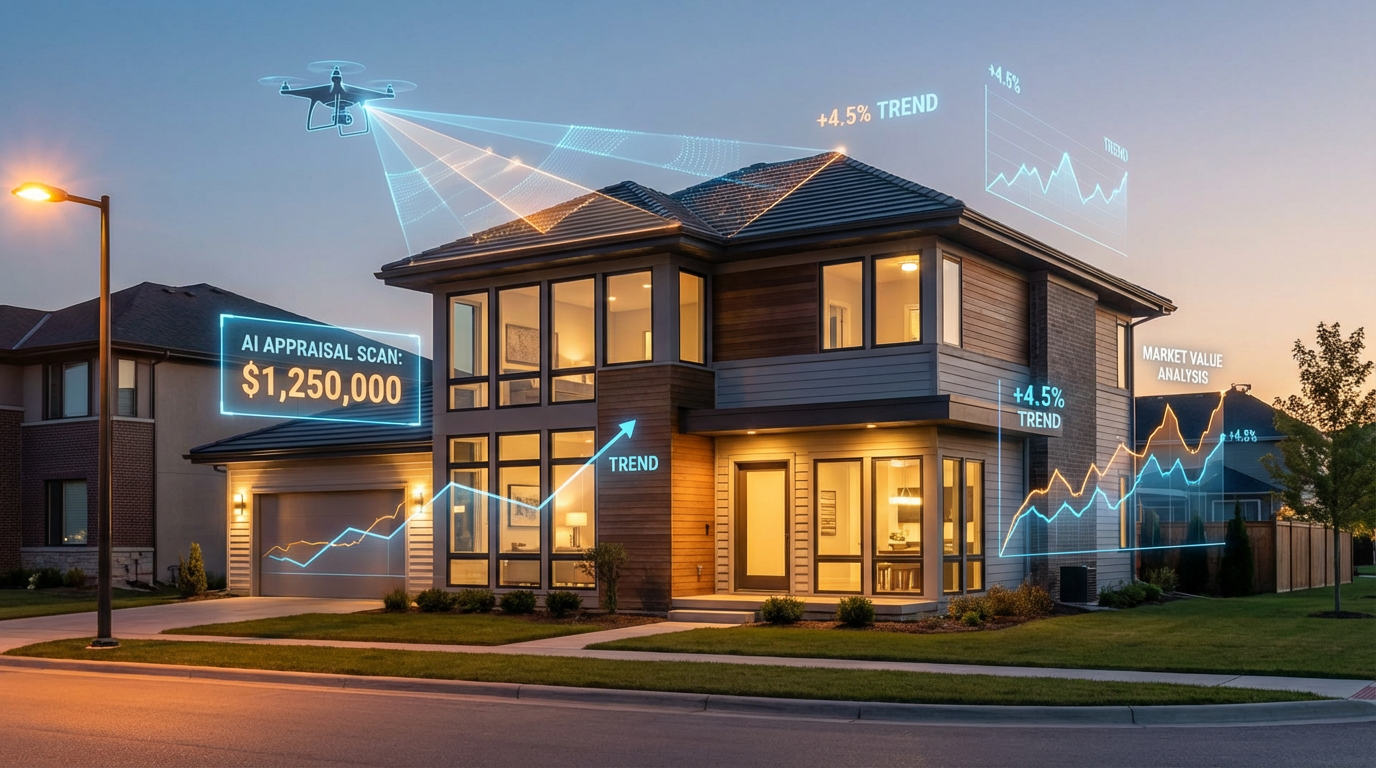
Last October, the Federal Housing Finance Agency did something that would have been unthinkable a decade ago: it raised the loan-to-value ceiling for appraisal waivers on purchase mortgages from 80% to 90%, and pushed inspection-based waivers all the way to 97% LTV. Translation: if you’re putting down as little as 3%, Fannie Mae and Freddie Mac may let you skip the $500 human appraisal entirely — because their AI already knows what your house is worth.
The $500 Visit That Takes Two Weeks
The traditional home appraisal is a strange ritual. A licensed professional drives to your home, spends 30–60 minutes measuring rooms and photographing fixtures, then disappears for 7–14 days to compile a report comparing your property to three recent “comps.” The fee ranges from $400 to $700 depending on your market. The whole process is essentially a human doing what a database could do in seconds: matching your home’s features against similar recent sales in the neighborhood.
The problem isn’t just speed. It’s subjectivity. A Brookings Institution study found that homes in majority-Black neighborhoods were appraised at 21–23% lower than comparable properties in majority-white neighborhoods, even after controlling for structural characteristics. The same house, same condition, same square footage — valued differently depending on which appraiser walked through the door and which neighborhood they drove through.
The Machines That See 116 Million Homes
Zillow’s Zestimate covers over 116 million U.S. homes and achieves a 1.83% median error rate on listed properties. That means on a $500,000 home, the algorithm is typically within $9,150 of the eventual sale price. The model ingests county tax records, MLS feeds, hundreds of property features, and real-time market data — far more information than any individual appraiser could process in a two-week turnaround.
“AI removes subjectivity and creates a scientific process that can handle vast fields of data — updating valuations automatically as market conditions change.”
Zillow isn’t alone. Redfin’s Estimate, CoreLogic’s analytics platform, and HouseCanary all deploy machine learning models trained on millions of transactions. CoreLogic processes data on virtually every residential parcel in the country. HouseCanary’s platform combines traditional comparable-sales analysis with computer vision that can assess a property’s condition from listing photos — detecting renovated kitchens, dated fixtures, and curb appeal without anyone stepping foot on the property.
What the AI Actually Sees
Modern automated valuation models go far beyond square footage and bedroom count. A landmark MIT study demonstrated that computer vision models could assess interior design quality, renovation status, and aesthetic appeal from listing photographs alone — and that adding these visual scores to traditional models improved prediction accuracy by up to 89% on certain metrics.
The most advanced systems now incorporate geospatial intelligence: proximity to transit, school district quality, flood zone risk, wildfire exposure, crime statistics, and even neighborhood sentiment signals scraped from social media. Two identical houses get different valuations if one sits near a park and the other borders an industrial zone — a distinction human appraisers have always made intuitively, but AI can now quantify and standardize.
Climate risk is the newest frontier. Insurers and lenders are increasingly factoring in wildfire, flood, and hurricane exposure scores from firms like ZestyAI (scoring 150 million+ properties) and First Street Foundation. A home that looks identical to its neighbor on paper may be worth $30,000 less if the algorithm detects it sits in a 100-year floodplain that’s now flooding every 25 years.
The Regulatory Shift
FHFA’s October 2024 announcement wasn’t a surprise — it was the culmination of years of “appraisal modernization.” The numbers tell the story: during the pandemic peak in March 2021, nearly 50% of GSE-backed loans used appraisal waivers. That settled to about 16% by mid-2025, but the regulatory direction is clear. Freddie Mac already allows nearly one in five purchase loans to close without a traditional appraisal. Fannie Mae’s newer high-LTV waiver program saw adoption jump from 2% to 15% within four months of launch.
The expansion isn’t replacing appraisers everywhere — yet. Complex properties, rural areas with thin transaction data, and homes with unique features still need human eyes. But for the cookie-cutter suburban tract home that makes up the majority of American housing stock? The algorithm has already won.
What This Means for New Construction
Here’s where it gets interesting for builders. New construction appraisals are notoriously difficult because there are often no direct comps — the home didn’t exist six months ago. Traditional appraisers rely on comparable sales from nearby subdivisions, which may not reflect the builder’s actual costs or the market’s willingness to pay for energy-efficient design, smart home features, or novel construction methods like 3D printing.
AI models trained on new-construction data can assess builder reputation, subdivision absorption rates, and premium-over-resale patterns far more granularly than a human appraiser comparing three comps. For builders using innovative methods — ICON’s 3D-printed walls, Hadrian X’s robotic bricklaying, CLT mass timber framing — this matters enormously. An AI that understands the energy performance data and structural warranties of these novel systems can price them fairly. A human appraiser who’s never seen a 3D-printed home will likely default to conservative comparisons.
The Bias Problem Isn’t Solved
There’s a catch. AI models are trained on historical transaction data — and that data reflects decades of discriminatory appraisal practices. If homes in minority neighborhoods were systematically undervalued by human appraisers for 50 years, the algorithm will learn those patterns and perpetuate them unless explicitly debiased. FHFA acknowledged this by simultaneously expanding the Uniform Appraisal Dataset to include FHA loan data, creating a broader and more representative training set.
The question isn’t whether AI appraisals are biased. It’s whether they’re less biased than the human system they’re replacing. The early evidence says yes — standardized algorithms don’t have bad days, don’t make snap judgments about neighborhood “character,” and can be audited for disparate impact in ways that individual appraisers never could. But “less biased than terrible” isn’t the same as fair.
For homebuyers: If your lender offers an appraisal waiver, you’ll save $400–$700 and close days faster. But you lose the independent check on whether the purchase price is reasonable. For a first-time buyer in a hot market, that check might be worth paying for.
For builders: The shift toward AI valuation is a tailwind. The more data your homes generate — energy performance, smart sensor readings, construction quality documentation — the better the algorithms can price them. Start treating your build data as an asset. It may soon be worth more than the appraisal it replaces.