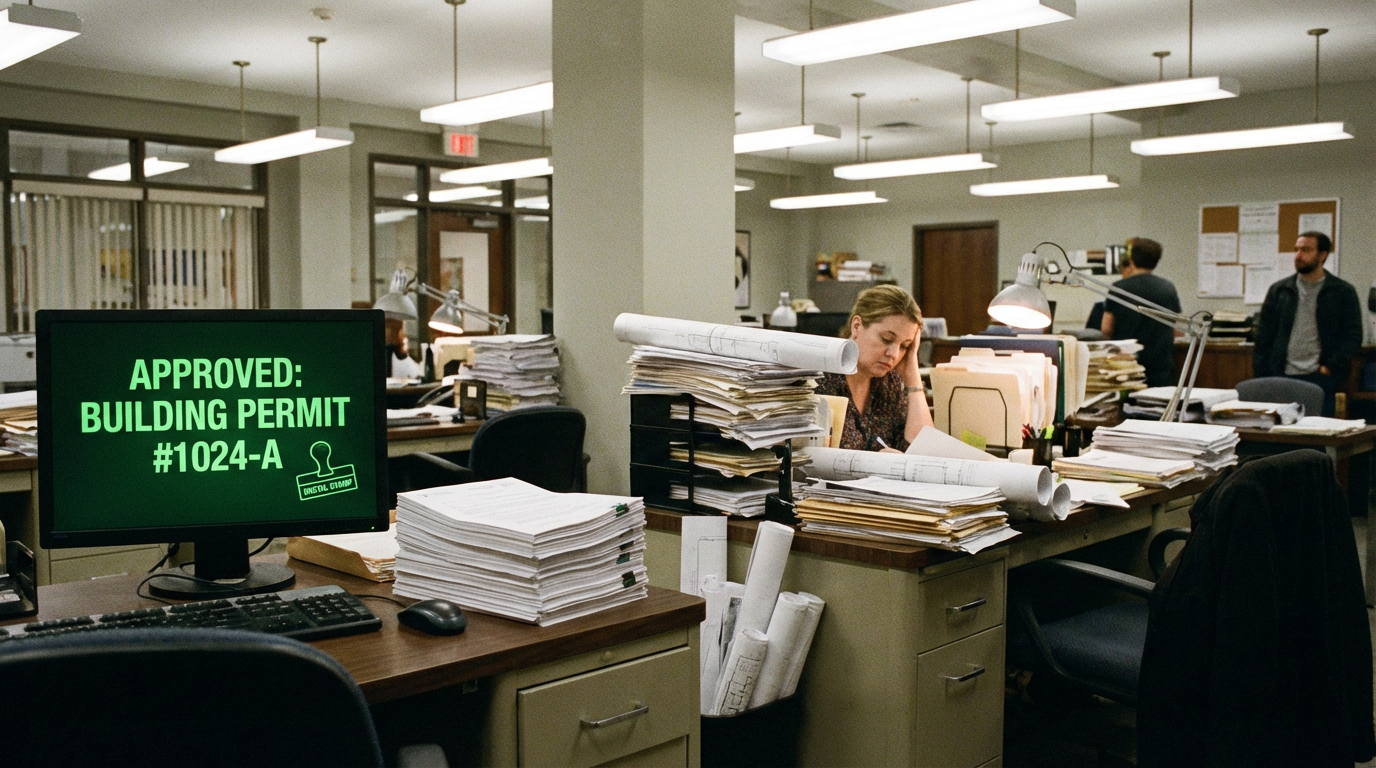
Honolulu deployed an AI prescreening bot for building permits in late 2024. The wait dropped from six months to two or three days to reach a human reviewer. Not a typo. A 60× improvement.
I practiced construction law for five years. I watched clients burn through $15,000 in carrying costs waiting for a residential permit that should have taken weeks. The rejection letter, when it finally arrived, cited a setback violation that any competent zoning check would have caught on day one. The architect resubmitted. Another eight weeks.
That cycle—submit, wait, reject, fix, resubmit, wait again—is the default experience for anyone building in America. According to Rescope’s 2026 analysis, roughly 80% of residential permit applications contain significant zoning deficiencies, requiring an average of 1.6 resubmissions. Each round adds weeks. The cumulative cost: permitting delays push project budgets up 11–15%.
Four Cities, Four Approaches
| City | Tool | Result |
|---|---|---|
| Honolulu, HI | AI prescreening bot | 6 months → 2–3 days to reviewer |
| Hamilton, ON | Bloomberg Center AI partnership | 60% decrease in processing time |
| Los Angeles, CA | eCheck (launched April 2025) | Wildfire recovery fast-track |
| Seattle, WA | PACT Team AI pilot | Full rollout expected late 2026 |
Honolulu is the standout. The city’s Department of Planning and Permitting had been drowning—a backlog measured in months, staff stretched thin, applicants calling weekly for status updates that never changed. The AI bot doesn’t replace the plan reviewer. It prescreens: zoning compliance, setback calculations, height limits, FAR, use restrictions. The applications that reach a human desk now arrive mostly clean.
Hamilton, Ontario worked with the Bloomberg Center for Cities at Johns Hopkins to implement AI scanning of first-stage applications against city rules, building codes, and zoning requirements. The 60% reduction in processing time came not from faster reviews but from fewer rejection cycles.
Los Angeles introduced Archistar’s eCheck platform in April 2025, initially to expedite permits for wildfire recovery after the January fires destroyed over 15,000 structures. The urgency was real: families living in hotels needed rebuild permits, and the normal 4–6 month timeline was unconscionable.
What the Software Actually Does
The tools fall into two categories: pre-submission validation (catch your mistakes before the city sees them) and municipal automation (the city catches mistakes faster).
Archistar eCheck digitizes zoning and building codes, then runs submitted plans against them instantly. An architect uploads a plan set; the system flags setback violations, height exceedances, parking deficiencies, and use conflicts before the application is ever filed. It’s available in parts of Australia, and the LA deployment is its highest-profile US presence.
Rescope offers automated zoning analysis and plan compliance checking. Their pitch is pre-submission validation: identify the problems that cause 80% of applications to bounce back. The company claims a 50%+ reduction in resubmission cycles for users who validate before filing.
Cove.tool approaches from the energy and performance side—a cloud-based platform with Revit and Rhino plugins that runs parametric energy modeling, daylight studies, and automated compliance checks against energy codes. Not a permit tool per se, but it catches Title 24 and IECC violations that would otherwise surface during plan review.
The Catch
Codes are local. Wildly, absurdly local.
A setback rule in Honolulu bears no resemblance to a setback rule in Hamilton. Overlay districts, historic preservation zones, HOA restrictions layered on top of municipal codes, conditional use permits with bespoke conditions attached by a planning commissioner who retired in 2019—the complexity isn’t just technical. It’s archaeological.
AI works well on the structured parts: Is this lot zoned R-1? Does the proposed height exceed 35 feet? Is the rear setback at least 20 feet? These are lookup problems with clear answers. The hard cases—variance requests, non-conforming use arguments, interpretation disputes—still require a human who understands the political context of the planning commission.
Seattle’s cautious rollout reflects this reality. Mayor Harrell’s executive order directs the Permitting and Customer Trust Team to use AI for prescreening and error flagging, with full rollout not expected until late 2026. They’re not replacing reviewers. They’re triaging the inbox.
What This Means If You’re Building
Three practical takeaways:
Check if your jurisdiction offers AI prescreening. The list is growing quarterly. Honolulu, LA, Hamilton, and Seattle are the ones with public deployments, but dozens of smaller cities are piloting similar tools through vendors like Rescope and Archistar.
Use pre-submission tools yourself. Even if your city doesn’t have AI permitting, tools like Cove.tool and Rescope can validate your plans against known code requirements before you file. The $200–500 cost is trivial compared to a $15,000 carrying-cost penalty from a rejected application.
Your architect should be doing this already. If they’re not running automated compliance checks before submission, ask why. The tools exist. The excuse that “we always catch it on the second round” is a confession, not a strategy.
The U.S. Census Bureau reports that the average single-family home takes roughly 40 days from permit authorization to construction start, followed by 6.3 months of building. The permit wait that precedes all of this? Varies from two weeks to six months depending on the city. AI isn’t going to solve the political fights over density or the staffing shortages at planning departments. But it can stop a clear setback violation from costing you three months.
Sources
- Rescope (2026). “How AI is Transforming Building Permit Approvals in 2026.” rescope.co
- Archistar. “AI for Building Code Compliance: A City Planner’s Best Friend.” archistar.ai
- Bloomberg Center for Cities at Johns Hopkins University. Hamilton, Ontario AI permitting partnership. bloombergcities.jhu.edu
- Cove.tool. Cloud-based building performance analysis platform. bimtrust.com/software/covetool
- City of Seattle. Mayor Harrell executive order on AI permitting, PACT Team pilot program (2025–2026).
- City of Los Angeles. eCheck AI permit tool launched April 2025 for wildfire recovery expediting.
- U.S. Census Bureau (2024). Survey of Construction: average single-family home timeline from permit to completion. census.gov
- Techeniz (2025). “Streamlining Permitting with AI-Driven Building Permit Automation.” techeniz.com