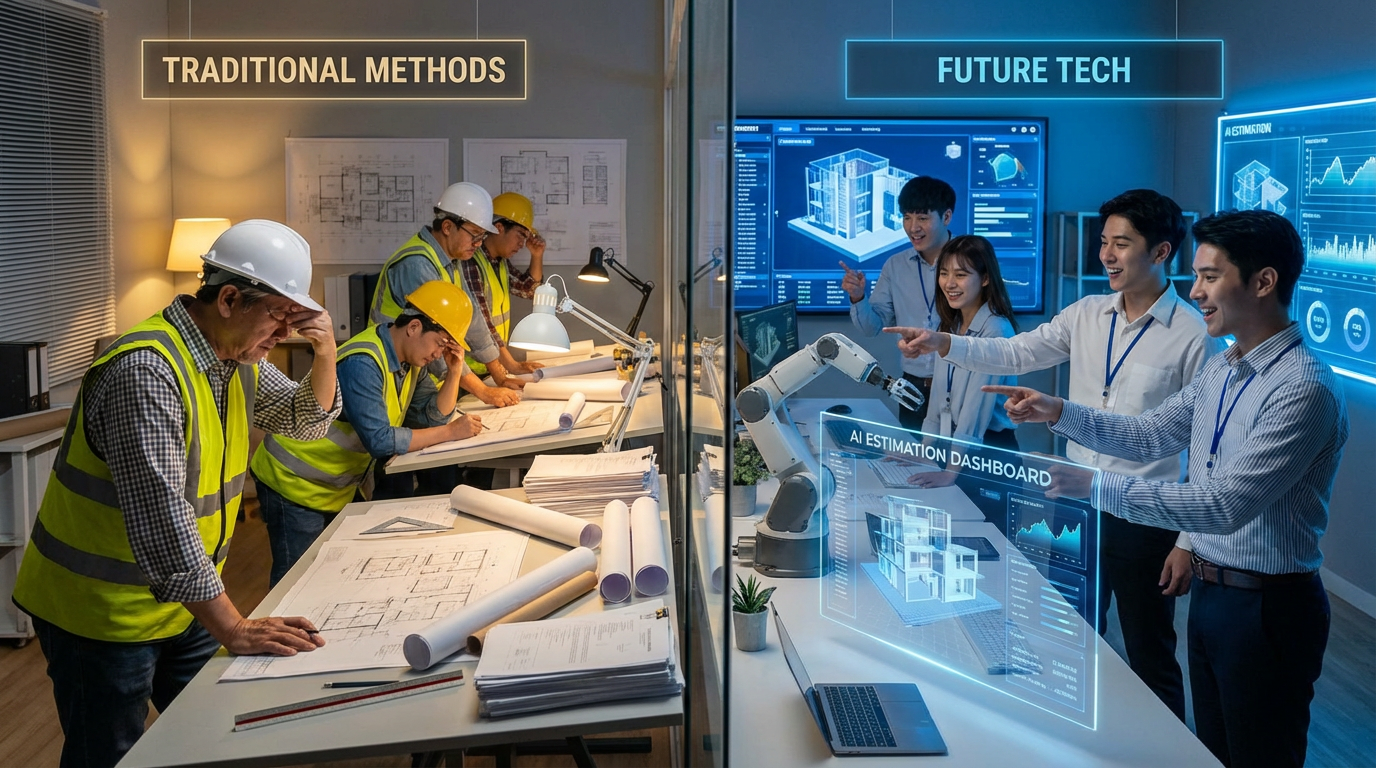
Take a mid-size home builder. Two hundred employees. Forty homes a year. Estimators, project managers, superintendents, framers, office staff. A company that runs on spreadsheets, gut instinct, and relationships — the way residential construction has worked for decades.
Now hand them AI. Not a single pilot tool, but the full stack: AI-powered estimating, generative scheduling, computer vision inspections, autonomous equipment, and predictive analytics for everything from lumber prices to crew productivity. The pitch from every vendor at IBS 2026: “Transform your operations. Cut costs 30%. Build faster.”
We ran the simulation. Month by month, role by role, across every department. What happens isn’t a smooth upward curve. It’s a J-curve — and the bottom of the J is where companies break.
Month 1–3: The Productivity Cliff
The vendor demos looked incredible. The reality is different. Your estimating team just spent 15 years building intuition about regional material costs, subcontractor reliability, and the hidden expenses that never show up in plans. Now they’re told to trust an algorithm.
ProEst and Buildxact’s AI estimating tools can generate a takeoff from plans in minutes instead of days. But in the first three months, your senior estimator — let’s call him Dave — spends more time checking the AI’s work than he spent doing the estimates manually. The tool gets material quantities right 85% of the time. That other 15% is where a $450,000 project becomes a $520,000 mistake.
Productivity actually drops 6–8% in the first quarter. The METR study on AI coding tools found the same pattern: experienced professionals using AI assistance were 19% slower than working without it — while believing they were 20% faster. The perception gap is real, and it’s expensive.
“The J-curve is the most predictable and most ignored phenomenon in technology adoption. Every executive expects the upside. Nobody budgets for the valley.”
— McKinsey Global Institute, “The State of AI in Construction,” 2025
Month 4–6: The Sorting
By mid-year, the 200-person company has silently sorted itself into five groups. This is where the vendor pitch diverges most sharply from reality:
The Thrivers (12%) — about 24 people who genuinely embrace the tools. Your youngest PM, who learned ALICE Technologies scheduling in a weekend. The superintendent who figured out that Buildots’ camera-on-hardhat progress tracking eliminated his three-hour daily reporting burden. They’re doing more with less, and they’re visible.
The Adapters (24%) — 48 people who use the tools competently but without enthusiasm. They do the training. They enter the data. They don’t evangelize. This is the silent majority that vendors never talk about.
The Stagnators (26%) — 52 people who completed all the training but haven’t meaningfully changed how they work. They learned the new system. They still call their sub contacts from memory instead of using the AI-optimized scheduling. The Klarna model is instructive here: 96% of employees “use AI daily,” but the actual workflow transformation is concentrated in a much smaller group.
The Transitioners (16%) — 32 people whose roles are fundamentally changing. Your three-person takeoff team becomes one person supervising AI-generated estimates. Two project coordinators find their status-tracking work automated by Procore’s AI agents. They’re not fired — not yet — but their job descriptions are unrecognizable.
The Exits (18%) — 36 people who leave, voluntarily or not. Your head estimator Dave takes early retirement rather than “learn to be a machine operator.” Two field supervisors go to a competitor that hasn’t adopted AI yet. And yes, some positions are quietly eliminated — the back-office roles that were always vulnerable to automation. The industry’s 349,000 worker shortage means most of these people find work elsewhere. But they don’t find the same work.
Month 7–12: The Payoff (for Some)
By month nine, the J-curve bottoms out and productivity starts climbing. But the gains aren’t distributed evenly.
Estimating is now 40% faster, but the team went from five people to three. The remaining estimators are higher-skilled, higher-paid, and functionally different — they’re AI auditors, not quantity surveyors. Project management overhead dropped 25% as ALICE and Procore AI handle scheduling, RFI routing, and daily log generation. Your PMs manage six homes each instead of four.
Field operations are the surprise winner. Autonomous layout robots from Dusty Robotics cut floor layout time by 75%. Spot-r by Triax wearables reduced safety incidents 35% through proximity alerts and fatigue detection. Drone surveys from Skydio generate progress reports in hours instead of days. The crews love the drones. They tolerate the wearables. They’re suspicious of everything else.
Net result after 12 months: productivity is up 18%, but headcount is down 12%. Revenue per employee jumped from roughly $275,000 to $350,000. The company is building 46 homes a year instead of 40, with 176 people instead of 200.
The Uncomfortable Truth
Here’s what no vendor will put on a slide:
The people who thrive are not the most experienced. They’re the most adaptable. Your 25-year superintendent with encyclopedic knowledge of local subcontractors is more threatened than the 28-year-old PM who treats every new tool as a video game. Experience — the thing construction has always valued above all else — becomes a liability when the tools change faster than habits do.
Knowledge debt accumulates invisibly. When Dave the estimator leaves, he takes 15 years of “this subcontractor always runs 10% over on tile” and “that inspector hates exposed Romex in garages.” The AI doesn’t know any of that. By month 12, you’re more efficient but more fragile — one unusual situation away from discovering what the institutional memory used to catch.
The 349,000 worker shortage doesn’t cancel out displacement. Builders can’t find framers and electricians. They have no trouble finding estimators, coordinators, and back-office staff. The shortage is in skilled trades. The displacement is in knowledge work. They’re not the same people.
What This Means If You’re a Builder
Budget for the valley. Plan for a 6–8% productivity drop in the first quarter. The companies that fail at AI adoption aren’t the ones that pick the wrong tools — they’re the ones that panic during the J-curve and pull the plug before the payoff arrives.
Protect institutional knowledge before it walks out. Document the tribal knowledge. Record the relationships. Build the “Dave database” before Dave retires. Once that knowledge leaves, no AI can reconstruct it.
Watch the Stagnators. Training completion rates are vanity metrics. The real measure is behavioral change — are your people actually working differently, or just checking boxes? The 90%-trained-28%-transformed gap is where most ROI projections die.
The AI vendors are right that the technology works. They’re wrong about how it lands. It doesn’t transform a company. It sorts one — and the sorting is messier, slower, and more human than any demo will ever show you.