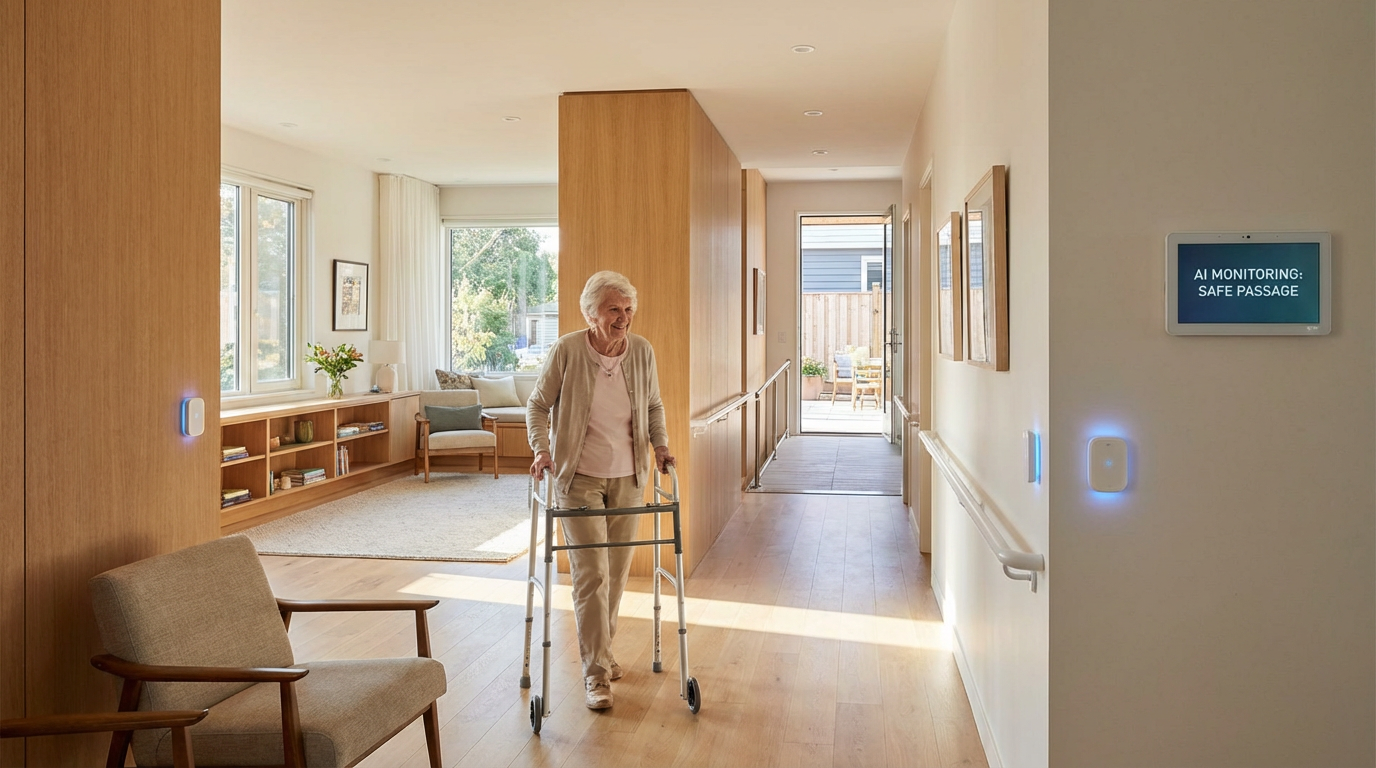
Every year, 14 million Americans over 65 fall at home. One in four. Falls are the leading cause of injury death among older adults, and they cost Medicare $80 billion annually — more than the entire budget of the Department of Homeland Security. The 2025 National Falls Prevention Action Plan, released by the National Council on Aging, calls for a “multi-disciplinary approach” to halve fall rates over the next decade. But the plan’s own authors acknowledge the core problem: we can’t fix 14 million homes one occupational therapist visit at a time.
Enter AI. A new generation of platforms is turning smartphones into safety assessors, ambient sensors into early-warning systems, and floor plans into accessibility blueprints — scaling what used to require an in-person professional visit into something that fits in your pocket.
The Smartphone as Safety Assessor
DwellSafe, an AgeTech startup that launched its platform in October 2025, is perhaps the clearest example of where this is headed. The company combines AI computer vision with clinician review to deliver hospital-grade home safety assessments — entirely through a smartphone camera.
Here’s how it works: a family member or caregiver walks through the home, recording video on their phone. DwellSafe’s AI analyzes the footage for fall hazards — loose rugs, inadequate lighting, missing grab bars, narrow doorways, step thresholds — and generates a structured risk profile. A licensed clinician then reviews the AI’s assessment, adds clinical context (the patient’s mobility limitations, medication side effects, cognitive status), and produces a personalized safety plan with prioritized modifications.
No in-person visit required. No six-week wait for an occupational therapist. No geographic limitation. The platform is designed to embed directly into hospital discharge workflows — because one in five Medicare patients is readmitted within 30 days, and falls at home are one of the leading drivers.
“The home itself has become a critical but overlooked setting of care. Falls at home are the leading cause of injury, death, and costly hospital readmissions among older adults — yet traditional in-person assessments cannot keep pace with the exploding growth of the older adult population.”
— DwellSafe
Ambient Intelligence: Sensors That Learn Your Routine
Scanning a home once is useful. Watching it continuously is transformative.
CarePredict’s Tempo wearable tracks daily activity patterns — eating duration, bathroom frequency, walking speed, sleep quality, socialization — and uses machine learning to detect deviations that predict health events before they happen. A senior who starts taking 40% longer to walk to the bathroom isn’t just slower — they may be developing a UTI, experiencing medication side effects, or showing early signs of a fall risk.
The system doesn’t just alert after a fall. It alerts before one. CarePredict’s predictive models identify behavioral drift days before an acute event, giving caregivers time to intervene with lighting adjustments, grab bar installation, or a medication review — rather than an emergency room visit.
Building Accessible from Day One
The cheapest accessibility modification is the one you don’t have to retrofit. And AI is finally making universal design economically viable at the floor plan stage.
Maket AI’s generative floor plan tool can produce hundreds of layout variations from a single set of constraints — including accessibility requirements like 36-inch minimum hallway widths, zero-threshold entries, wheelchair turning radii, and curbless shower dimensions. What used to require an architect specializing in ADA-compliant residential design now takes seconds.
The numbers make the case. A zero-threshold entry costs essentially nothing during new construction — it’s just a design decision. Retrofitting one later costs $1,500–$3,000. A curbless shower in new construction adds maybe $200–$500 over a standard tub. Retrofitting a bathroom for wheelchair access after the fact: $8,000–$25,000. Widening a hallway from 32 inches to 42 inches during framing is a few extra studs. After drywall, it’s a $5,000 demolition project.
Google Research’s Natively Adaptive Interfaces framework, announced in late 2025, points toward an even more ambitious vision: AI that doesn’t just design accessible spaces but adapts interfaces in real time to the occupant’s needs. Lighting that adjusts based on time of day and visual acuity. Smart displays that resize text based on proximity. Voice interfaces that switch modalities when they detect hearing difficulty.
The Policy Gap
Here’s where my legal background gets twitchy. The technology exists. The economics work — aging in place costs a fraction of assisted living ($4,500/month median nationally) or nursing home care ($9,000+/month). But the regulatory framework is still stuck in the pre-AI era.
Medicare covers hospital stays and rehabilitation but provides minimal funding for home modifications that prevent the hospitalization in the first place. The HUD Section 504 program and the “Money Follows the Person” initiative help, but they’re chronically underfunded relative to the 65+ population that will reach 82 million by 2050 (up from 58 million today).
Some states are ahead. California’s CalHFA ADU program funds accessory dwelling units that can serve as accessible in-law suites. Connecticut offers up to $10,000 in home modification grants for seniors. But there’s no federal standard requiring new single-family homes to meet even basic visitability requirements — a zero-step entrance, one accessible bathroom, and doorways wide enough for a wheelchair on the main floor.
The NCOA’s action plan estimates that a $45 million annual federal investment in falls prevention programs could save $1.2 billion in Medicare and Medicaid costs annually. That’s a 26:1 return on investment. The math is absurd. The political will is absent.
What This Means If You’re Building
Design for 80, build at 40. Every home should have at least one zero-threshold entry, one main-floor bathroom with blocking for future grab bars, and hallways wide enough for a walker. These decisions cost almost nothing during construction. They cost tens of thousands during renovation.
Pre-wire for ambient monitoring. Low-voltage wiring for motion sensors, PoE connections for smart cameras, and conduit for future sensor placement. The same infrastructure that supports a Ring doorbell today supports a CarePredict-style health monitoring system tomorrow.
Use AI floor plan tools. Maket AI and similar generators can explore accessibility-constrained layouts at a speed no human designer can match. The best accessible homes don’t look accessible — they look beautiful, with wider hallways that feel generous and curbless showers that feel luxurious.
America is about to have 82 million people over 65, and 77% of adults over 50 say they want to stay in their homes as they age (AARP, 2024). The homes we’re building today will need to serve those people for the next 30–50 years. AI can’t solve the policy gap. But it can make the right design decisions so obvious — and so cheap — that ignoring them becomes indefensible.