There is a dimension of residential architecture that most builders treat as an afterthought, if they consider it at all. Not light. Not thermal performance. Sound. The invisible medium that determines whether your bedroom is a sanctuary or an acoustic fishbowl — and the one dimension you cannot fix after the drywall goes up without tearing open the walls.
The World Health Organization calls environmental noise the second most harmful stressor affecting human health in Europe, behind only air pollution. It contributes to cardiovascular disease, sleep disruption, cognitive impairment in children, and chronic stress. And yet the International Building Code still requires only an STC (Sound Transmission Class) rating of 50 for party walls in multifamily construction — a threshold so low that normal speech is audible through it, and a television at conversational volume comes through clearly.
The Problem: Acoustics by Gut Feel
Ask a residential architect how they design for sound, and most will give you an honest answer: they specify whatever wall assembly the code requires, maybe add a layer of resilient channel if the client mentions noise, and hope for the best. Acoustic consultants exist, but they charge $5,000 to $15,000 per residential project and are almost exclusively hired for high-end custom homes or multifamily developments facing noise ordinance compliance.
The result is predictable. Noise is the number one complaint in multifamily housing, according to the National Multifamily Housing Council. A 2024 Lemonade survey found that over half of Americans are annoyed by their neighbors, with noise being the primary driver. Remediation after occupancy — adding mass-loaded vinyl, decoupling walls, floating floors — costs 3 to 5 times what it would have during construction.
Enter AI: Hear the Building Before It Exists
Treble Technologies, an Icelandic startup, closed an €11 million Series A in September 2024 to do for acoustics what energy modeling did for thermal performance — make simulation fast enough and cheap enough that it becomes a standard design step rather than a luxury add-on.
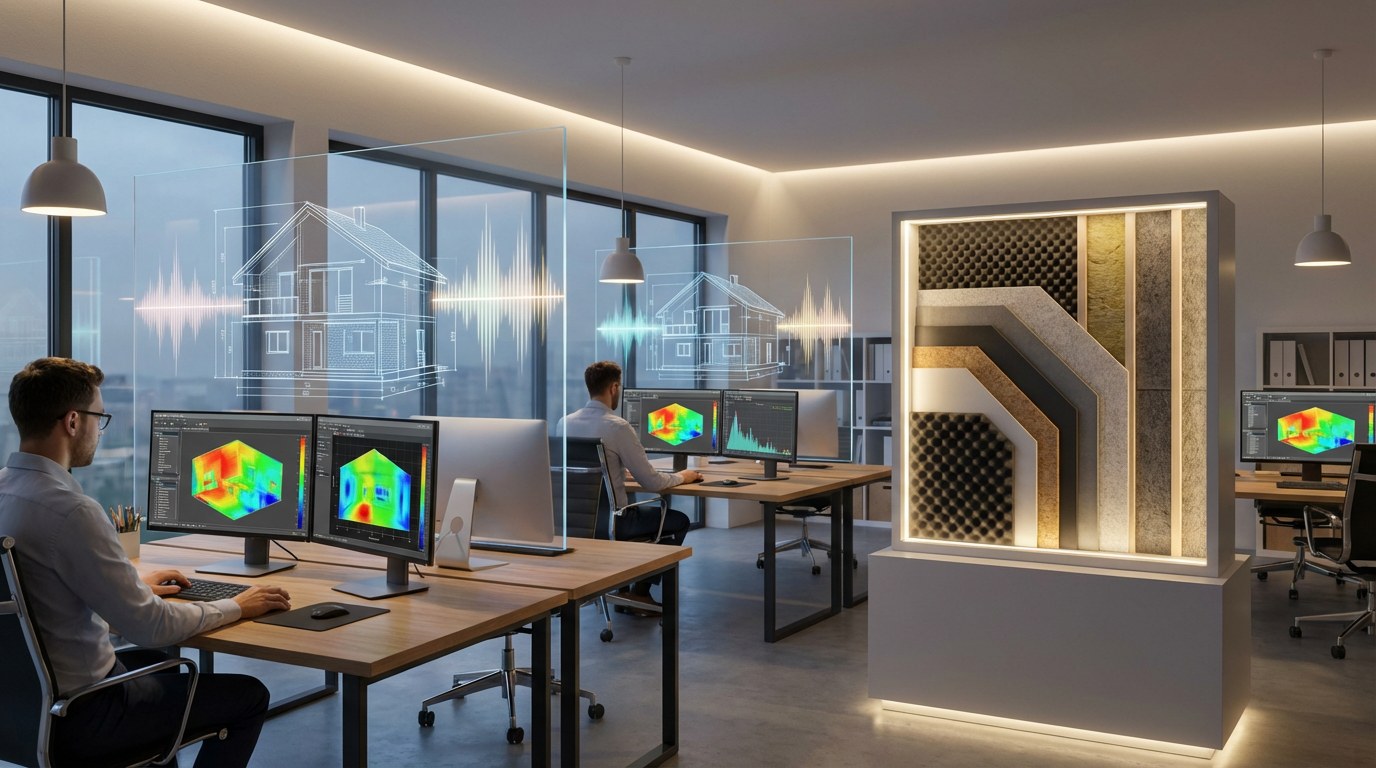
Treble’s cloud platform uses proprietary wave-based simulation that the company claims is 100× faster than traditional acoustic modeling. Upload your Revit, Rhino, or SketchUp model, assign materials to surfaces, and the system calculates how sound propagates through the space — reflections, absorption, diffusion, transmission through walls and floors. The output isn’t just a number. You can listen to the simulated acoustics through headphones, hearing exactly how a conversation in the living room will sound from the bedroom next door.
“Sound has a major impact on people’s health, well-being, productivity and ability to connect with one another. For too long, engineers and designers have lacked the necessary tools to harness the power of sound.” — Dr. Finnur Pind, CEO & Co-founder, Treble Technologies
The investor list tells you where the industry thinks this is heading: Saint-Gobain, the world’s largest building materials manufacturer, participated as a strategic partner. So did L-Acoustics. The lead investor, KOMPAS VC, focuses exclusively on the built environment. Within a year of launch, Treble says three of the five largest global tech companies are using the platform.
From Simulation to Prediction
Sonusoft’s Acoulatis platform approaches the problem from the component level. Rather than simulating entire rooms, it predicts the STC and IIC (Impact Isolation Class) ratings of individual wall and floor assemblies — timber frames, steel studs, CLT panels, concrete slabs — using empirical models validated against lab measurements, plus a neural network AI model for lightweight frame walls. Accuracy is typically within 3 dB.
This is the tool an architect needs at the design stage: “If I use 5/8-inch drywall on resilient channel with R-19 fiberglass, what STC do I get?” Acoulatis returns third-octave frequency band predictions from 50 to 5,000 Hz in seconds. Compare that to sending a sample wall to a transmission loss testing lab — $3,000 to $8,000 per assembly, with weeks of lead time.
The Residential Opportunity
The WELL Building Standard — which more developers now pursue as a differentiator — requires acoustic performance well above code minimums, including maximum ambient noise levels and minimum sound isolation between units. Multifamily developers chasing WELL certification need exactly the tools Treble and Sonusoft provide. But the bigger prize is the 1.4 million single-family housing starts per year where acoustic design currently means nothing more than “we used standard insulation.”
Consider the numbers: a standard interior wall with two sheets of 1/2-inch drywall on wood studs provides an STC of about 33 — essentially no sound privacy. Add fiberglass insulation and you reach 39. Use staggered studs and you jump to 45. Add a second layer of drywall with Green Glue damping compound and you hit 55+. The difference between “I can hear my teenager’s music” and “I didn’t know anyone was home” is about $200 in materials per wall — if you know where to spend it.
That’s the real value of AI acoustics: not just simulating sound, but optimizing the cost curve. Which walls need the treatment? Where does a $200 investment eliminate $5,000 in future complaints? An AI that can model the entire home’s acoustic envelope and pinpoint the three walls that matter most is worth far more than a blanket spec that adds mass everywhere.
What’s Still Missing
The tools exist for expert users — acoustic engineers, architects comfortable with simulation software. What doesn’t exist yet is the “AutoHVAC for acoustics” — a phone-first tool where a builder uploads plans and gets a red-yellow-green overlay showing where noise will be a problem and what to do about it. Given that Treble is already 100× faster than legacy tools and Sonusoft has a neural network making predictions in seconds, the computational floor is close. The UX gap is the remaining moat.
Until then, every builder nailing up standard drywall on standard studs is making an acoustic commitment they can’t undo. The AI can hear the problem. The question is whether anyone listens before the walls close up.